





















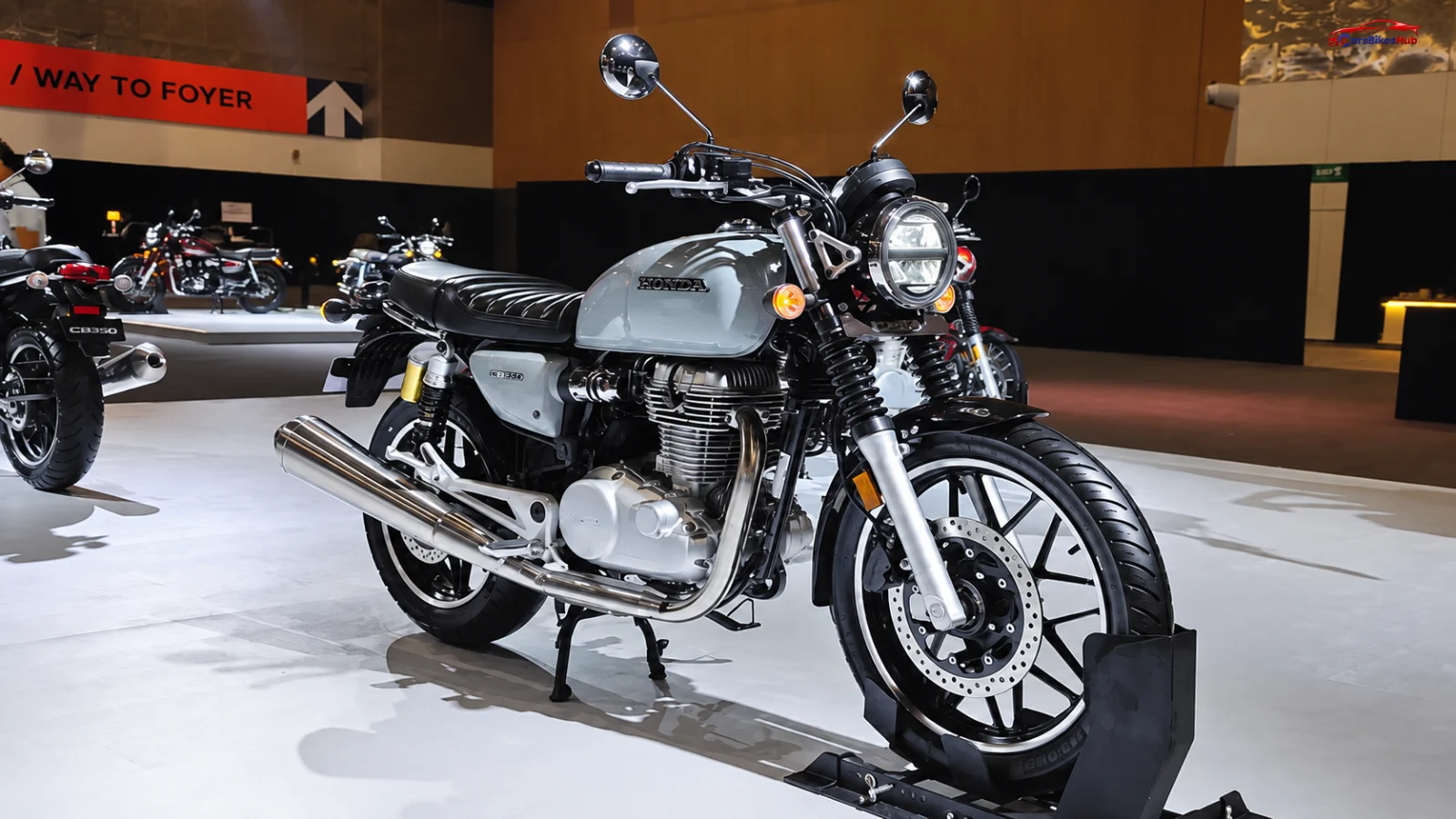
Honda has launched the CB500 in India at a starting price of Rs 2.75 lakh (ex-showroom), with the range topping out at Rs 3.01 lakh. The motorcycle comes in three variants, is built around an all-new 501cc single-cylinder engine, and is manufactured locally in India.
Unlike Honda’s international CB500 models, which use a twin-cylinder engine, the India-spec CB500 gets a new single-cylinder unit. It enters a part of the Indian motorcycle market that has had few modern large-capacity single-cylinder roadsters since Royal Enfield’s 500cc UCE models were discontinued.
Honda CB500 Price in India
The CB500 is offered in three variants, and the difference between them is smaller than the model names might suggest; it’s largely down to wheels, colours, and graphics rather than mechanical upgrades.
| Variant | Price (ex-showroom) | Key Difference |
| CB500 Alloy | Rs 2,75,000 | Alloy wheels; two paint options |
| CB500 Spoke | Rs 2,99,900 | Cross-spoke wheels with tubeless tyre compatibility |
| CB500 Spoke with Stripes | Rs 3,01,900 | Cross-spoke wheels plus dedicated graphics |
These figures are ex-showroom Bangalore as reported at launch, and ex-showroom prices in your city may vary slightly. Bookings are open through Honda BigWing dealerships, with deliveries expected to follow shortly.
The Alloy variant is the base bike and comes in Pearl Deep Ground Gray and Pearl Igneous Black. Step up to the Spoke variant, and you get cross-spoke wheels that support tubeless tyres, a useful upgrade for anyone worried about punctures on longer rides, along with two new shades, Rebel Red Metallic 2 and Mat Steel Silver Metallic. The range-topping Spoke with Stripes carries the same wheels as the Spoke variant, just with a single Pearl Igneous Black paint scheme finished in graphics. In short: buy the Alloy for the lowest price, the Spoke if you want tubeless tyres, and the Stripes version only if the graphics matter to you; the mechanical package underneath doesn’t change.
What Is the Honda CB500?
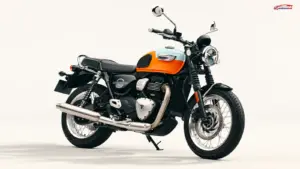
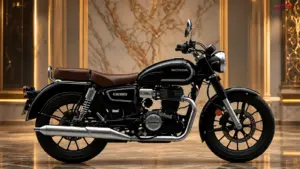
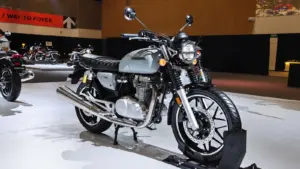
The CB500 is a heritage roadster, styled in the same retro idiom as Honda’s CB350 range but sitting a rung above it in Honda India’s motorcycle line-up. It borrows visual cues from the CB350: round LED headlight, teardrop fuel tank, single-piece seat, but the larger engine gives it a larger and more substantial mechanical package.
The key difference from the CB350 isn’t styling; it’s displacement and character. The CB350 range runs a 348cc single making around 21 PS and 30 Nm, tuned primarily for relaxed, low-revving commuting and touring. The CB500’s 501cc unit produces meaningfully more power and torque, which changes what the bike can do on paper: more overtaking margin, more headroom on the highway. It doesn’t replace the CB350; it sits above it as a bigger, torquier alternative for buyers who’ve outgrown a 350 but don’t necessarily want a twin-cylinder motorcycle.
The 501cc Single-Cylinder Engine Explained
The engine is one of the most important aspects of the CB500.
- Displacement: 501cc
- Configuration: Single-cylinder
- Cooling: Air-cooled, with an oil cooler
- Power: 28 PS (reported as 28 hp / 28.1 PS across different sources, essentially the same figure, rounded differently)
- Torque: 43.3 Nm
- Gearbox: 5-speed
- Clutch: Slipper clutch (confirmed)
The 43.3Nm torque figure is one of the CB500’s key specifications, but its real-world character will depend on how Honda has tuned the engine and gearing. The larger single should give it a different feel from the twin-cylinder motorcycles in this price range, but acceleration, refinement, and highway performance are best judged after independent road tests.
Honda CB500 Variants Explained
CB500 Alloy (Rs 2,75,000): The entry point to the range, with alloy wheels and two colour choices.
CB500 Spoke (Rs 2,99,900): Same engine, same electronics; the change is cross-spoke wheels that support tubeless tyres, which makes a real difference for riders who do a lot of highway distance and want easier puncture repair. Two colour options here too.
CB500 Spoke with Stripes (Rs 3,01,900): Identical to the Spoke variant mechanically, with the addition of graphics and a single paint option. This exists for buyers who want the tubeless wheels and prefer the more striking look; it isn’t a meaningfully “higher” motorcycle in any functional sense.
Honda CB500 Features and Equipment
Safety
- Honda Selectable Torque Control (HSTC), switchable traction control
- Dual-channel ABS
Convenience
- Honda RoadSync connectivity, bringing turn-by-turn navigation and call/SMS alerts to the instrument console
- Slipper clutch
Design
- Semi-digital (analogue-digital) instrument console
- 19-inch front wheel, 17-inch rear wheel
- Telescopic front fork with twin gas-charged rear shock absorbers
- Disc brakes front and rear
Notably, Honda has kept this entire feature list identical across all three variants; HSTC, the instrument console, RoadSync, and the slipper clutch are standard from the base Alloy upward. Buyers aren’t paying more to unlock electronics; they’re paying more for wheel type and cosmetics.
Honda CB500 Design and Riding Position
Honda has not yet published the CB500’s complete dimensional and weight specifications. For now, the confirmed setup includes a 19-inch front wheel, 17-inch rear wheel, telescopic fork, and twin rear shocks.
Honda CB500 vs Rivals
The Honda CB500 enters a segment with motorcycles that use very different engine formats and riding approaches. The Royal Enfield Interceptor 650 brings a larger parallel-twin engine, while the Harley-Davidson X440 uses a smaller single-cylinder engine and starts at a lower price. The CB500 sits between them in terms of engine displacement and price, while adding features such as HSTC and Honda RoadSync as standard.
| Specification | Honda CB500 | Royal Enfield Interceptor 650 | Harley-Davidson X440 |
| Price | Rs 2.75–3.02 lakh | Starts at Rs 3.39 lakh | Roughly Rs 2.35–2.8 lakh |
| Engine | 501cc, single-cylinder | 648cc, parallel-twin | 440cc, single-cylinder |
| Power | 28 PS | ~47 PS | ~27 PS |
| Torque | 43.3 Nm | ~52 Nm | ~38 Nm |
| Gearbox | 5-speed | 6-speed | 6-speed |
| Weight | Not yet confirmed | ~213–218 kg | ~190 kg |
| Key features | HSTC, slipper clutch, RoadSync | Dual-channel ABS, slipper clutch | Dual-channel ABS |
On paper, the Interceptor 650 offers substantially more peak power from its larger twin-cylinder engine and gets a six-speed gearbox. The X440, meanwhile, has a smaller 440cc single-cylinder engine and a lower starting price. The CB500 sits between the two with its 501cc single-cylinder engine, 43.3Nm of torque and a starting price below the Interceptor 650.
The engine configuration is likely to be one of the biggest deciding factors. Buyers looking for a parallel-twin motorcycle have the Interceptor 650, while the CB500 and X440 both use single-cylinder engines but differ in displacement, equipment, and positioning. The CB500’s standard HSTC and Honda RoadSync also give it a different equipment package from these alternatives.
For buyers comparing these motorcycles, price, engine configuration, riding position, equipment, and the kind of riding they plan to do will matter more than displacement alone. The CB500’s real-world refinement, comfort,t and highway performance will be clearer once independent road tests and ownership reports are available.
What Makes the Honda CB500 Different?
Its biggest distinction is the combination of a 501cc single-cylinder engine, retro-roadster styling, and a starting price below the Royal Enfield 650 twins. That’s a formula India hasn’t had on sale since Royal Enfield’s 500cc single-cylinder models were discontinued, and the CB500’s three-variant structure doesn’t complicate that positioning much; the mechanical package and electronics are identical across the line-up, so buyers are really choosing between wheel type and paint.
What Has NOT Changed Across the CB500 Variants?
Every CB500 variant shares:
- The 501cc single-cylinder engine, power and torque output
- The 5-speed gearbox and slipper clutch
- HSTC switchable traction control
- The semi-digital instrument console with Honda RoadSync
- Telescopic front fork and twin rear shocks
- Wheel sizes (19-inch front, 17-inch rear) and dual-channel ABS with disc brakes at both ends
What actually changes is limited to wheel type (alloy vs cross-spoke), tubeless tyre compatibility on the Spoke variants, colour options, and the presence of graphics on the top-spec version.
Who Is the Honda CB500 For?
The CB500 will likely appeal to:
- Riders moving up from a 350cc motorcycle who want more torque without jumping straight to a 650cc twin
- Buyers who specifically want a large-capacity single-cylinder engine rather than a twin
- Retro roadster fans who like the CB350’s design language but want something bigger
- Riders who split their time between city commuting and highway trips
- Buyers actively comparing the Interceptor 650 or the X440 and want a third option to weigh against them
It may be a less obvious fit for riders specifically chasing twin-cylinder smoothness and top-end performance, those for whom purchase price is the deciding factor at the lower end of this segment, or riders who prefer a different riding stance altogether, such as a cruiser or an adventure-styled motorcycle.
Final Verdict
The Honda CB500 stands out mainly because of its 501cc single-cylinder engine and the way Honda has positioned it between its CB350 range and larger twin-cylinder motorcycles. Its three variants keep the choice relatively simple, with the main differences coming down to wheel type and styling. Before booking, buyers should compare it with the Interceptor 650 and X440, while waiting for full specifications and independent reviews to assess its everyday usability.


FAQs
What is the Honda CB500 price in India?
The CB500 starts at Rs 2,75,000 (ex-showroom) for the Alloy variant and goes up to Rs 3,01,900 for the Spoke with Stripes variant.
How many variants does the Honda CB500 have?
Three: Alloy, Spoke, and Spoke with Stripes.
What engine does the Honda CB500 use?
A 501cc, single-cylinder, air-cooled engine with an oil cooler, producing 28 PS and 43.3 Nm of torque, paired with a 5-speed gearbox.
Is the Honda CB500 a single-cylinder motorcycle?
Yes. Unlike Honda's international CB500 twins, the India-spec CB500 uses a single-cylinder engine.
What is the Honda CB500's power and torque?
The power and torque are 28 PS and 43.3 Nm.