




















BMW India has launched the facelifted i7 for 2026, and on paper it looks like a substantial update: a bigger battery, a longer claimed range, faster charging, and an entirely new dashboard. The BMW i7 50 xDrive M Sport starts at Rs 1.95 crore (ex-showroom), while the range-topping M70 xDrive costs Rs 2.65 crore. Alongside it, BMW has also launched the facelifted petrol 7 Series at the same starting price of Rs 1.95 crore.
The bigger story, though, is what BMW has actually changed under the skin and inside the cabin, and whether that adds up to a meaningfully different car, or mostly a mid-life technology refresh wrapped around a familiar EV. This article tries to answer that question.
BMW i7 Facelift Price in India
The i7 facelift is sold in India in two trims:
- BMW i7 50 xDrive M Sport: Rs 1.95 crore, ex-showroom, the entry point to the i7 range in India
- BMW i7 M70 xDrive: Rs 2.65 crore, ex-showroom, the performance flagship
For context, the outgoing i7 launched in India in January 2023 at Rs 1.95 crore in its sole xDrive60 trim. So the starting price hasn’t moved in absolute terms; what buyers get for that money has changed instead, largely because BMW has replaced the base variant’s specification rather than simply carrying it over.
One notable pricing quirk: BMW has positioned the locally assembled i7 50 xDrive M Sport at the same Rs 1.95 crore as the locally assembled petrol BMW 740 M Sport. That’s a deliberate move, putting the electric and petrol flagships at price parity rather than charging a premium for the EV, as was the case earlier.
Deliveries of the new i7 are expected to begin in October 2026. BMW hasn’t officially tied the price to local production in its communication; that link is worth noting as a possibility, not a stated fact.
BMW i7 Facelift: What’s New in 2026?
Exterior
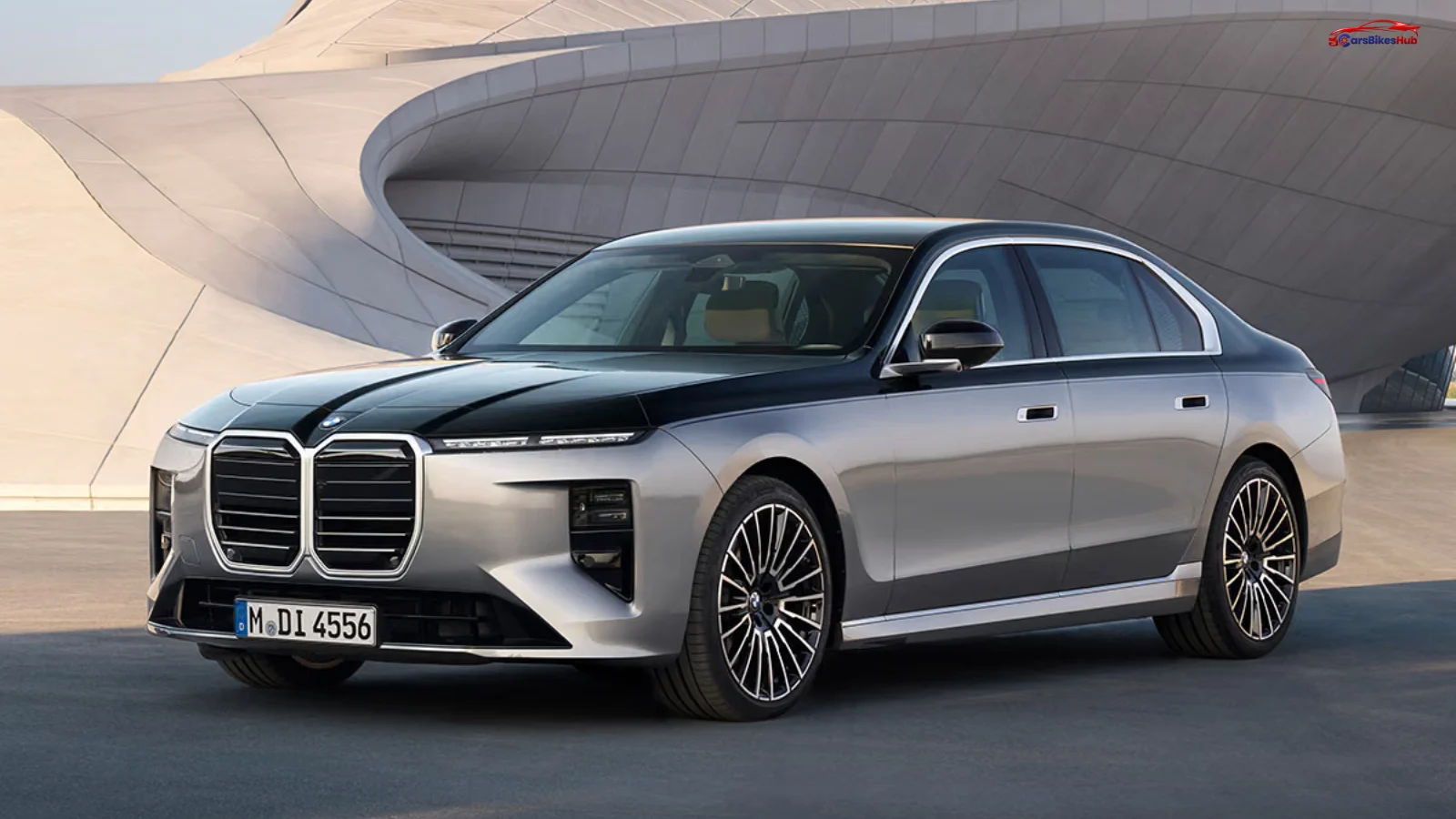
The i7 facelift doesn’t get a new body; the overall silhouette, proportions, and doors carry over. The changes are concentrated at the front and rear:
- A reworked, more squared-off kidney grille with illuminated surrounds
- Revised LED headlamps
- A new front bumper design
- Newly designed rear lights and revised bumper detailing
- A new alloy wheel design, with the M70 getting larger 21-inch wheels and additional M badging
- Flush-fitting door handles are retained
The exterior changes are evolutionary rather than a complete redesign. If you park the outgoing and facelifted i7 side by side, you’d recognise them as the same generation of car; the changes read more like a mid-cycle update than a new face for the model.
Interior
This is where BMW has made its biggest changes, and it’s the part of the update that will actually be felt every time someone gets in the car.
- BMW Panoramic iDrive: a full-width projection at the base of the windscreen replaces the conventional driver’s instrument display, putting key information directly in the driver’s eyeline.
- 17.9-inch central touchscreen, running BMW’s latest Operating System X.
- 14.6-inch passenger display, BMW’s first passenger-side screen on a production car, letting the front passenger watch content without distracting the driver.
- A redesigned dashboard and a new four-spoke steering wheel, borrowed from the styling language of BMW’s newer Neue Klasse models.
- The rear cabin retains its 31.3-inch, 8K “Theatre Screen” mounted in the roof, along with powered doors, adjustable rear seats with calf support, and touch-sensitive door displays.
- Audio is handled by a Bowers & Wilkins surround-sound system with Dolby Atmos.
- The panoramic glass roof can be specified with more than 40 individually controllable LED points.
- Powered ottomans and powered, heated, ventilated, massaging seats continue to be offered.
In practical terms: the screens, the dashboard layout, and the way you interact with the car have all changed meaningfully. The core cabin architecture, seat positions, space, and general luxury features like the rear entertainment screen are carried over from the outgoing car, because that was already a strong point.
Technology
Beyond the screens, the i7 gets BMW’s Driving Assistant Plus package, which includes adaptive cruise control with Stop&Go, lane control assistance, and blind-spot monitoring. Adaptive LED headlights with cornering light and matrix high beam (claimed range up to 600 metres) are standard, along with BMW’s non-dazzling high-beam assist. Over-the-air update capability and wireless Apple CarPlay/Android Auto continue.
BMW i7 Facelift Battery, Range and Charging
This is the most tangible mechanical change in the facelift.
- Battery: 112.5kWh (up from 101.7kWh in the outgoing i7), BMW has moved to newer, more energy-dense cylindrical cells, packaged into a housing with the same external dimensions as before.
- Claimed range (i7 50 xDrive M Sport): 728km, WLTP; BMW states this is 125km more than the outgoing model’s 625km.
- Claimed range (M70 xDrive): 686km, WLTP, lower than the 50 xDrive because of the higher-output motors, but still well above the outgoing xDrive60’s 625km.
- DC fast charging: peak rate of 250kW (up from 195kW), with a 10–80% charge claimed to take 28 minutes. BMW also claims a 10-minute top-up can add around 235km of range.
- AC charging: up to 22kW, with a full 0–100% charge taking about six hours. Both trims come with a complimentary wallbox charger and installation.
It’s worth being clear about what these numbers mean. WLTP is a standardised European test cycle, and it’s what BMW quotes, but it does not reflect real-world Indian driving conditions. Actual range on Indian roads will be lower than 728km, and how much lower depends on:
- Speed and driving style (highway cruising at 100km/h+ eats into range faster than city driving)
- Traffic and stop-start conditions
- Air-conditioning use, which matters more in Indian summers than in the European conditions WLTP is tested under
- Number of passengers and load
- Ambient temperature, since battery efficiency drops in extreme heat
There isn’t yet an independent, India-specific real-world range test for the facelifted i7, so it would be misleading to state a firm real-world figure here. Until an independent India-specific test is available, the 728km figure should therefore be treated as a standardised WLTP claim rather than an everyday driving expectation.
Performance: Is the New i7 More Powerful?
| i7 50 xDrive M Sport | i7 M70 xDrive | |
| Power | 455hp | 680hp |
| Torque | 660Nm | 1,015Nm (Sport), 1,100Nm (Sport Boost) |
| 0–100kph | 5.5 seconds | 3.8 seconds |
| Top speed | 210kph | 250kph |
| Drive | All-wheel drive | All-wheel drive |
The outgoing i7 xDrive60 made 544hp, 745Nm and did 0–100kph in 4.7 seconds. The i7 50 xDrive M Sport has less peak power than the outgoing xDrive60, although BMW has paired it with a larger battery, longer range and faster charging. The M70, meanwhile, moves the performance story much further with 680hp.
For a car this large and heavy, everyday acceleration and the smoothness of power delivery matter more to most buyers than the headline 0–100kph figure, which is where electric power delivery suits a flagship limousine better than a highly strung petrol engine would.
Ride Comfort and Rear-Seat Experience
The i7 is built around being driven in, not just driven. BMW’s long-wheelbase 7 Series platform, adaptive air suspension and active damping are aimed squarely at rear-seat comfort, and this is an area where the facelift is more about keeping pace than reinventing anything.
The rear cabin gets calf-support adjustment on the seats, powered doors that open and close on their own, and touch-sensitive control panels built into the door panels. The 31.3-inch roof-mounted Theatre Screen remains one of the most elaborate factory-fitted entertainment setups available in any production car sold in India, turning the rear seat into something closer to a private screening room on longer drives. For chauffeur-driven owners, which is how a meaningful share of 7 Series and i7 buyers in India actually use the car, this is arguably a bigger selling point than the powertrain changes.
BMW i7 Facelift vs Outgoing i7: What Has Actually Changed?
| Feature | Outgoing BMW i7 (xDrive60) | 2026 BMW i7 Facelift |
| Power | 544hp | 455hp (50 xDrive M Sport) / 680hp (M70) |
| Torque | 745Nm | 660Nm (50 xDrive M Sport) / 1,015–1,100Nm (M70) |
| Battery | 101.7kWh | 112.5kWh |
| Claimed range (WLTP) | 625km | 728km (50 xDrive M Sport) / 686km (M70) |
| DC fast charging | Up to 195kW | Up to 250kW |
| 0–100 km/h | 4.7 seconds | 5.5s (50 xDrive M Sport) / 3.8s (M70) |
| Infotainment | BMW iDrive 8, 14.9-inch curved display | BMW Panoramic iDrive, 17.9-inch display, Operating System X |
| Passenger display | Not offered | 14.6-inch, first for the segment |
| Production in India | Fully imported (CBU) | i7 50 xDrive M Sport locally assembled in Chennai; M70 remains CBU |
| Starting price | Rs 1.95 crore | Rs 1.95 crore |
Reading this table, the changes fall into two buckets. The genuinely important ones are the bigger battery and real range gain, the faster charging, and the new display/infotainment hardware; these change how the car is used day to day and how anxious (or not) an owner needs to be about charging stops. The more incremental ones are the styling tweaks, which are easy to miss unless you’re looking closely, and the headline price, which hasn’t moved at the entry point despite the extra content.
The move to local assembly for the i7 50 xDrive M Sport is arguably the single most consequential change for the Indian market, even though it doesn’t show up as a spec on paper; more on that below.
BMW i7 Facelift vs BMW 7 Series: Which One Makes More Sense?
BMW now sells the i7 and the petrol BMW 740 M Sport at an identical Rs 1.95 crore starting price in India, which puts the decision squarely on powertrain preference rather than budget.
i7 advantages:
- Silent, vibration-free running, which suits a chauffeur-driven luxury car particularly well
- Instant torque delivery for smooth, effortless acceleration
- A genuinely long claimed range for an EV, reducing (though not eliminating) range anxiety
- Potentially lower running costs per kilometre for owners who can charge at home or the office on their own tariff
- Newer cabin technology debuts on the i7 lineup first in some markets, though in India both the i7 and 7 Series get the same Panoramic iDrive suite
Petrol 7 Series advantages:
- A fuel stop takes minutes, not the better part of an hour, which matters for owners who regularly drive long distances between cities
- No dependence on charging infrastructure being available and working at the destination
- A familiar ownership experience with no learning curve around charging etiquette or planning
- The 740 M Sport’s 3.0-litre six-cylinder turbo-petrol now makes 400hp and 540Nm (0–100kph in 5.4 seconds, 250kph top speed), an increase over the outgoing 740i M Sport’s 381hp and 520Nm, while retaining the smoothness that’s long been a 7 Series strength.
It would be inaccurate to claim outright that the i7 is cheaper to run; that depends heavily on an individual owner’s electricity tariff, how much they drive, whether they can charge at home overnight, and local fuel prices. For an owner with reliable home or office charging and mostly city/highway use within India’s expanding charging network, the i7 makes a strong case. For someone who frequently drives to smaller towns or highway stretches with patchy fast-charging coverage, the petrol 740 remains the lower-friction choice.
What Does Local Production Mean for the BMW i7 in India?
This is one of the more significant developments buried under the facelift headlines. BMW has started assembling the i7 50 xDrive M Sport at its Chennai plant, alongside the petrol 740 M Sport. India is now the only market outside Germany where BMW builds its flagship electric sedan; previously, the i7 was sold in India only as a fully imported (CBU) unit.
This matters for a few reasons:
- It’s unusual for a flagship luxury EV, a segment BMW builds in very low volumes globally, to get local assembly anywhere outside the home market
- Local assembly can have an impact on the tax and cost structure compared with importing a car as a CBU, but BMW has not said that local production is the specific reason for the i7’s Rs 1.95 crore price.
- It gives the i7 a different position within BMW’s Indian portfolio, particularly with the locally assembled version now priced alongside the petrol 740 M Sport
The M70 xDrive, notably, continues to come in as a CBU.
What Could Still Hold the i7 Back?
The facelift addresses some real shortcomings of the outgoing car, but a few practical constraints remain:
- Price: even at parity with the petrol 740, Rs 1.95–2.65 crore puts this firmly in a narrow, wealthy buyer segment
- Charging planning: while 250kW DC charging is a big improvement, it still requires access to a compatible fast charger, and India’s high-power charging network, while growing, isn’t as dense or consistent as in Europe
- Home/office charging dependency: the ownership experience is meaningfully better for buyers who can install a wallbox and charge overnight; without that, the i7 becomes less convenient than its petrol sibling
- Size: at over 5.3 metres long, manoeuvring and parking in dense Indian cities remains a consideration regardless of powertrain
- Real-world range uncertainty: until independent testing is available, buyers should budget for meaningfully less than the 728km claimed figure in everyday use, particularly with air-conditioning running through Indian summers
None of these are unique to the facelifted i7; they’re broadly true of any high-end EV in India today, but they’re worth stating plainly rather than glossing over.
Who Should Consider the BMW i7 Facelift?
The i7 makes more sense for:
- Buyers with reliable home or office charging access
- Chauffeur-driven owners who value cabin quietness and rear-seat comfort over involvement in the drive
- Buyers who want an electric flagship specifically, rather than viewing the powertrain as incidental
- Owners whose usage is mostly within cities and along well-established highway corridors with charging infrastructure
The petrol 7 Series may make more sense for:
- Buyers who travel frequently and unpredictably to smaller towns or regions with limited fast-charging coverage
- Those who prioritise minimal refuelling friction over powertrain novelty
- Buyers without convenient charging access at home or work
Final Verdict
The 2026 i7 facelift is a more substantial update than its unchanged silhouette suggests. The bigger battery, genuine range increase, faster charging, and all-new display technology are real, usable improvements, not just spec-sheet padding. The exterior changes, by contrast, are minor enough that most people won’t register them at a glance, and the core mechanical layout, the platform, the general cabin architecture, and the drive character carry over largely unchanged.
The most important story for Indian buyers isn’t actually a number on the spec sheet: it’s that the i7 50 xDrive M Sport is now built in Chennai and priced identically to the petrol 740 M Sport. That gives the electric flagship a different position within BMW India’s luxury range.
Whether that translates into more i7s on Indian roads will depend less on what BMW has changed and more on how quickly India’s high-power charging network keeps pace with cars capable of using it. For a buyer with dependable charging access, this facelift makes the i7 a genuinely easier car to live with than before. For anyone without that, the equally-priced petrol 740 remains the lower-friction choice.




FAQs
What is the BMW i7 facelift price in India?
The BMW i7 50 xDrive M Sport starts at Rs 1.95 crore, and the i7 M70 xDrive is priced at Rs 2.65 crore, both ex-showroom.
What is the BMW i7 facelift's range?
The i7 50 xDrive M Sport has a claimed WLTP range of 728km, and the M70 xDrive is rated at 686km. Real-world range in Indian conditions will be lower than these figures.
What has changed in the 2026 BMW i7?
The biggest changes are a larger 112.5kWh battery, a genuine range increase, faster 250kW DC charging, and an entirely new cabin with BMW Panoramic iDrive, a 17.9-inch central screen and a 14.6-inch passenger display. Exterior changes are more subtle: a revised grille, headlamps, bumpers, and wheel designs.
How powerful is the new BMW i7?
The i7 50 xDrive M Sport makes 455hp and 660Nm; the M70 xDrive makes 680hp and up to 1,100Nm with Sport Boost.
Is the BMW i7 locally manufactured in India?
The i7 50 xDrive M Sport is now assembled locally at BMW's Chennai plant. The M70 xDrive continues to be imported as a fully built unit.