

















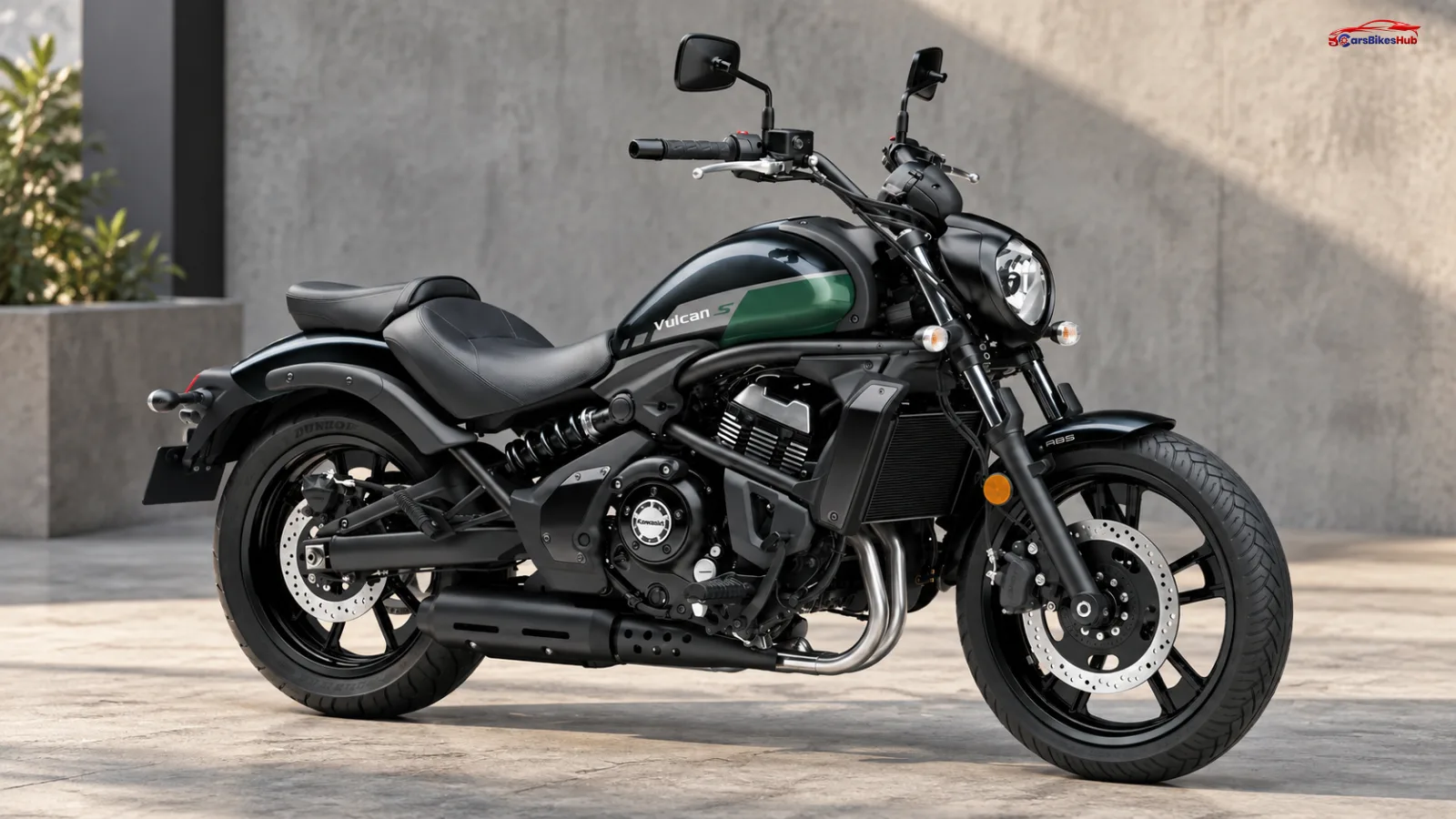
Kawasaki has launched the 2027 Vulcan S in India at ₹8.23 lakh (ex-showroom), with deliveries scheduled to begin in mid-September 2026. The bike is getting attention because the 2027 update makes a few mechanical changes, rather than being limited to a new colour. That said, before assuming this is a substantially reworked motorcycle, it’s worth clarifying what this update actually is: a running change to an existing model, not a new generation of the Vulcan S.
The Vulcan S has been sold in India since 2019, with the model receiving periodic updates over the years. The 2027 version brings two mechanical changes: torque and brake disc size, along with a new colour. Everything else on the motorcycle, from its 649cc parallel-twin engine architecture to its seat height and chassis, carries over unchanged.
This article looks at exactly what has changed, what hasn’t, and whether the ₹8.23 lakh price makes sense for an Indian buyer shopping in this segment.
2027 Kawasaki Vulcan S Price in India
The 2027 Kawasaki Vulcan S is priced at ₹8.23 lakh (ex-showroom, India). This is ₹10,000 more than the 2026 Vulcan S, which was priced at ₹8.13 lakh.
The ₹10,000 increase is relatively small at about 1.2% of the previous price, although the 2027 update itself remains fairly limited. Kawasaki hasn’t added a new electronic package or substantially reworked the motorcycle’s core hardware, and it hasn’t tried to position this as a major overhaul either. The increase is broadly in line with the kind of yearly price movement the Vulcan S has seen before.
On-road prices will vary by state and city depending on RTO and insurance costs, so it’s worth checking with a local Kawasaki dealership before budgeting a final number, rather than relying on a single blanket figure.
What’s New on the 2027 Kawasaki Vulcan S?
There are three confirmed changes on the 2027 model, and each one is worth unpacking on its own.
Torque is back up to 62.4Nm. When Kawasaki updated the Vulcan S for 2026, the 649cc parallel-twin lost 1.4Nm of torque, dropping to 61Nm. With the 2027 update, that torque has been restored, bringing the engine back to 62.4Nm at 6,600rpm, the same figure the motorcycle produced in its 2024 form. Peak power is unchanged. In practical terms, this isn’t a retune aimed at giving the bike noticeably more shove; it’s Kawasaki reversing a dip that most owners likely never noticed in the first place. For a returning or cross-shopping buyer, it mainly matters as a data point rather than something that changes how the bike feels to ride.
The brake discs have gotten smaller. The front disc rotor is now 272mm, down from 300mm on the 2026 bike, and the rear rotor is 216mm, down from 250mm. Dual-channel ABS continues to be standard, and Kawasaki hasn’t stated a reason for the smaller rotors. This is worth flagging clearly: smaller discs can mean a cost or weight optimisation, but without Kawasaki explaining the change, it would be inaccurate to say braking performance has been compromised or improved. What can be said factually is that outright stopping power depends on the whole system, pad compound, calliper design, and ABS tuning, not disc diameter alone. Without an explanation from Kawasaki or independent testing, it is better to treat the change as a specification difference rather than assume it improves or worsens braking performance.
There’s a new colour. The 2026 Vulcan S was sold in a single Metallic Flat Spark Black shade. The 2027 version switches to a Metallic Carbon Gray finish with a hint of bluish-green running through it, a nod to the greener shades Kawasaki has historically used on its cruisers. Some regional dealer listings have described this as a two-tone Gray and Bluish Green option; either way, this is a cosmetic change and doesn’t affect performance or equipment.
2027 vs 2026 Kawasaki Vulcan S: What Has Actually Changed?
| Specification | 2026 Vulcan S | 2027 Vulcan S |
| Price (ex-showroom) | ₹8.13 lakh | ₹8.23 lakh |
| Peak torque | 61Nm @ 6,600rpm | 62.4Nm @ 6,600rpm |
| Peak power | Unchanged | Unchanged |
| Front disc | 300mm | 272mm |
| Rear disc | 250mm | 216mm |
| Colour | Metallic Flat Spark Black | Metallic Carbon Gray with bluish-green tint |
| ABS | Dual-channel | Dual-channel (unchanged) |
| Suspension | 41mm telescopic fork (130mm travel), monoshock (80mm travel, preload-adjustable) | Unchanged |
| Seat height | 705mm | Unchanged |
| Ground clearance | 130mm | Unchanged |
| Kerb weight | 235kg | Unchanged |
| Instrument cluster | Analogue-digital | Unchanged |
Looked at together, these are minor changes. A returning owner who rode the 2026 bike wouldn’t feel a dramatic difference on the 2027 version; the torque gain is small, and the brake change is more of a hardware note than something that transforms the riding experience. This is an update in the truest sense of the word: Kawasaki has made a handful of specific adjustments to an existing motorcycle rather than reworking it.
Engine and Performance
The Vulcan S is built around a 649cc, liquid-cooled, DOHC, 8-valve parallel-twin, essentially a cruiser-tuned relative of the engine that powers Kawasaki’s Ninja 650 and Z650 twins. It’s paired with a 6-speed gearbox and produces 61PS at 7,500rpm and 62.4Nm at 6,600rpm.
What matters more than the numbers is where that power is delivered. Kawasaki has consistently tuned this engine to be friendly in the low-and-mid rpm range, which is where most cruiser riding, city commuting, relaxed highway cruising, and gentle overtakes actually happen. It isn’t a big-inertia, high-torque V-twin in the way a Royal Enfield Super Meteor 650 is; it revs more like a Kawasaki inline-format engine wearing cruiser clothing. That makes the Vulcan S feel more eager and freer-revving than a typical cruiser, at the cost of some of the low-rpm thump that traditional cruiser buyers associate with the format.
This is worth being upfront about: if what you want from a cruiser is a slow-revving, torque-heavy character, the Vulcan S’s parallel-twin will feel like a different proposition altogether. If you want cruiser styling and ergonomics with a more versatile, rev-happy engine underneath, it’s a closer match.
Riding Position, Seat Height and ERGO-FIT
The Vulcan S has a seat height of 705mm, which is genuinely low for a 650cc motorcycle and makes it accessible to a wide range of rider heights, something that matters in a market where inseam length varies widely and many riders are put off larger cruisers purely because they can’t get both feet down comfortably.
Kawasaki’s ERGO-FIT approach is another important part of the Vulcan S’s appeal. The motorcycle gets three-position adjustable footpegs, allowing riders to move the foot position 25mm forward or back from the standard setting. Combined with the 705mm seat height, this gives the Vulcan S more flexibility than many traditional cruisers.
This is one of the genuine points of difference for the Vulcan S. A low seat height combined with an adjustable riding position is something most competing 650cc cruisers in India don’t offer in this form, and it’s a real, practical reason, not a marketing claim, why the bike suits a broader range of riders than its rivals.
Design and Hardware
The Vulcan S keeps its familiar cruiser silhouette: a long, low stance, a perimeter frame, five-spoke alloy wheels (18-inch front, 17-inch rear), an oval headlamp, and a split-seat layout. None of this has changed for 2027.
Suspension duties are handled by a 41mm telescopic fork with 130mm of travel up front, and a preload-adjustable monoshock offering 80mm of travel at the rear, a setup carried over unchanged from the 2026 bike. Braking is via twin discs, now at the revised 272mm (front) and 216mm (rear) sizes, backed by dual-channel ABS as the sole electronic rider aid. There’s no traction control, riding modes, or other electronic assistance, which is consistent with where this bike sits: a mechanically simple, cruiser-focused motorcycle rather than a tech-laden one.
The instrument cluster remains an analogue-digital unit, without connectivity features like Bluetooth. For buyers used to fully digital dashboards on modern 650cc bikes, this will feel like the Vulcan S’s most dated element, and it’s one of the areas where the 2027 update hasn’t tried to catch up.
2027 Kawasaki Vulcan S for City Riding and Highway Touring
In the city, the Vulcan S’s low seat height and manageable proportions genuinely help; you can get flat feet on the ground at most stops, and the parallel-twin’s low-rpm manageability makes filtering through traffic less of a chore than it would be on a torquier, lower-revving cruiser engine. At 235kg kerb weight, it isn’t light, but the weight is carried low, which helps at a standstill and at walking pace.
Ground clearance is a genuine practical concern. At 130mm, it’s on the lower side for Indian road conditions, and speed breakers, uneven surfaces, and potholed stretches need to be approached with some caution. This isn’t unique to the Vulcan S among low-slung cruisers, but it is a real limitation worth knowing before buying, not an afterthought.
On the highway, the parallel-twin’s willingness to rev makes overtaking and cruising at typical Indian highway speeds reasonably relaxed, and the riding position, with the adjustable ergonomics, keeps long stints comfortable for most rider heights. For genuine long-distance touring, the Vulcan S lacks factory wind protection, luggage provisions, and a more relaxed low-end torque delivery that dedicated tourers offer, so it’s better thought of as a comfortable weekend and highway-cruising motorcycle than a purpose-built tourer.
Fuel economy figures aren’t officially published by Kawasaki for the Indian market, so it’s best not to quote a specific mileage number here; expect real-world efficiency in this segment to depend heavily on riding style and conditions rather than assume a fixed figure.
2027 Kawasaki Vulcan S vs Its Rivals
The Vulcan S doesn’t have a true one-to-one rival in India, which is part of why Kawasaki has been able to hold its price and positioning steady for years. The closest comparison most buyers will make is with the Royal Enfield Super Meteor 650, priced at ₹4.05 lakh (ex-showroom), roughly half the Vulcan S’s price.
The two bikes take very different approaches. The Super Meteor 650 uses a torquier, lower-revving parallel-twin tuned for a classic cruiser feel and has a more traditional cruiser riding posture. It also benefits from Royal Enfield’s much larger sales and service network and a significantly lower purchase price. The Vulcan S, by comparison, offers a more rev-happy engine, a lower and more accessible seat height, adjustable ergonomics, and Kawasaki’s brand positioning, but at nearly double the price and with a comparatively small dealership footprint in India.
None of this makes one motorcycle objectively better than the other; it depends on whether a buyer is prioritising outright value and network reach, or a specific riding character and brand.
What Has Not Changed?
It’s worth stating plainly what the 2027 update leaves untouched, because it’s most of the motorcycle: the 649cc engine architecture, peak power output, 6-speed gearbox, perimeter frame, suspension travel at both ends, 705mm seat height, 130mm ground clearance, 235kg kerb weight, 14-litre fuel tank, wheel sizes, the analogue-digital instrument cluster, and the ERGO-FIT adjustable ergonomics system. Dual-channel ABS remains the only electronic rider aid, with no traction control or riding modes added.
In effect, the 2027 Vulcan S is the 2026 Vulcan S with restored torque, smaller brake discs, and a new colour, nothing more.
Is the 2027 Kawasaki Vulcan S Worth the Price?
At ₹8.23 lakh, the Vulcan S remains a premium purchase in the Indian cruiser segment, and the 2027 update doesn’t change that calculation much either way. The ₹10,000 increase over the 2026 model brings back 1.4Nm of torque that most riders won’t consciously notice, along with revised brake hardware that hasn’t been shown to meaningfully change stopping performance, and a new colour option.
What you’re really paying for with the Vulcan S, in 2027 as in previous years, is Kawasaki’s engineering and brand positioning, a distinctive rev-happy parallel-twin cruiser character that’s genuinely different from anything else in this price bracket in India, and an accessible, adjustable riding position that suits a wide range of rider builds. If those are things you value, the small year-on-year changes don’t really move the needle on the ownership proposition either way.
If you’re comparing purely on value, a Royal Enfield Super Meteor 650 delivers a broadly similar cruiser experience, better sales and service reach, and a significantly lower price, and the 2027 Vulcan S’s minor updates don’t do much to close that value gap.
Who Should Consider the 2027 Kawasaki Vulcan S?
It makes the most sense for buyers who want a cruiser with a lower seat height and more accessible ergonomics than typical of the format, who prefer a rev-happy, more versatile engine character over a slow-revving traditional cruiser feel, and who are buying into the Kawasaki brand and dealer experience specifically rather than shopping purely on price or running costs. It’s a less obvious fit for buyers focused on long-distance touring, low ground clearance tolerance, or best-in-class value for money.
Final Verdict
The 2027 Kawasaki Vulcan S is a straightforward running update, a small torque correction, revised brake discs and a new colour, all wrapped into a ₹10,000 price bump. It doesn’t reinvent the motorcycle, and Kawasaki hasn’t tried to sell it as though it does.
What continues to set the Vulcan S apart in India is unchanged from before: its accessible seat height, adjustable ergonomics and distinctive parallel-twin cruiser character. Buyers already drawn to those traits get a slightly better version of the same bike; buyers who were on the fence about the Vulcan S’s price and positioning will find nothing new here to tip the decision.



FAQs
What is the price of the 2027 Kawasaki Vulcan S in India?
The 2027 Kawasaki Vulcan S is priced at ₹8.23 lakh (ex-showroom, India), which is ₹10,000 more than the 2026 model.
What is new on the 2027 Kawasaki Vulcan S?
Kawasaki has restored 1.4Nm of torque (now 62.4Nm), revised the front and rear brake disc sizes to 272mm and 216mm respectively, and introduced a new Metallic Carbon Gray colour with a bluish-green tint, replacing the previous Metallic Flat Spark Black option.
What engine does the Kawasaki Vulcan S use?
It uses a 649cc, liquid-cooled, DOHC, 8-valve parallel-twin engine paired with a 6-speed gearbox, producing peak torque of 62.4Nm at 6,600rpm.
What is the seat height of the Vulcan S?
The Vulcan S has a seat height of 705mm, which is low and accessible for a 650cc cruiser, along with a ground clearance of 130mm.
How is the 2027 Vulcan S different from the 2026 model?
The core motorcycle is unchanged. The 2027 update restores 1.4Nm of torque lost in the 2026 model, uses smaller brake discs front and rear, and gets a new colour option, at a ₹10,000 price premium.