


















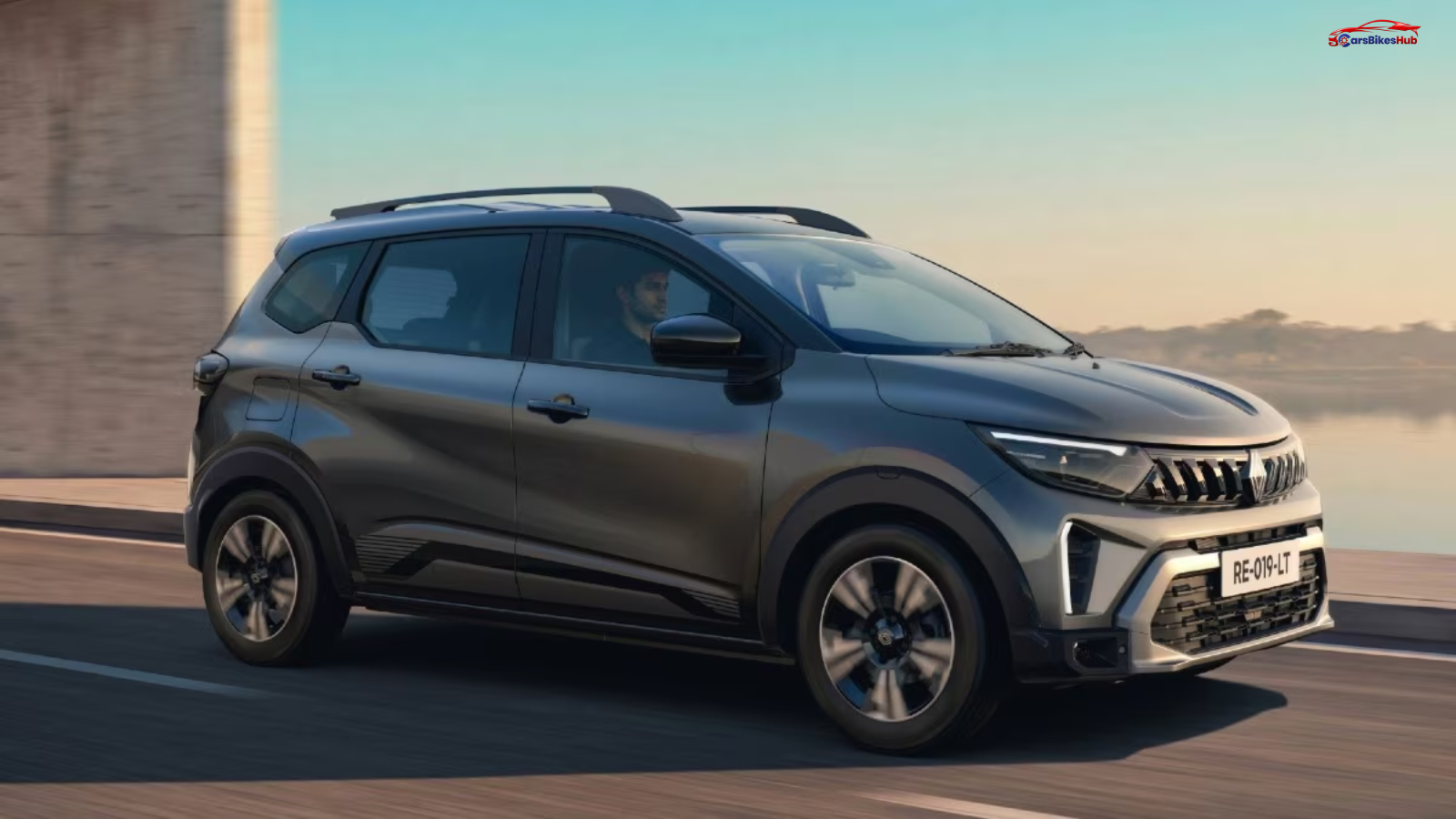
Renault India has added a more powerful turbo-petrol version to the Triber lineup, badged the Triber 100PS, with prices ranging from Rs 7,84,900 to Rs 8,99,900 (ex-showroom). The biggest change is under the bonnet: the new 1.0-litre turbo-petrol engine produces 100 PS and 180 Nm, compared with 72 PS and 96 Nm from the regular naturally aspirated Triber.
That means a substantial jump in torque, which is particularly relevant for a compact seven-seater that may often be driven with multiple passengers and luggage. For now, the Triber 100PS is offered only with a five-speed manual gearbox. But the turbo engine is not the only change Renault has made, with updates to the platform and chassis aimed at supporting the extra performance. Here’s what the Triber 100PS gets, what remains unchanged, and how much difference the new engine actually makes.
Renault Triber Turbo Price in India
All prices below are ex-showroom. Renault’s launch statement gives the starting price, and the variant-wise list comes from launch reports.
| Variant | Triber Turbo (MT) |
| Evolution | Rs 7,84,900 |
| Techno | Rs 8,53,900 |
| Emotion | Rs 8,99,900 |
How Much More Does the Turbo Cost?
Compared with the equivalent naturally aspirated manual variants, the Triber 100PS costs more across the range:
| Variant | Turbo premium over regular Triber (MT) |
| Evolution | Rs 1,11,295 |
| Techno | Rs 1,09,780 |
| Emotion | Rs 94,550 |
Because equipment lists differ across trims, the trim-for-trim comparison is not always the most useful one. It is covered in the regular Triber section below.
Renault Triber Turbo: What’s New?
The engine. The turbo-petrol is the 1.0-litre three-cylinder unit that also powers the Kiger and Duster 1.0. Carlelo reports that it is tuned for 180 Nm here, compared with 160 Nm in the Kiger and 166 Nm in the Duster. Renault claims this is the highest torque in the segment. Treat that as a company claim.
The platform and underpinnings. This is the bigger story beyond the engine. Renault says the Triber 100PS is the first Renault India model on the Renault Group Entry Platform (RGEP) and has been comprehensively re-engineered rather than simply given a new engine. According to Renault, the changes include:
- A new engine management system (R-EMS)
- Revised thermal management with a brushless DC cooling fan
- Structural enhancements
- Revised suspension geometry
- Front and rear anti-roll bars
- MTV damper technology
- Braking calibration and vehicle-dynamics tuning for Indian roads
All of these are Renault’s claims, and no independent testing exists yet.
Design and features. The body remains unchanged, with no design differences from the naturally aspirated petrol version apart from a new Turbo badge on the tailgate. The features and safety equipment also remain largely the same as the standard petrol Triber.
What has not changed:
- The 5-, 6- and 7-seat modular layout
- The sub-4-metre footprint
- The 182 mm ground clearance
- The feature list carried over from the NA Triber
Turbo Engine and Performance: What Changes?
| Specification | Triber Turbo | Regular Triber |
| Engine | 1.0L three-cylinder turbo-petrol (TCe 100) | 1.0L three-cylinder NA petrol |
| Power | 100 PS | 72 PS |
| Torque | 180 Nm | 96 Nm |
| Transmission | 5-speed manual | 5-speed manual / 5-speed AMT |
| Fuel type | Petrol | Petrol (dealer-fitted CNG kit on NA) |
The Triber 100PS has a claimed 0–100 km/h time of 10.8 seconds. Independent performance tests are not available yet.
Torque is what you feel at everyday speeds, and here it nearly doubles. No road tests are out yet, so what follows is a reading of the numbers, not measured behaviour.
- City driving: The NA Triber copes well in light traffic. The additional torque should reduce the need for frequent downshifts and high engine speeds when accelerating. It also matters when the car is loaded, and the air-conditioning is working continuously, as is common in Indian conditions.
- Highway cruising: A small naturally aspirated engine can feel more strained at highway speeds when the car is carrying a full load. The turbo should leave more in reserve.
- Overtaking: This is likely the biggest change. The added torque makes overtaking, inclines, and passenger loads easier.
- Full load and hill roads: These are the conditions where the NA engine’s shortfall was most visible. The turbo should hold speed on gradients with more passengers on board.
The trade-offs:
- Price: The turbo costs about Rs 95,000 to Rs 1.11 lakh more than the equivalent NA manual.
- Driving style: Turbo engines respond to how they are driven. Fuel use will vary between a driver who accelerates hard and one who doesn’t.
- Gearbox: You lose the AMT option for now.
- Maintenance: Renault has not published turbo-specific service costs or intervals. Long-term reliability cannot be assessed yet.
Manual vs Automatic: Which Triber Turbo Gearbox Do You Get?
Only manual, at launch. All three turbo variants use the five-speed manual. The regular Triber’s AMT is available only on the NA Emotion.
Renault has confirmed that a CVT automatic and a factory-fitted underbody CNG option are coming soon. Motoring World says there is no information on when the CVT will arrive. No date, price, or variant allocation has been announced, so neither should be treated as available.
For now, the practical choice is this:
- Manual turbo: Suits highway-heavy or frequently loaded use, where you choose the gear yourself.
- AMT (NA Emotion): The only automatic Triber today. It is convenient in stop-and-go traffic, but it pairs with the NA engine’s 96 Nm.
If you want both an automatic and a turbo, the only route is to wait for the CVT.
Does the Turbo Make More Sense for a 7-Seater?
The benefits of the extra torque become more noticeable when the Triber is carrying a full load.
- Five or more occupants: A car with five adults, or a family with grandparents and children, is much heavier than the one the NA engine was comfortable with. More torque means the engine can pull that weight without being revved hard.
- A loaded boot: Luggage and passengers together are a common Triber use. The turbo gives more headroom for that combined weight.
- Inclines: Climbing a flyover or ghat road with a full car is a common test for small NA engines. The turbo addresses this directly.
- Highways and overtaking: A 7-seater on an expressway is often at sustained speed with a full load. The extra reserve should make overtaking less of a planned manoeuvre.
The turbo does not change the Triber’s size, weight class or third-row space. It adds capability to the same platform. If you rarely carry more than two or three people, most of the benefit will go unused.
Features and Safety
Renault says equipment varies by variant. Here is what the launch coverage confirms.
Available depending on variant:
- 8-inch touchscreen with wireless Android Auto and Apple CarPlay
- Digital instrument cluster (a 7-inch unit per CarDekho)
- Automatic climate control
- Cruise control
- Wireless charging
- Rain-sensing wipers
- Automatic headlamps
- Smart Access Card and push-button start
- Independent rear AC vents for second and third rows
Safety: Six airbags and 21 safety features are standard. Front parking sensors, a rear camera with guidelines, and TPMS are available on higher variants. CarDekho also lists ISOFIX mounts and a speed alert warning.
Not yet confirmed: A variant-by-variant feature list and an itemised list of the 21 safety features were not available in launch coverage. ESC and hill-start are commonly listed for the Triber, but they have not been confirmed for the turbo trims specifically. No ADAS has been mentioned in any launch report. Check the official brochure before buying.
Crash safety: The current Triber is not yet tested, though the outgoing model had scored 4 stars at Global NCAP. The RGEP platform has no rating yet.
Practicality: Space, 7 Seats and Boot
The Triber’s practicality is unchanged.
- Seating: Five-, six-,x and seven-seat configurations. Renault lists Easy-Fix third-row seats, slide-and-recline second-row seats and one-touch tumble access.
- Boot space: Renault lists 625 litres in the five-seat layout. With all seven seats up, spec listings for the existing Triber put boot space at about 84 litres. That is a listing figure for the current model, not a turbo-specific Renault number. Renault’s site claims up to 1,065 litres with the second and third rows folded.
- Roof rails: Renault quotes a 50 kg load capacity.
- Ground clearance: 182 mm, per Renault.
- Dimensions: Renault says the footprint stays sub-4 metres. Spec listings for the existing Triber give roughly 3,985 mm in length, 1,734 mm in width and 1,643 mm in height.
Does the turbo improve the drive without cutting into practicality? On the evidence, yes. Renault has reported no change to interior space, though a turbo-specific boot figure for the seven-seat layout is not available.
Renault Triber Turbo vs Renault Kiger Turbo
The two share an engine but are different cars.
| Triber Turbo | Kiger Turbo | |
| Power | 100 PS | 100 PS |
| Torque | 180 Nm | 160 Nm (MT) / 152 Nm (CVT) |
| Seats | 5, 6 or 7 | 5 |
| Length | ~3,985 mm | ~3,990 mm |
| Boot | 625 L (5-seat) / ~84 L (7-seat) | 405 L |
| Ground clearance | 182 mm | 205 mm |
| Gearbox | 5-speed manual | 5-speed manual / CVT |
On price: The Triber Turbo runs from Rs 7.85 lakh to Rs 8.99 lakh. Variant-wise Kiger Turbo prices could not be verified from Renault, so there is no trim-for-trim comparison here. CarDekho’s Kiger page lists the top Emotion Turbo CVT at Rs 10.40 lakh, which suggests the Kiger’s turbo range extends higher. Check current Kiger pricing before deciding.
The Triber Turbo gets more torque and a third row. The Kiger has higher ground clearance, a CVT option today, and an SUV stance, but seats five. The decision comes down to how many people you carry and how often.
Renault Triber Turbo vs Regular Triber
What the turbo adds:
- 28 PS more power and 84 Nm more torque
- An updated platform with revised suspension, anti-roll bars and braking calibration, per Renault
- A Turbo badge
It does not add new features. Equipment matches the NA range, so you are paying for the engine and the underpinnings.
The cost, from official prices: Rs 94,550 to Rs 1,11,295 more, depending on trim.
Two cross-trim comparisons are worth noticing. The Turbo Evolution (Rs 7,84,900) costs about Rs 41,000 more than the NA Techno MT. The Turbo Techno (Rs 8,53,900) costs about Rs 48,500 more than the NA Emotion MT. In both cases, you are choosing engine over equipment. Separately, the Turbo Emotion is only about Rs 47,000 more than the NA Emotion AMT, so the real choice there is power against automatic convenience.
Mileage and Running Costs
Renault has quoted 21 kmpl for the Triber 100PS. The launch material available does not clearly specify the certification cycle. Real-world fuel economy figures are not available yet.
For context, listing sites put the regular Triber at roughly 17 to 20 kmpl depending on variant and gearbox. These are not directly comparable, since they come from different sources and configurations.
What is worth knowing:
- Turbo-petrol fuel use varies with driving style. Frequent hard acceleration will cost more than steady driving.
- City traffic, highway speed, a full load,oad and constant AC use all affect economy.
- A higher ex-showroom price generally means slightly higher registration and insurance costs. That is an inference, not a Renault figure.
- Service costs and warranty for the turbo have not been published.
Who Should Consider the Renault Triber Turbo?
- Families who need seven seats and often travel with a full car.
- Buyers who found the regular Triber underpowered on highways or hills.
- Buyers who want a compact, sub-4-metre family vehicle with stronger performance.
- Buyers comfortable with a manual gearbox.
Who May Still Prefer the Regular Triber?
- Buyers who put purchase price first. The regular Triber starts at about Rs 5.81 lakh. Mostly city drivers who rarely carry a full load.
- Buyers who want an automatic today. Only the NA Triber offers one.
- Buyers who prefer simple naturally aspirated power delivery.
- Buyers focused on running costs. No verified real-world data is showing the turbo is cheaper or costlier to run.
Final Verdict
The Triber Turbo adds a proper engine to a package that already had space and features. Power rises from 72 PS to 100 PS and torque from 96 Nm to 180 Nm, aimed squarely at the loaded-family use where the NA engine struggled. Renault also says the car has been re-engineered around a new platform, with revised suspension and braking, though those changes await independent verification.
Practicality is intact: the same 5-, 6- and 7-seat layout, the same footprint and no new features. The cost is Rs 94,550 to Rs 1.11 lakh over the equivalent NA manual, and for now only in manual form. A CVT and factory CNG have been flagged as coming, but without dates or prices.
The turbo makes the most sense for families who regularly carry full loads, drive on highways or hills, and are happy with a manual gearbox.





FAQs
What is the Renault Triber Turbo price in India?
The Triber Turbo is priced from Rs 7,84,900 to Rs 8,99,900 (ex-showroom) across Evolution, Techno and Emotion variants.
What engine does the Renault Triber Turbo get?
A 1.0-litre three-cylinder turbo-petrol (TCe 100), the same family used in the Kiger and Duster, but tuned for 180 Nm.
How much power and torque does the Triber Turbo produce?
100 PS and 180 Nm, against 72 PS and 96 Nm for the regular Triber.
Is the Renault Triber Turbo available with an automatic gearbox?
Not at launch. It comes with a five-speed manual only. Reports say a CVT is coming, but no date or price has been announced.
Is the Triber Turbo more powerful than the Kiger?
Power is the same at 100 PS. Torque is higher at 180 Nm against 160 Nm for the Kiger's manual, per portal listings.