


























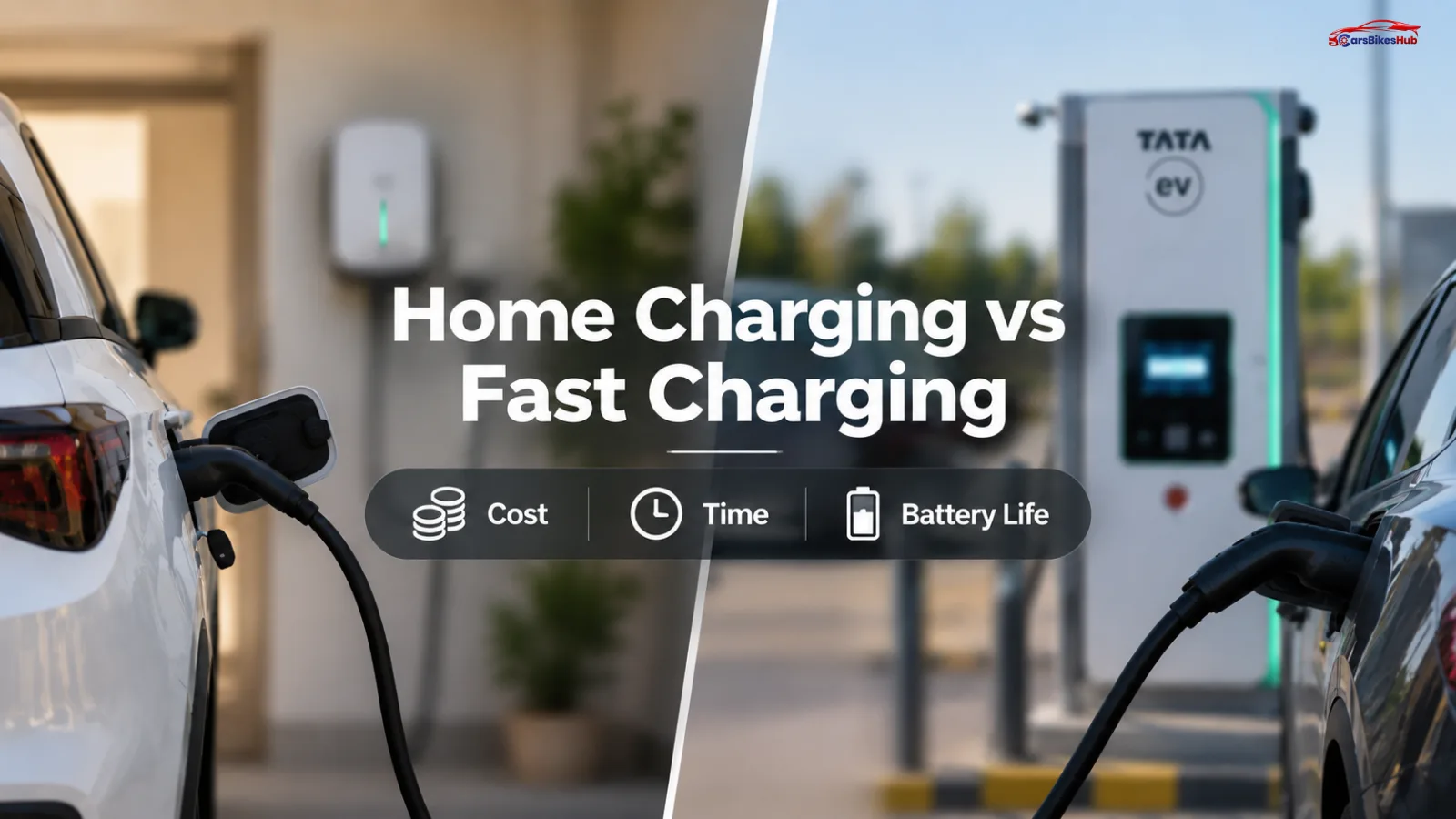
You’ve bought your first EV, or you’re close to it, and there’s one question that keeps coming back: where and how will you actually charge this thing every day? Most new owners quickly realise there isn’t one single answer. You have two broad options: plugging in at home using AC power, or pulling into a public DC fast charger on the way somewhere. Home charging suits the routine, everyday top-up. Fast charging earns its place when you need range back in a hurry. Neither one replaces the other completely, and which you lean on more depends on your driving pattern, where you park, and what you’re willing to pay for speed.
This article compares home charging and fast charging to help you figure out which option fits your driving and charging needs
Home Charging vs Fast Charging: What’s the Difference?
EV charging in India is broadly divided into two types: AC (alternating current) and DC (direct current).
Home charging is almost always AC. You plug a cable into a wall socket or a wallbox, and your car’s onboard charger converts that AC power into DC power the battery can actually store. This conversion step is exactly why AC charging is slower: your car’s onboard charger can only convert power at a limited rate, usually a few kilowatts at a time.
DC fast charging skips that step. The charging station itself does the AC-to-DC conversion using much bigger, more powerful equipment, and sends DC power straight into the battery. That’s the whole reason it’s faster: you’re bypassing the bottleneck of your car’s small onboard charger and feeding the battery directly.
In practice, AC home charging is what you use night after night in your garage or society parking. DC fast charging is what you use at highway stops, mall charging hubs, or dedicated fast-charging stations when you need a meaningful amount of range in a short window.
How Home Charging Works
When you plug your EV into a home charger, you’re usually using one of two setups: a basic portable charger that comes with the car (often just 3.3 kW), or a dedicated wallbox installed by an electrician (commonly 7.2 kW, sometimes higher depending on your home’s electrical capacity).
The actual charging speed depends on three things: the power rating of your charger, your car’s onboard AC charger capacity, and your battery size. A 3.3 kW portable charger might take most of the night to fill a mid-size battery pack, while a 7.2 kW wallbox can do the same job in roughly half the time. There’s no single “home charging takes X hours” figure that applies to every EV, because battery sizes and onboard charger ratings vary a lot across models; always check your specific car’s spec sheet.
This is exactly why overnight charging suits most owners so well. You plug in when you get home, the car charges slowly and steadily through the night, and it’s ready by morning regardless of whether it takes four hours or eight. You’re not standing around waiting.
If you’re setting up home charging, a few basics matter: your existing electrical wiring needs to handle the load safely, you’ll likely need a dedicated circuit for a wallbox, and your housing society or landlord needs to be on board if you don’t own the parking spot outright. Most EV makers or their charging partners handle the installation survey and paperwork as part of the purchase.
How DC Fast Charging Works
A DC fast charger is a different piece of equipment altogether; it’s a standalone unit that does its own AC-to-DC conversion at much higher power levels, then feeds that DC power directly into your battery, bypassing your car’s onboard charger. That’s why it can add a large chunk of range in a fraction of the time home charging would take.
But fast charging isn’t a flat, constant speed from 0 to 100%. Your car’s battery management system deliberately slows the charging rate down as the battery fills up, particularly after it crosses roughly 80%. This is standard behaviour across EVs and isn’t a fault or a sign of a weak charger; it’s how the system protects the battery cells from stress as they approach full capacity. This is also why you’ll often see charging stations, and even EV owners themselves, talk about charging “to 80%” on a fast charger rather than 100%; the last stretch takes disproportionately longer, so it isn’t the most time-efficient use of a fast charger.
This makes fast charging genuinely useful in one specific situation: when time is the constraint, not electricity. A quick 20–40 minute stop that takes you from a low battery to a comfortable range is the whole point.
Fast Charging vs Home Charging: Key Differences
| Factor | Home (AC) Charging | Public DC Fast Charging |
| Charging speed | Slow: a few kW | Much faster: significantly higher power output |
| Charging time | Several hours, typically overnight | Roughly 20–60 minutes for a large top-up, varies by car and charger |
| Cost per unit | Generally lower, tied to your domestic electricity tariff | Generally higher, set by the charging network operator |
| Convenience | Very high once installed, plug in and forget | Requires a trip to a charging station and some waiting |
| Availability | Only where you have a private charging point | Growing but still uneven across cities and highways |
| Best use case | Daily, routine charging | Long trips, emergencies, quick top-ups |
| Battery considerations | Lower-power charging is generally suited to routine charging | Charging naturally slows past ~80% to protect the battery |
| Suitability for daily charging | Ideal | Usually less practical for routine daily charging |
| Suitability for road trips | Not practical on its own | Very useful for covering long distances quickly |
Which Is Cheaper: Home Charging or Fast Charging?
Home charging is, in almost every case, the cheaper option, but by how much depends entirely on where you live and which network you’re using for fast charging.
Domestic electricity tariffs vary widely across India, while public DC charging rates depend on the charging network, location, and charger. A commonly quoted illustrative range for home EV charging is roughly ₹4 to ₹10 per kWh (unit), while public DC fast charging rates at private networks commonly run somewhere in the ₹15 to ₹25 per kWh range, though this varies by operator, city, and time of day. Some PSU-run networks and Ministry of Power advisory tariffs have pushed for lower fast-charging rates in specific windows, so it’s worth checking the app of whichever network you actually use rather than assuming one number applies everywhere.
Here’s a simple worked example, with the assumptions stated clearly. Say you have a 40 kWh battery and you charge it from empty to full at home, at an assumed rate of ₹8 per kWh. The straightforward math gives you 40 × ₹8 = ₹320. In reality, your actual bill will likely be a bit higher than this because of charging losses; some electricity is lost as heat during the AC-to-DC conversion inside your car, so you typically draw a little more from the grid than the battery actually stores. Treat ₹320 as a rough floor, not a promise.
Now compare that to charging the same 40 kWh at a public DC fast charger. Using an illustrative rate of ₹20 per kWh (check your actual network’s current tariff, as this is not a fixed nationwide number), the same charge would cost roughly ₹800, well over double the home-charging estimate. This gap is the core financial argument for doing most of your charging at home and treating fast charging as an occasional convenience rather than a routine habit.
Does Fast Charging Affect EV Battery Life?
This is one of the most common worries first-time EV buyers have, and it deserves a careful, non-alarmist answer.
Every modern EV has a battery management system (BMS) that actively monitors temperature, voltage, and charging rate. Fast charging does generate more heat in the battery than slow AC charging, simply because more energy is moving in less time. The BMS is designed specifically to manage this; it’s why charging speed tapers down as the battery fills, and why the car may reduce charging power further in very hot weather.
Manufacturers set fast-charging limits for exactly this reason, to keep charging within a range the battery can handle safely without excessive stress. Fast chargers are designed for situations where you need to add range quickly. Using lower-power AC charging for routine charging can reduce the need to rely on DC fast charging every day.
There isn’t a reliable, universal figure for exactly how much battery capacity you’d lose from frequent fast charging; this varies by battery chemistry, climate, car model, and how the manufacturer has tuned its BMS, so treat any specific percentage you see online with caution unless it comes from the manufacturer itself. The safer, well-supported takeaway is simple: occasional fast charging is a normal and intended part of EV ownership, while using it as your only charging method, day after day, is generally not what most manufacturers recommend.
When Should You Use Fast Charging?
- Highway trips, covering long distances between cities, where a 20–40 minute stop for coffee and a washroom break lines up naturally with a fast-charge session.
- Long-distance travel with tight timing, when you genuinely can’t afford to wait several hours.
- Unexpected extra driving, an unplanned trip that eats into your remaining range faster than expected.
- When home charging isn’t available, a night away from home, a friend’s place with no charger, or a hotel with no charging point.
- A quick top-up before an important drive, you’re low on range and need just enough to get through the day.
When Is Home Charging Better?
- Daily office commutes: plug in at night, wake up to a full (or sufficiently full) battery.
- Regular city driving: predictable daily distances that a home charger can easily replenish overnight.
- Overnight charging: the car sits idle for hours anyway, so slow charging costs you nothing in time.
- Predictable driving schedules: if you broadly know how much you’ll drive each week, home charging is simple to plan around.
- Owners with dedicated parking, an independent house, bungalow, or a society flat with an allotted spot make installing a home charger straightforward.
What If You Don’t Have Home Charging?
This is a real, common situation for a lot of Indian buyers: apartment dwellers without dedicated parking, renters who can’t install fixed equipment, and people in shared or stacked parking setups where running a cable isn’t practical.
Can you still own an EV without a home charger? Realistically, yes, but it takes more planning. Workplace charging, where available, is one of the most practical substitutes, since it mimics the same “long, slow charge while you’re not using the car” pattern as home charging. Public AC charging points at malls, office complexes, and dedicated parking facilities are a reasonable middle ground too, slower than a fast charger, but far cheaper than relying on DC fast charging alone. Public DC fast charging can work as a fallback, but leaning on it as your everyday charging method will cost noticeably more over time, as the cost comparison above shows.
Before buying, it’s worth talking to your housing society about installing a shared or dedicated charging point, and checking what charging infrastructure exists near your workplace and along your regular routes. Owning an EV without home charging is workable, especially in cities with decent public charging density, but it usually means being more deliberate about where and when you charge rather than simply plugging in every night.
Should You Charge an EV to 100% Every Time?
For everyday driving, charging to 100% at home isn’t automatically harmful, but many manufacturers recommend keeping regular charging in a moderate range (commonly discussed as roughly 20–80%) and reserving full 100% charges for days you actually need the extra range, such as a long trip. This guidance varies by manufacturer and battery chemistry, so the most reliable answer is what your car’s owner’s manual or manufacturer app specifically recommends; don’t assume one rule applies to every EV on Indian roads.
Home Charging vs Fast Charging: Which One Should You Use?
The honest answer is both, used for different jobs.
- Daily city use: home charging is generally more practical and considerably cheaper.
- Long road trip: fast charging becomes genuinely useful, even necessary.
- No home parking: public AC or workplace charging can fill the daily role, with fast charging as an occasional backup.
- Emergency or quick top-up: fast charging, without question.
- Overnight routine: home charging, every time.
Your own driving pattern decides the mix. Someone doing a short daily commute with occasional weekend trips will lean almost entirely on home charging. Someone who regularly drives long distances between cities will use fast charging far more often, and should factor that higher running cost into their overall budget.
Final Verdict
Home charging and fast charging aren’t competing for the same job; they’re solving two different problems. Home charging is about convenience and cost for your everyday routine. Fast charging is about speed when time matters more than money. Where you park, how far you typically drive, and how often you travel between cities should decide how much you lean on each one. Most owners will end up using both, just in very different proportions, and that’s perfectly normal.









FAQs
Is home charging cheaper than fast charging?
Yes, in almost all cases. Home electricity tariffs are typically lower than the per-unit rates charged by public DC fast-charging networks, though the exact gap depends on your state's tariff and the specific network you use.
Is fast charging bad for an EV battery?
Not inherently. Modern EVs have battery management systems designed to handle fast charging safely, including tapering the charging speed as the battery fills. Occasional fast charging is normal; relying on it exclusively, day after day, is generally not what manufacturers recommend.
Can I fast-charge an EV every day?
You can, but frequent reliance on DC fast charging may cost more than home charging. For battery-care guidance, follow your EV manufacturer's recommendations.
How long does home charging take?
It varies by charger power, your car's onboard charger, and battery size, anywhere from a few hours to overnight. Check your specific EV's spec sheet rather than relying on a generic figure.
Can I own an EV without a home charger?
Yes, though it requires more planning. Workplace charging, public AC points, and occasional DC fast charging can substitute for a home charger, particularly in cities with reasonable public charging infrastructure.