











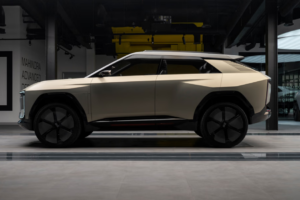













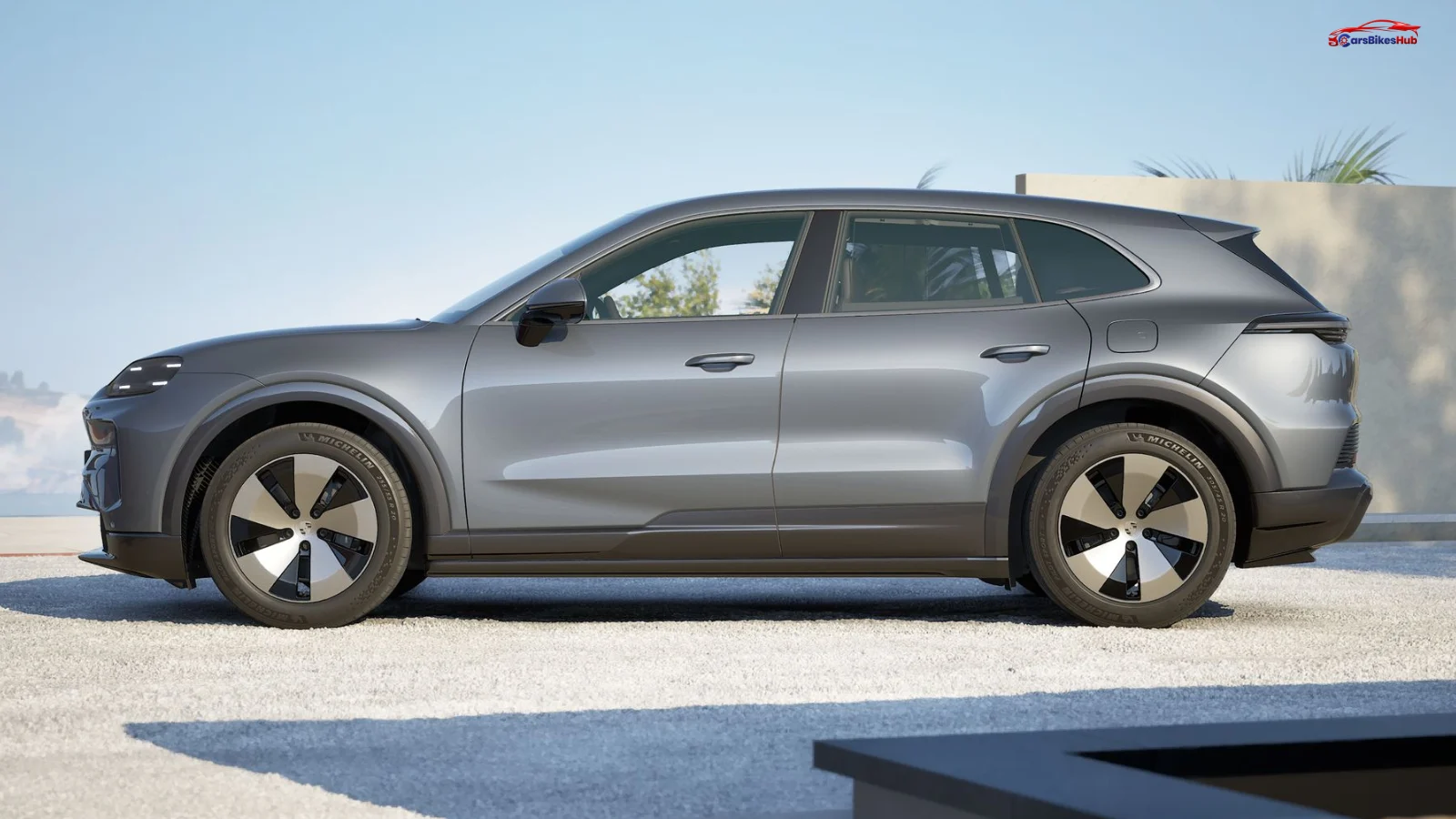
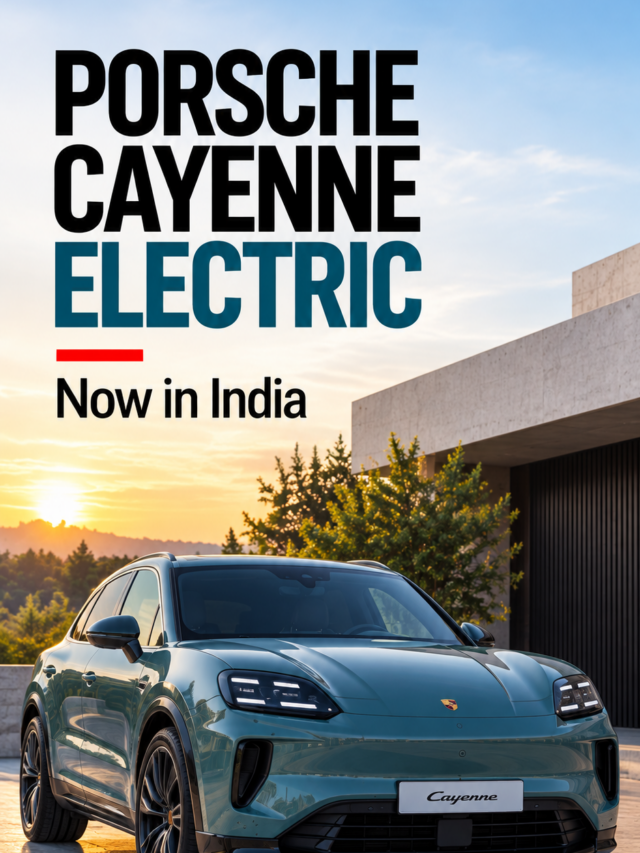
Porsche has officially brought the Cayenne Electric to India, marking the first time the brand’s popular luxury SUV is available with a fully electric powertrain. Prices start at ₹1.77 crore (ex-showroom, before options), with the range offered in two variants: the Cayenne Electric at ₹1,77,27,000 and the Cayenne Turbo Electric at ₹2,27,51,000. Both get a 113 kWh battery and dual-motor all-wheel drive, while Porsche claims up to 642 km of WLTP range and DC charging of up to 390 kW. The Turbo Electric takes things much further, producing up to 1,156 PS with Launch Control and reaching 100 km/h in a claimed 2.5 seconds.
The Cayenne Electric is the third electric Porsche in India, after the Taycan and the Macan Electric, and the first electric version of Porsche’s Cayenne SUV. It also does not replace the petrol Cayenne. Porsche is selling both side by side, which makes this launch as much about charging access and buying priorities as about performance. This article covers what has launched, what it costs, what you get, and what an Indian buyer needs to check before signing.
Porsche Cayenne Electric Price in India
Porsche India’s configurator lists the following prices, including GST, before options.
| Variant | Ex-showroom price |
| Cayenne Electric | ₹1,77,27,000 |
| Cayenne Turbo Electric | ₹2,27,51,000 |
The Turbo Electric costs ₹50.24 lakh more than the standard Cayenne Electric, roughly 28 per cent extra. Both prices are starting points. Porsche’s paint, wheel, seat and package options are priced separately, and ex-showroom figures do not include registration, insurance or other local charges. We have not verified an official on-road price for any city.
One caution if you are comparing listings: pre-launch coverage and an earlier version of the configurator showed the base car at ₹1,75,68,000 (about ₹1.76 crore). The current listing is ₹1,77,27,000. Confirm the final figure with your Porsche Centre.
What Is the Porsche Cayenne Electric?
The Porsche Cayenne Electric is the fully electric Cayenne. It is built on the Volkswagen Group’s 800-volt Premium Platform Electric (PPE), the same architecture as the smaller Macan Electric.
It does not replace the existing Cayenne. Porsche’s global position is that the electric Cayenne complements the combustion and plug-in hybrid models, which continue to be offered in parallel, and that it will keep developing petrol and hybrid Cayennes well into the next decade. Indian launch coverage says the same: the electric SUV sits alongside the petrol Cayenne in the showroom rather than replacing it as reported.
Two things to keep separate. Globally, Porsche also sells a Cayenne S Electric (added in March 2026) and a Cayenne Coupé Electric. The India launch covers two SUV variants only, the Cayenne Electric and the Cayenne Turbo Electric, so global specifications for the S or the Coupé do not apply here. Customer deliveries in India are reported to have begun on 30 September, the day of the Mumbai launch.
Porsche Cayenne Electric Battery, Range and Charging
Battery: both variants use the same newly developed 113 kWh high-voltage battery with double-sided cooling. Porsche’s material quotes 113 kWh as the headline figure. We did not find an official usable (net) figure in the India material; some third-party databases list roughly 108 kWh, which should be treated as unconfirmed.
Range: Porsche claims up to 642 km for the Cayenne Electric and up to 623 km for the Turbo Electric on the WLTP cycle. These are best-case figures. Porsche’s international site lists a model range of roughly 568 to 641 km for the standard car, depending on equipment such as wheel size, and Porsche notes that options, weather, traffic, and driving style change range. WLTP is a laboratory test. We have not seen a credible independent real-world range test for the India-spec car, so we are not quoting one.
Charging:
- Porsche quotes DC charging of up to 390 kW on the 800-volt system, while its global technical material mentions peak charging of up to 400 kW under specific conditions.
- Porsche’s 10 to 80 per cent figure is under 16 minutes. In 10 minutes of charging, Porsche says the Cayenne Electric can add up to 325 km of range (315 km for the Turbo).
- AC charging is up to 11 kW with the standard on-board charger. A 22 kW on-board charger is listed by Porsche as optional globally. One Indian report quotes 22 kW AC and a 5.75-hour full charge, but we could not confirm whether the 22 kW option is offered in India.
Porsche’s 16-minute figure assumes a CCS charger delivering more than 390 kW at more than 850 V and 520 A, a battery temperature of 15°C, and a starting charge of about 9 per cent. The 400 kW peak needs a charger above 400 kW, a battery at 40 to 42°C, and a charge level of 45 to 48 per cent. Miss those conditions and the car charges more slowly.
What this means in India
The 390 kW figure describes the car’s peak charging capability, not the average power it will hold through a session. Many high-speed public chargers on Indian highways are rated below the Cayenne Electric’s maximum, and the charger’s own limit caps the car. Most buyers will plan around home charging for daily use and treat public DC charging as a trip tool. More on this in the charging section below.
Performance: Cayenne Electric vs Cayenne Turbo Electric
| Specification | Cayenne Electric | Cayenne Turbo Electric |
| Power, normal driving | 300 kW / 408 PS | 630 kW / 857 PS |
| Power, with Launch Control | 325 kW / 442 PS | 850 kW / 1,156 PS |
| Torque, normal driving (reported) | 750 Nm | 1,360 Nm |
| Torque, with Launch Control | 835 Nm | 1,500 Nm |
| 0–100 km/h (with Launch Control) | 4.8 s | 2.5 s |
| Top speed | 230 km/h | 260 km/h |
| Drive | Dual-motor AWD | Dual-motor AWD |
Porsche’s published power, Launch Control torque, 0–100 km/h and top-speed figures are confirmed and match the India configurator. The normal-driving torque figures come from Autocar India’s launch report. The 0–100 km/h times are Launch Control figures, achieved with the mode activated, not what you get with an ordinary push of the accelerator.
What the Turbo’s extra output actually changes
The standard car already has 408 PS in normal driving, and a sub-five-second sprint, which is more than most buyers will use on Indian roads. The Turbo roughly doubles the power and cuts the 0–100 km/h time by 2.3 seconds, but much of that extra figure is reserved for short bursts.
Porsche’s Push-to-Pass function adds another 130 kW for 10 seconds on the Turbo, and its rear motor gets direct oil cooling to hold high output for longer. Its top speed is 30 km/h higher, which has little practical use here. The Turbo also adds Porsche Torque Vectoring Plus (a rear limited-slip differential) as part of its chassis package. The trade-off is a slightly lower claimed range of 623 km against 642 km, a gap of 19 km.
What Makes the Porsche Cayenne Electric Different?
- Dual-motor all-wheel drive: There is a motor on each axle, managed by electronic Porsche Traction Management. In practice, this means strong traction from a standstill and better grip in wet conditions.
- Adaptive air suspension: Porsche Active Suspension Management with air suspension is standard on both variants. It lets the SUV raise or lower itself and change damping, which matters for both comfort and speed breakers.
- Rear-axle steering (optional): The rear wheels turn up to five degrees. Reports say it is an option, not standard. It makes a 4,985 mm SUV easier to park and turn in tight spaces, and steadier at speed.
- Porsche Active Ride (optional, Turbo): Porsche says this active suspension, offered on the Turbo, almost completely cancels body movement. We did not see it confirmed for India, so check before assuming it is available.
- Active aerodynamics: Moving cooling-air flaps in the nose and an adaptive roof spoiler (plus active aero blades at the rear of the Turbo) help the SUV reach a drag coefficient of 0.25. Lower drag helps range, especially at highway speeds.
- Strong regenerative braking: Porsche says regeneration can reach up to 600 kW, and that about 97 per cent of everyday braking can be handled by the motors alone. For owners, rs this means less wear on the friction brakes and more energy returned in stop-go traffic. Ceramic brakes are an option on the Turbo, and the India configurator lists them.
Design: What Changes from the Regular Cayenne?
The Cayenne Electric is still recognisably a Cayenne, but with EV-specific changes.
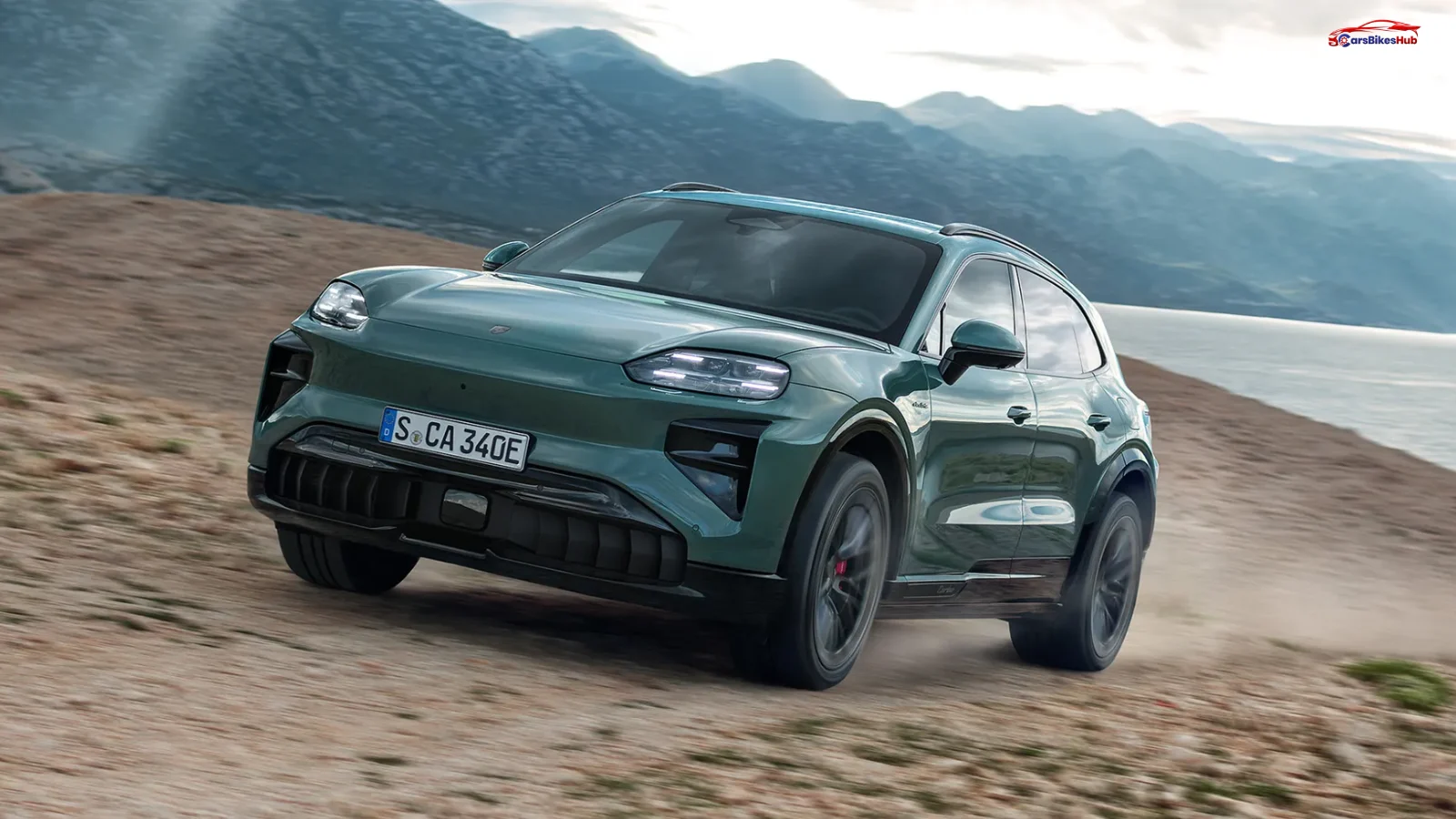
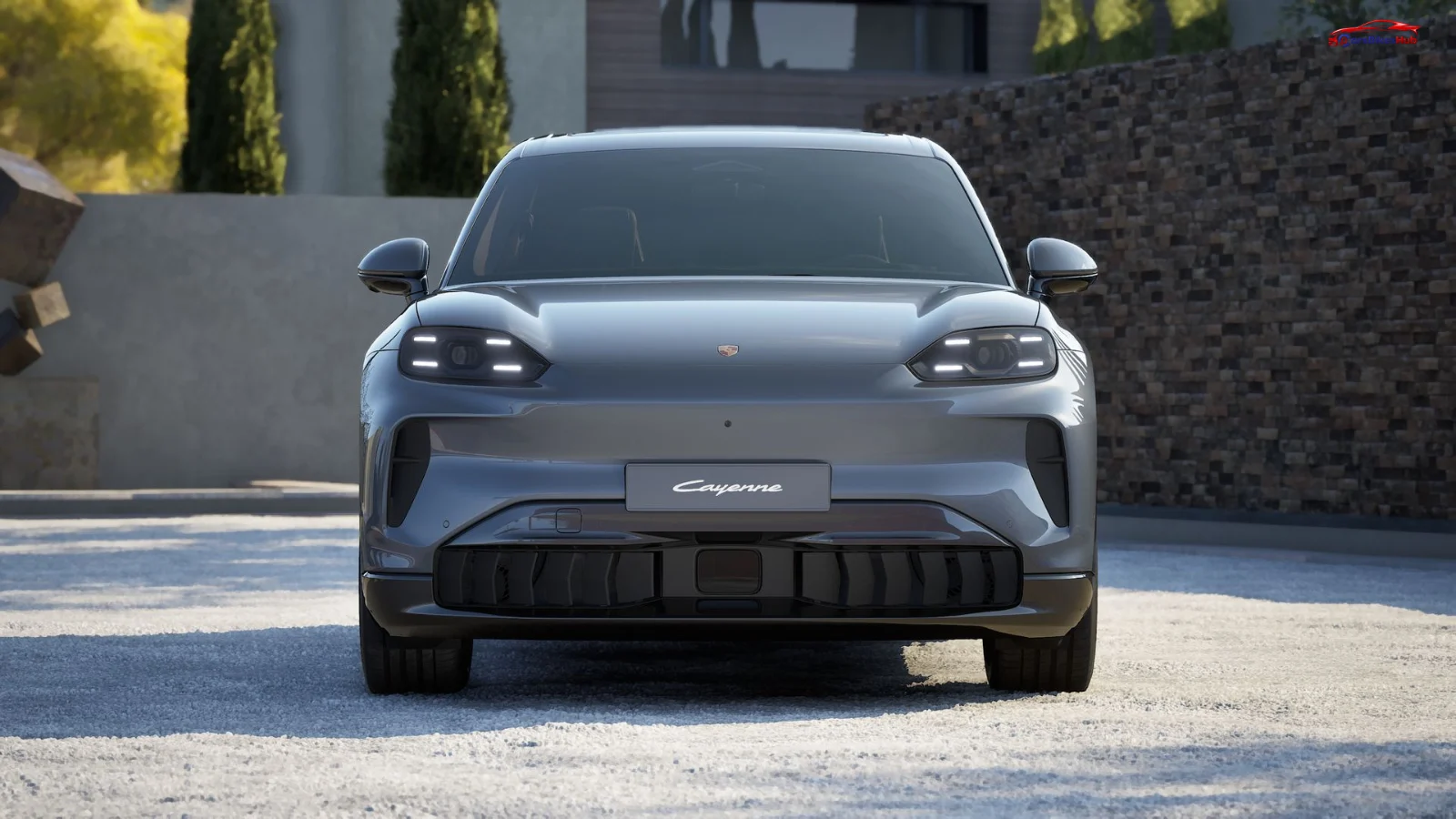
- Front: Slim Matrix LED headlamps sit on a low bonnet, with a wide air dam and vertical intakes in the bumper. Without an engine to cool, the front is smoother.
- Size: The Cayenne Electric is 55 mm longer than the combustion Cayenne, at 4,985 mm. Most of the change is in the wheelbase, now 3,023 mm.
- Wheels: 20-inch aero wheels are standard, and larger wheels, up to 22 inches, are optional.
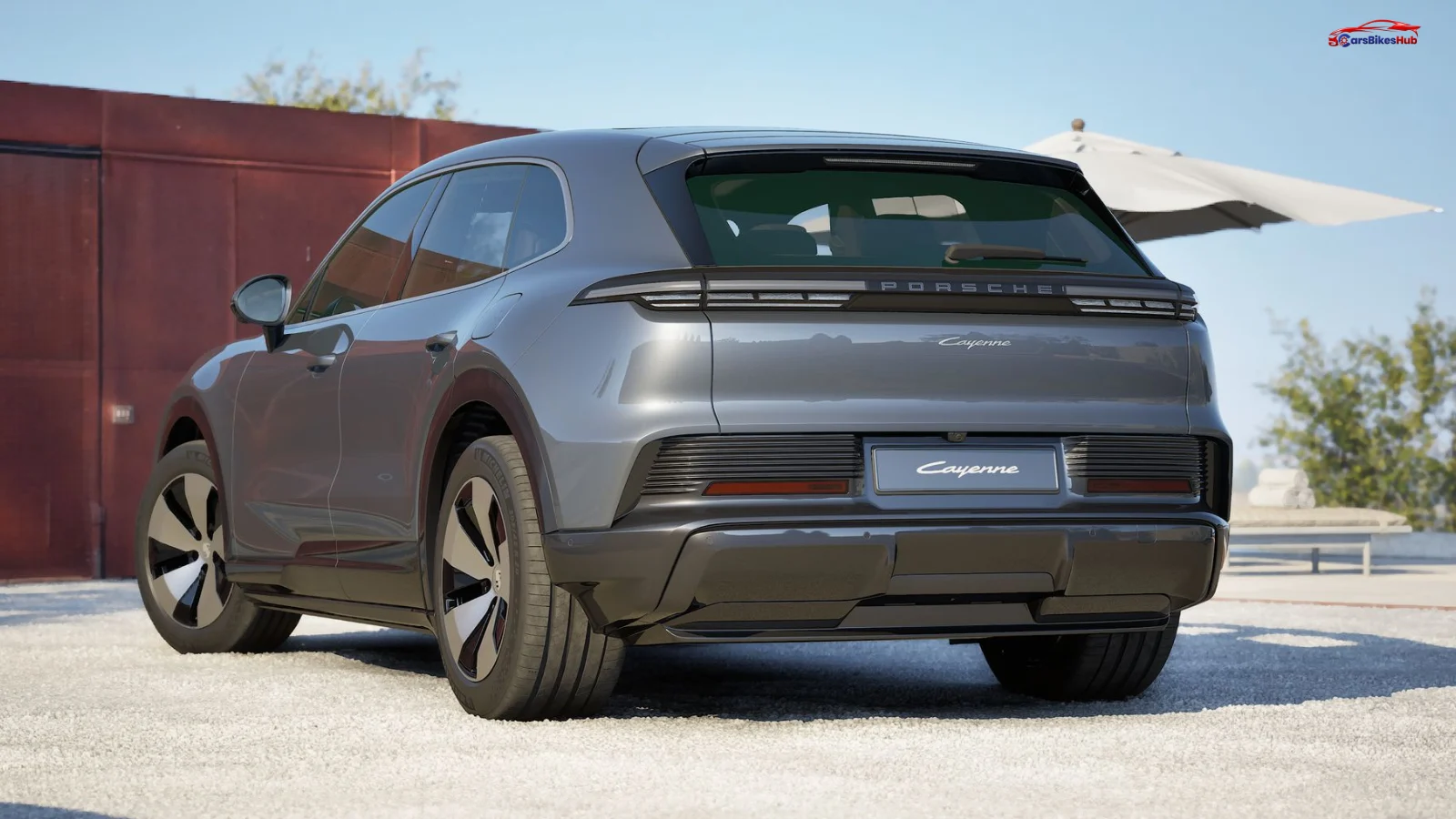
- Rear: A full-width LED light strip with an illuminated Porsche wordmark, a large roof spoiler, and a blacked-out lower section.
- EV details: Frameless, soft-close doors, and an almost fully enclosed underbody and rear diffuser for airflow.
The Turbo is set apart by gloss-black or Turbonite detailing, depending on the finish.
Porsche Cayenne Electric Interior and Features
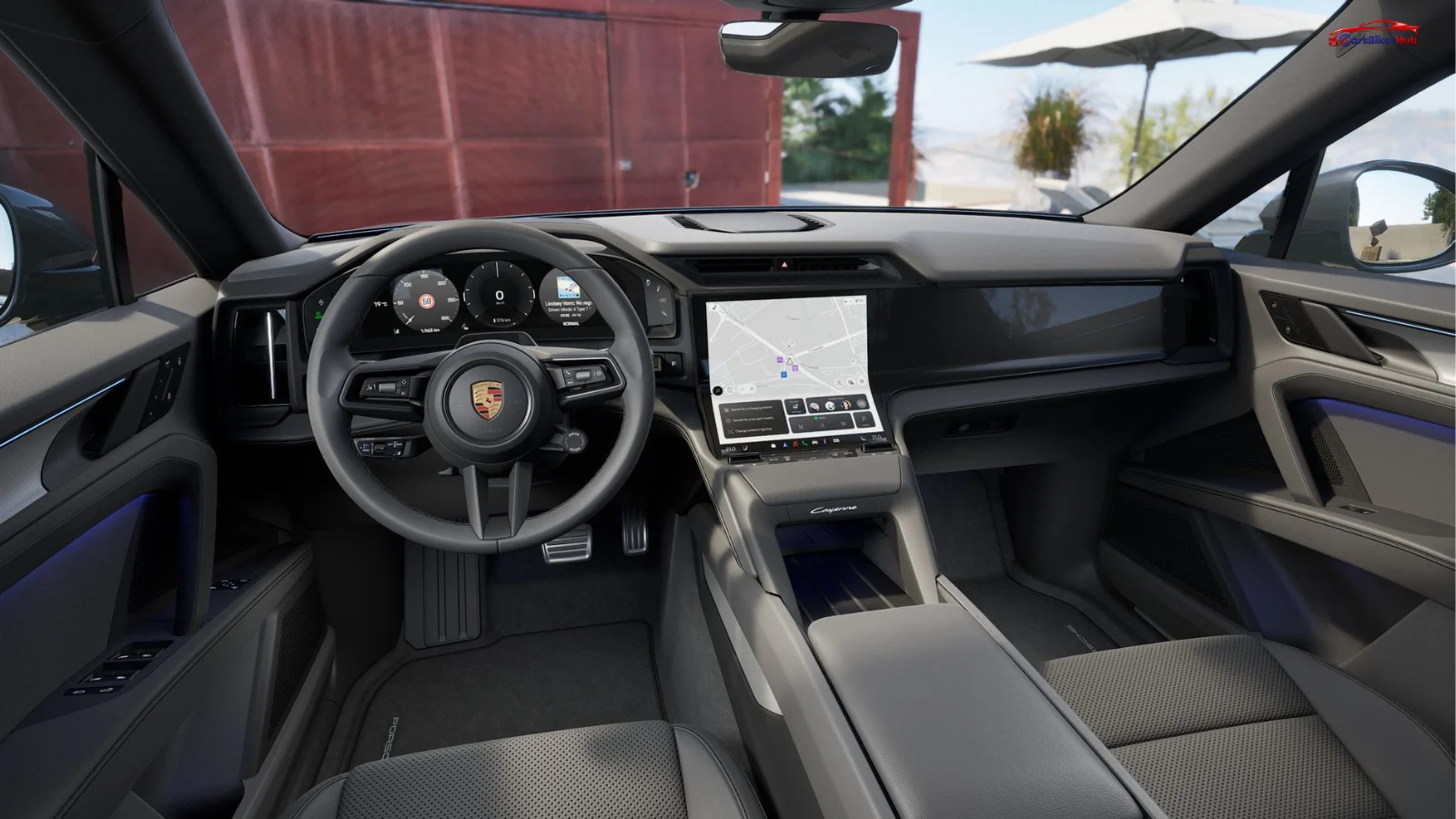
Dashboard and screens:
A 14.5-inch curved OLED touchscreen sits in the centre, and a 14.25-inch OLED driver display sits behind the steering wheel. A 14.9-inch passenger screen and an augmented-reality head-up display are optional. Porsche has kept physical controls for climate and volume. One practical note from international reviews: the air vents are adjusted through the touchscreen.
Standard equipment in India:
- 10-speaker audio system
- 8-way electrically adjustable front seats
- Four-zone climate control and an air-quality system
- Sliding panoramic roof
- Electric rear side sunblinds
- 360-degree camera
- Advanced driver assistance systems (ADAS)
- Powered boot lid
- Wireless phone charging pad
Optional equipment:
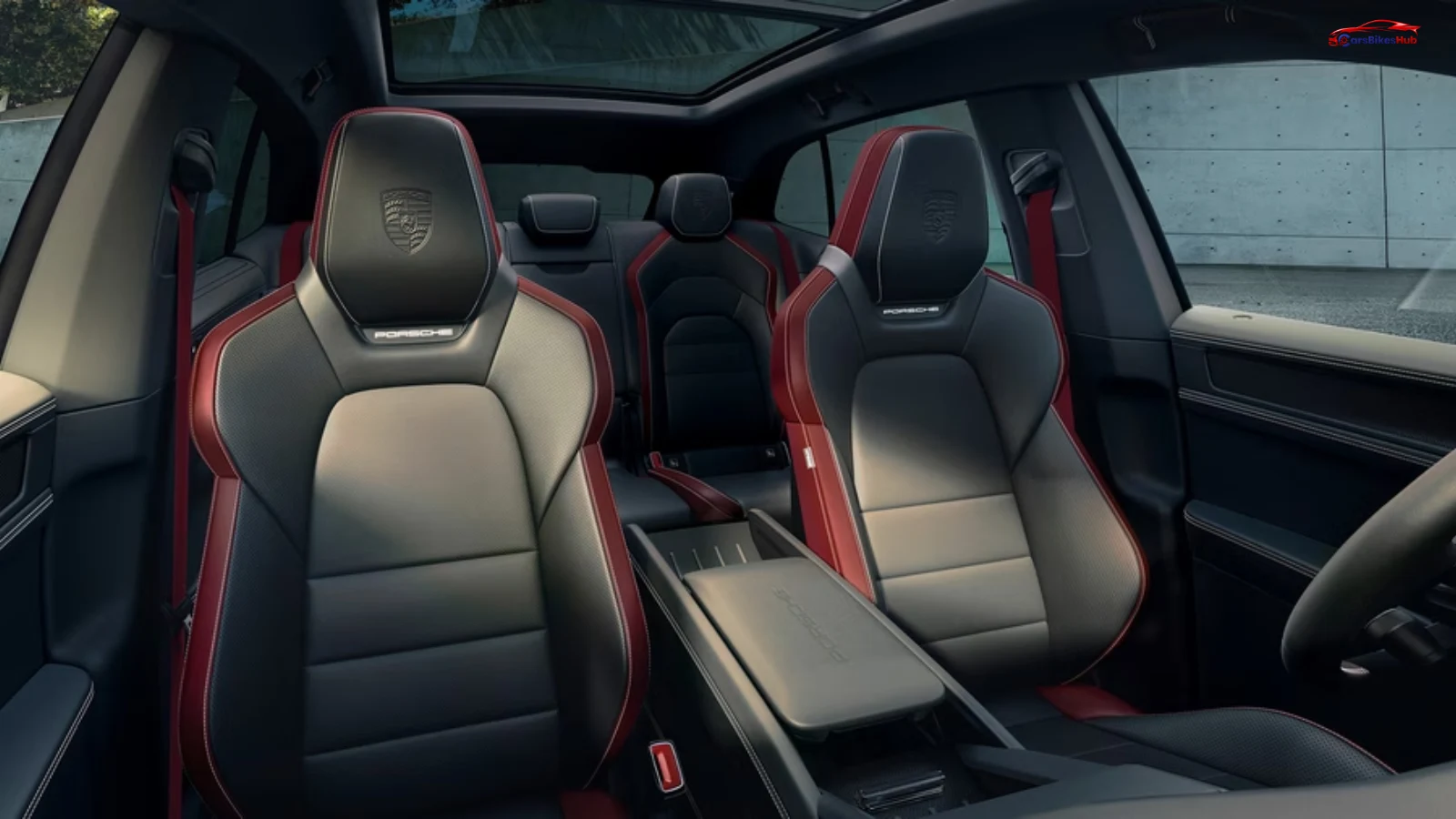
- 14-way seats with a memory package (₹1,80,900) and 18-way adaptive sport seats (₹2,36,300)
- Seat heating, front and rear (₹68,400), surface heating (₹1,35,900) and front seat ventilation (₹1,54,100)
- Race-Tex (leather-free) and Club Leather upholstery
- 14.9-inch passenger display and AR head-up display
- Rear-axle steering
- 21-inch and 22-inch wheels
- Wireless inductive charging at up to 11 kW (listed as optional in launch coverage; we could not confirm how it is offered in India)
Practicality: Boot Space, Seating and Dimensions
- Seating: Five seats.
- Boot: Confirmed: 781 litres up to the top of the rear seats, expanding to 1,588 litres with the seats folded, plus a 90-litre front boot (frunk).
- Dimensions: 4,985 mm long, 1,980 mm wide, 1,674 mm tall, with a 3,023 mm wheelbase. The wheelbase is almost 13 cm longer than the combustion Cayenne, which Porsche says brings more rear legroom.
- Rear seats: Porsche says the rear seat system is electrically adjustable as standard globally.
- Towing: Up to 3.5 tonnes, equipment-dependent, per Porsche’s global figures. India homologation has not been confirmed.
- Ground clearance: Not published for India in the material we reviewed. For the US-market car, Autoblog reports 175 mm in the lowest air-suspension setting, about 190 mm normal, about 210 mm in off-road mode, and about 245 mm at the highest setting (converted from inches). Autocar India’s comparison lists 190 mm for the Cayenne Electric.
A large luxury EV is not automatically practical. The battery sits in the floor, so the car is low and wide. Indian owners will want to use the higher suspension setting over speed breakers and rough patches, and a 1,980 mm width needs care in older parking spaces. Porsche’s Off-Road package, listed on the India configurator for the Turbo, changes the front geometry for better approach angles if you expect rough roads.
Porsche Cayenne Electric vs Regular Cayenne
| Factor | Cayenne Electric | Petrol/hybrid Cayenne |
| Powertrain | Dual-motor AWD, 113 kWh battery, 800 V | Petrol V6 or V8, or plug-in hybrid (petrol plus electric motor) |
| Fuel/energy | Electricity only (AC or CCS2 DC) | Petrol; plug-in hybrids can also use electricity |
| Range/refuelling | Up to 642 km WLTP (claimed), dependent on charging access | Refuel at any petrol pump |
| Performance | 442 PS with Launch Control (standard); 1,156 PS (Turbo) | Base 3.0-litre V6 petrol is listed at about 348 bhp (Reported, CarWale); GTS and hybrid versions sit higher |
| Charging/refuelling time | 10–80% in under 16 min at best; hours on AC at home | A few minutes at a pump |
| Driving character (Analysis) | Silent, instant torque, low centre of gravity, heavier | Engine sound and gear shifts, a more familiar rhythm |
| Long-distance practicality (Analysis) | Depends on high-power chargers on your route | Easy on any highway |
| Price (ex-showroom) | ₹1.77 crore / ₹2.28 crore | Petrol Cayenne from about ₹1.51 crore (Reported); hybrid, GTS, and Coupé versions cost more. |
On the starting prices, the Cayenne Electric costs about ₹26 lakh more than the base petrol Cayenne, while offering more power on paper (442 PS is about 436 bhp, against about 348 bhp). We could not find one consistent, current India price list for the hybrid Cayennes, so verify those with Porsche India before comparing.
The trade-off is simple. The electric car adds power, quietness, and strong charging hardware, but its usefulness depends on your charging access. The petrol or hybrid car keeps the ease of refuelling. Neither is the better car for everyone.
Porsche Cayenne Electric vs Other Luxury EVs
The comparison is meant to provide price and specification context. Rival prices can vary by variant and change over time, so check the latest manufacturer-listed figures for the most accurate comparison.
- BMW iX xDrive50: about ₹1.40 crore ex-showroom. Battery listed at 105.2 kWh (Autocar India) or 111.5 kWh (other listings), claimed range of 575 km to 635 km depending on the test cycle quoted, about 516 bhp, and DC charging of up to about 195 kW.
- Mercedes-Benz EQS SUV 580 4MATIC: about ₹1.48 crore ex-showroom. A 122 kWh battery, a claimed 809 km on the ARAI cycle, about 536 bhp, and DC charging of up to about 200 kW.
The Cayenne Electric’s ₹1.77 crore starting price is roughly ₹29 to ₹38 lakh higher than these two. Remember that the BMW and Mercedes prices are for single, well-equipped trims, while the Porsche price excludes options. Range figures also use different test cycles (WLTP for the Porsche, ARAI for some rivals), so they should not be compared directly. The Porsche’s most obvious difference on paper is its 390 kW charging capability and, in the Turbo, its power output.
Charging the Porsche Cayenne Electric in India
- Home AC charging. The car accepts up to 11 kW on AC. That needs a three-phase supply and a wallbox. Many Indian homes have single-phase supply, which typically limits home charging to about 7 kW, so check with an electrician before buying. At 11 kW, a charge from empty takes roughly 10 to 11 hours; at about 7.4 kW, roughly 16 to 17 hours. A regular 15-amp socket would take well over a day and a half.
- Apartment owners. A dedicated parking spot with a charger point approved by the society is the practical requirement. Without it, the Cayenne Electric relies on public charging, which is not a comfortable daily plan for a 113 kWh battery.
- Public DC charging. A charger’s output is shared with the car’s acceptance rate. Many high-speed public chargers on Indian highways are rated below the Cayenne Electric’s maximum. On a 150 kW charger, for example, a 10 to 80 per cent charge would take roughly 32 minutes at the very best.
- Highway charging. Some operators have installed 360 kW chargers in major cities, and a few networks are reported to be adding even higher outputs. We could not verify a public Indian charger that meets Porsche’s full test condition of above 390 kW, 850 V, and 520 A, so the 16-minute figure should be treated as a ceiling.
- Why speeds vary. Charging power depends on the charger’s output and cooling, the battery temperature, the charge level, and how many cars share the unit. A battery that is too cold or too full will charge more slowly.
Who Is the Porsche Cayenne Electric For?
The Cayenne Electric could make sense for buyers who:
- want a large luxury SUV with an electric powertrain
- have reliable home charging, ideally on a three-phase supply
- drive mostly in cities and on familiar routes
- want strong performance without a combustion engine
- are comfortable planning longer trips around charging stops
The petrol or hybrid Cayenne may remain relevant for buyers who:
- often take long highway trips
- have limited access to high-speed charging
- prefer refuelling in a few minutes
- like the character of a combustion or hybrid powertrain
The standard Cayenne Electric and the Turbo Electric serve different priorities. The standard car has plenty of performance; the Turbo is for buyers who specifically want the extra output and chassis hardware.
Final Verdict
The significant thing about this launch is not a single number. The Porsche Cayenne Electric arrives in India with very high performance, a starting price above ₹1.77 crore, and charging hardware ahead of most of the country’s public network. At the same time, Porsche is keeping petrol and hybrid Cayennes on sale, so buyers get a choice rather than a push. For an Indian buyer, the more practical question is where and how often the car can be charged, rather than how often its 1,156 PS will be used. That is worth settling, along with the final options bill, before deciding.


FAQs
What is the Porsche Cayenne Electric price in India?
The Cayenne Electric starts at ₹1,77,27,000 and the Cayenne Turbo Electric at ₹2,27,51,000, both ex-showroom and before options, per Porsche India's configurator.
What is the range of the Porsche Cayenne Electric?
Porsche claims up to 642 km (WLTP) for the Cayenne Electric and up to 623 km for the Turbo Electric. Real-world range will vary with wheels, options, driving style, weather and traffic.
How long does the Porsche Cayenne Electric take to charge?
Porsche claims 10 to 80 per cent in under 16 minutes at up to 390 kW, but only on a charger meeting specific conditions (above 390 kW, 850 V and 520 A, with the battery at about 15°C). On many Indian public chargers, expect longer. On 11 kW AC at home, a full charge takes roughly 10 to 11 hours (estimated).
What is the power of the Porsche Cayenne Electric?
The Cayenne Electric makes 300 kW (408 PS) in normal driving and 325 kW (442 PS) with Launch Control. The Turbo Electric makes 630 kW (857 PS) in normal driving and up to 850 kW (1,156 PS) with Launch Control.
What is the Porsche Cayenne Turbo Electric 0–100 km/h time?
Porsche claims 2.5 seconds with Launch Control. The standard Cayenne Electric claims 4.8 seconds, also with Launch Control.