



















The numbers that came out this June 1st deserve a moment of pause. India’s electric car sales in 2026 didn’t just grow, they exploded. And the two names sitting at the top of that surge? Tata Motors and Mahindra & Mahindra. And when it comes to Tata and Mahindra EV Sales, both brands have hit record highs as petrol, diesel, and CNG prices continue to climb. Indian car buyers are doing the math, and the math is pointing squarely toward EVs.
The performance of Tata Motors in electric vehicles was phenomenal. The automaker saw record passenger vehicle wholesale sales of 631,387 units in FY2026, which was a 14% growth year-over-year and was the first instance ever where Tata saw over 600,000 passenger vehicle wholesales in a single fiscal year. Regarding electric cars, Tata had record EV deliveries of 92,120 units in FY2026, being the first-ever Indian manufacturer to cross the 300,000 cumulative EV delivery mark since FY2021. That is a number worth repeating: 3 lakh EVs from a single Indian brand.
And the success story of Mahindra in terms of electric car sales in India in 2026 is no less interesting. Thus, the Indian company has sold as many as 42,780 electric SUVs during FY2026, which is 408% more compared to the preceding financial year. In addition, its market share has tripled to reach 21%. According to the data for May 2026, total automobile sales by the M&M amounted to 99,636 units, which is 20% higher year-to-year, with passenger vehicle sales growing 11% to 58,021 units.
What’s Fuelling the EV Rush?
The honest answer is: fuel itself. Fuel costs have been increasing quite fast in 2026, and this is due to some of the geopolitical reasons that exist in West Asia and also because of the supply chain around the world. Rising tension between Iran, Israel, and the US has caused panic in the global energy market, making Indians who belong to the middle class take recourse to electric vehicles because of energy inflation.
Tata Motors’ own MD, Shailesh Chandra, articulated it best: “If there is a ₹10 increase in petrol price, typically people would be filling 100 litres a month, that would mean a ₹1,000 increase in expenses. And that definitely disturbs the dynamics for an entry buyer.” Tata and Mahindra EV sales are directly benefiting from this fuel-driven shift in buyer sentiment.
Tata and Mahindra EV Sales: How They Stack Up
Here’s a quick look at how the two EV market leaders in India compare in the current cycle:
| Parameter | Tata Motors | Mahindra & Mahindra |
| FY2026 EV Sales | 92,120 units | 42,780 units |
| EV Market Share (FY2026) | 40% | 21% |
| April 2026 EV Sales | 8,506 units | 5,394 units |
| YoY Growth (April 2026) | +77% | +63% |
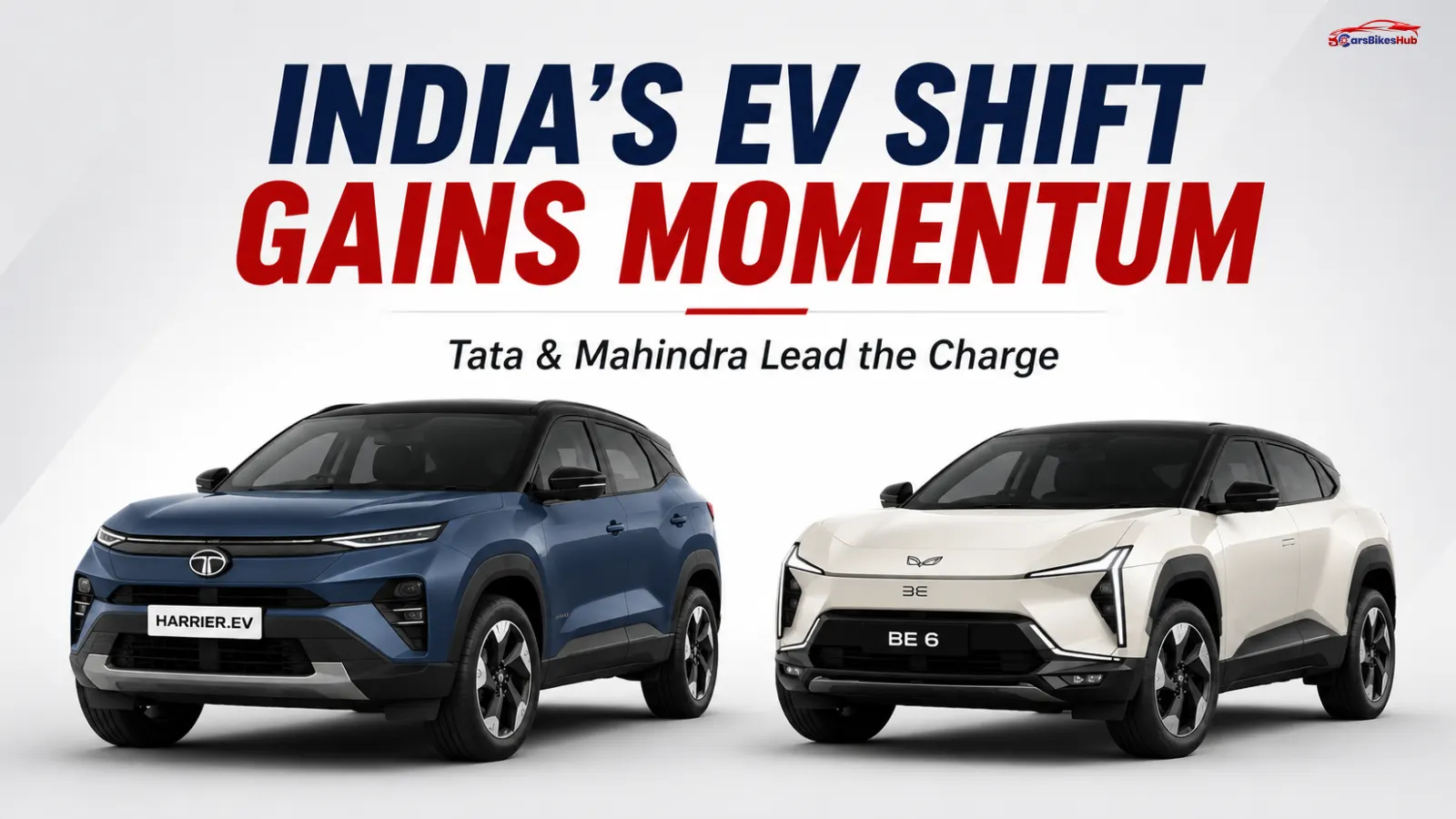
| Key EV Models | Nexon EV, Punch EV, Harrier EV | BE 6, XEV 9e, XEV 9S |
| ICE Price Hike (2026) | Yes (0.5%, EVs exempt) | No announcement |
| EV Cumulative Milestone | 3,04,156 units | Rapidly scaling |
The table makes one thing clear: while Tata Motors EV sales lead in volume, Mahindra is growing faster in percentage terms. In March 2026, Mahindra outsold JSW MG Motor in a single month for the first time, signalling it has firmly arrived as a #2 force in electric car sales in India 2026.
The Models Doing the Heavy Lifting
For Tata, it’s a portfolio play. The Harrier EV has helped revive demand, while the Nexon EV, Tiago EV, and Punch EV continue to attract a steady stream of buyers across price points. The Tata Motors EV sales engine runs on breadth; there’s an EV for the ₹10 lakh buyer and one for the ₹25 lakh buyer, and that range matters in a market as diverse as India’s.
Mahindra, on the other hand, is playing premium and playing it well. The BE 6 and XEV 9e, launched in early 2025, along with the XEV 9S, Mahindra’s first three-row born-electric SUV, launched in November 2025, gave the company significant firepower in the electric SUV space. These aren’t budget buys. They’re aspirational products, and they’re selling.
The Bigger Picture for the EV Market in India
The progress being made by India’s EV market is even more remarkable than it meets the eye. Tata and Mahindra EV sales together account for around 60% of India’s total electric passenger vehicle market, a testament to homegrown dominance. The total number of EVs, in addition to CNG and hybrid cars, reached 13.58 lakh units during FY2026, accounting for roughly 30% of total passenger vehicles sold in India. EV sales alone stood at around 1,99,923 units in FY2026, registering a YoY growth of 83.6%.
What’s also notable is Tata’s pricing strategy. When Tata hiked prices of its petrol, diesel, and CNG models by 0.5% from April 1, 2026, it deliberately exempted its EV lineup, a quiet but powerful signal to fence-sitters about which direction to lean.
Globally, the IEA projects electric car sales will reach 23 million units in 2026. India is contributing to that wave, with domestic manufacturers Tata and Mahindra EV sales together accounting for around 60% of India’s electric car sales. That homegrown dominance is a point of national pride, but it’s also a business reality; these two brands understand the Indian buyer better than any foreign entrant.
What Comes Next?
The second half of 2026 will be fiercely competitive. Maruti Suzuki’s expanded EV portfolio is expected to reshape the affordable end of the EV market, while Mahindra’s Born Electric range is likely to see additional variants. Tata will need to keep pushing; its market share has dipped from 53% in FY2025 to 40% in FY2026 as competition intensifies.
But here’s the thing: the rising tide of electric car sales in India in 2026 is lifting all boats. The fuel price environment is not going away. Geopolitical tensions remain unresolved. And Indian buyers, once they experience the running cost difference between an EV and a petrol or diesel car, rarely look back. For Tata and Mahindra, rising fuel prices aren’t a crisis; they’re a tailwind.
FAQs
Which company leads electric car sales in India in 2026?
Tata Motors dominates the market with 40% share in FY2026 after selling more than 92,000 units. Mahindra holds the second position with 21% market share.
How has the petrol and diesel price hike affected car sales in India?
Due to the increase in petrol and diesel prices, more and more people have started buying electric and CNG vehicles due to the lower costs associated with fuel.
What are the best-selling electric cars from Tata Motors in 2026?
Tata Motors' Nexon EV, Punch EV, Tiago EV, and Harrier EV are its best-selling electric cars.
What electric SUVs does Mahindra sell in India in 2026?
Mahindra has an electric SUV range that comprises the BE 6, XEV 9e, XEV 9S (3-row), and the older XUV400.
Is India's EV market growing fast enough to challenge petrol car dominance?
Yes, EVs, CNG, and hybrids combined accounted for 30% of the PVs market in FY2026, up dramatically from less than 10% only three years back.