




















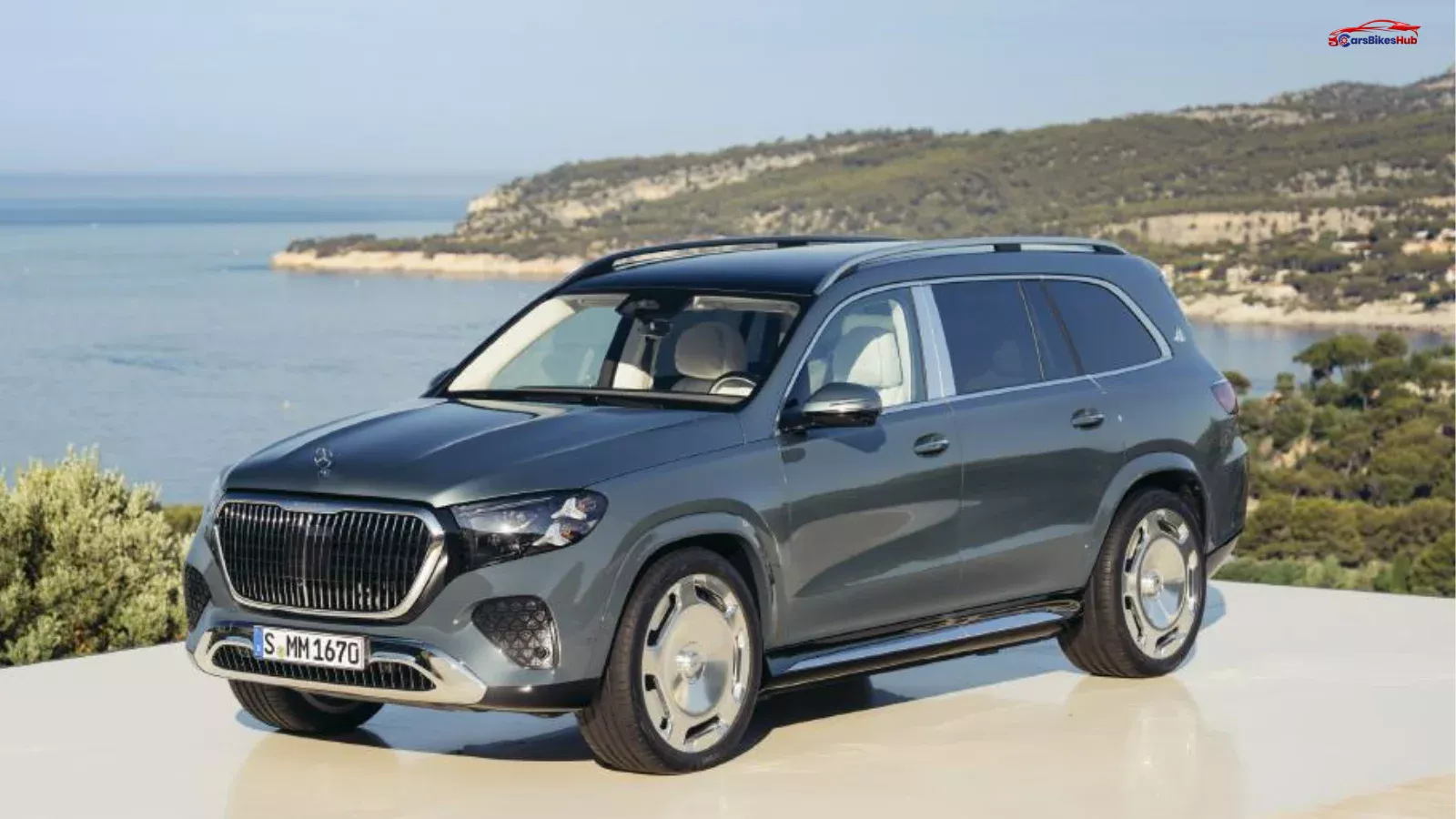
Mercedes-Benz has just pulled the wraps off the facelifted Maybach GLS, and it’s arrived wearing a new badge: GLS 680, replacing the outgoing GLS 600. That name change isn’t just marketing.
Under the bonnet sits a reworked V8 with a genuinely meaningful power bump, and inside there’s a new trio of digital screens replacing the old dial-and-toggle layout that Maybach loyalists had grown fond of. Add two new paint options, reworked lighting, an even quieter cabin, and a suspension system that now leans on cloud data from other Mercedes cars to smooth out the road ahead, and you have a fairly substantial mid-life refresh dressed up as a “facelift.”
Ultra-luxury SUV buyers in India and globally have been circling this segment for a while now, cross-shopping the Maybach GLS against the Bentley Bentayga, the Range Rover SV, and, for those with even deeper pockets, the Rolls-Royce Cullinan. A refresh at this level, with a genuine power increase and a full tech overhaul, resets the conversation for anyone currently comparing these four.
Here’s everything you need to know before considering the 2026 Mercedes-Maybach GLS 680.
Why Is the 2026 Mercedes-Maybach GLS 680 Trending?
Three things are driving the buzz. First, this is the car’s second real update since it launched in 2019; Mercedes gave it a facelift for 2023, and this 2026 refresh is a noticeably bigger step than that one was. Second, the reveal lands in an SUV-dominated luxury market with strong competitors like the Rolls-Royce Cullinan, Bentley Bentayga, and Range Rover SV all fighting for the same buyer, so any meaningful update to the Maybach GLS immediately becomes a talking point in that circle. Third, the name change to GLS 680 signals Mercedes wants this car taken more seriously as a performance flagship, not just a plush people-mover.
For buyers, this matters because it resets depreciation curves, used-car values on the outgoing GLS 600, and, most importantly, the yardstick every rival gets measured against for the next few years.
Why This Update Matters for Indian Buyers
For the Indian market specifically, this refresh lands at a particularly relevant moment. Mercedes-Benz India already builds the outgoing Maybach GLS locally, and that local-assembly setup is what brought the car’s price down meaningfully and shortened waiting periods, a strong signal that the GLS 680 will follow the same route rather than arriving as a low-volume, fully imported model.
Local assembly also has a direct impact on resale. Because Mercedes-Benz India can supply the car more consistently than it could as a full import, ownership costs and second-hand values tend to be more predictable, an important consideration at this price point, where depreciation in absolute rupee terms is steep regardless of the car.
There’s also the buyer profile to consider. Most Maybach GLS buyers in India are likely to use the SUV with a chauffeur rather than driving it themselves, which is exactly the audience this update is built for: a quieter cabin, better rear massage, and a predictive suspension that should smooth out India’s inconsistent road surfaces more effectively than before.
Finally, competition in this segment has intensified. With the Range Rover SV building genuine momentum among Indian buyers and the Bentley Bentayga continuing to sell in respectable numbers, Mercedes-Benz needed the GLS 680 to feel meaningfully newer than a cosmetic refresh, and on the strength of the reveal, it does.
Expected Price in India
Mercedes-Benz India currently builds the outgoing Maybach GLS locally, which is part of why prices dropped sharply from the fully imported figure. The India-made Maybach GLS launched at Rs 2.75 crore, a significant drop from the fully imported model’s Rs 3.17 crore, with a top-spec Celebration Edition variant going up to Rs 4.10 crore.
Given that the 2026 GLS 680 brings a more powerful engine, the new Hyperscreen setup, and expanded MANUFAKTUR options, Mercedes-Benz India is expected to position it above the current range rather than at parity.
| Variant (Expected) | Expected Ex-Showroom Price | Expected On-Road Price (Delhi) |
| GLS 680 4MATIC (base) | Rs 2.95 – 3.10 crore | Rs 3.35 – 3.55 crore |
| GLS 680 Night Series / Special Edition | Rs 3.30 – 3.50 crore | Rs 3.75 – 4.00 crore |
| GLS 680 Celebration/MANUFAKTUR-heavy trim | Rs 4.20 crore+ | Rs 4.75 crore+ |
These figures are estimates based on the outgoing model’s pricing structure and typical increases Mercedes-Benz India has applied on comparable facelifts; official confirmation will only come closer to the India launch.
For context, in the US, the outgoing model started at $180,000, and the newer GLS 680 is expected to land closer to the $200,000 mark, which reinforces the idea that Indian pricing will climb meaningfully over the current Rs 2.75 crore starting point.
Should You Buy the Outgoing GLS 600 or Wait for the GLS 680?
This is the practical question for anyone shopping today rather than researching for later. The outgoing GLS 600 is already on Indian roads, locally assembled, and available at a known, negotiable price, none of which is true yet for the GLS 680. But the GLS 680 brings a meaningfully stronger engine and a more modern cabin, which matters if you plan to keep the car for the better part of a decade, as most Maybach buyers do.
| Factor | Outgoing GLS 600 | New GLS 680 |
| Availability | In showrooms now | India launch timing not yet confirmed |
| Price | Known: Rs 2.75 – 4.10 crore (ex-showroom) | Estimated, likely higher |
| Engine | 557hp / 770Nm | 603hp / 850Nm |
| Interior tech | Dual 12.3-inch screens | Triple-screen Hyperscreen, AI assistant |
| Negotiability | Higher — dealers may offer better terms on outgoing stock | Unlikely, given it’s a new arrival |
| Best for | Buyers who want the car now and value predictable pricing | Buyers willing to wait for the latest tech and more power |
If you need the car in the next few months and the current feature set already covers what you want, the GLS 600 remains a strong, well-sorted choice, and outgoing-model discounts are worth asking your dealer about. If you can wait, the GLS 680’s power and technology gains make a genuine case for holding off.
What’s New in the 2026 Mercedes-Maybach GLS 680?
Exterior: reshaped LED headlamps with dual three-pointed star DRL signatures, a new chrome-laden grille with illumination for both the surround and the Maybach wordmark, and an optionally illuminated bonnet emblem. Powered side steps, redesigned bumpers with chrome inserts, dual chrome exhaust tips, and wraparound taillights with star-shaped internals connected by a black strip round out the changes.
Interior: a Hyperscreen setup with three 12.3-inch displays and a new 3-spoke steering wheel, running on Mercedes’ latest MB.OS software.
Infotainment: the system supports over-the-air updates and an AI assistant integrating ChatGPT, Google Gemini and Microsoft Copilot, alongside a revised dashboard with wider central air vents.
Rear-seat luxury: improved massage functions for the front seats, while rear-seat massage now extends to the footrests, along with new leather upholstery options and colour schemes.
Audio: the Burmester 3D surround sound system has been upgraded from 13 to 15 speakers, paired with a 710W amplifier.
Wheels and colours: fresh 22-inch alloy wheels are now standard, with 23-inch monoblocks available as an option, alongside two new exterior colours, Dark Petrol and Verde Silver Metallic.
MANUFAKTUR: an extended MANUFAKTUR portfolio now includes exclusive full-leather packages, including a hand-stitched headliner crafted in Sindelfingen from up to 20 precisely cut leather sections, reportedly the most requested MANUFAKTUR refinement among Maybach buyers globally in 2026. The optional 23-inch forged wheels even feature a self-levelling Mercedes-Benz star that stays upright as the wheel spins.
Suspension and steering: Mercedes has tweaked the steering system for improved feedback and agility, and the standard air suspension now uses cloud-based predictive dampers that draw on road data from other connected Mercedes vehicles to adjust ride and handling automatically.
Specifications at a Glance
| Spec | Detail |
| Engine | 4.0-litre twin-turbo V8 (M177 Evo) |
| Power | 603hp (petrol) |
| Torque | 850Nm |
| Mild-hybrid boost | 23hp additional, temporary |
| Transmission | 9-speed automatic |
| Drivetrain | 4MATIC all-wheel drive |
| Suspension | Air suspension with cloud-based predictive damping |
| Wheels | 22-inch standard, 23-inch optional |
| Seating | 4/5-seat executive layout |
| Sound system | Burmester 3D, 15 speakers, 710W |
Exact figures for top speed, 0-100km/h acceleration, fuel tank capacity and boot space for the India-spec car will be confirmed closer to launch, since Mercedes-Benz India typically finalises local specification after the global reveal.
Engine & Performance
The headline change is under the bonnet. Output jumps to 603hp and 850Nm, an increase of 53hp and 121Nm over the outgoing Maybach GLS, which for a car this size and this focused on comfort is a genuinely large jump rather than a token bump. The engine continues to work with a 48V mild-hybrid system for a brief additional shove under hard acceleration.
What actually matters for buyers isn’t the number on paper; it’s how that power gets delivered. A Maybach isn’t meant to feel fast in the way a performance SUV does; it’s meant to feel effortless, gliding past traffic without any drama reaching the cabin. The extra torque should make overtaking on the highway feel even less strained, while the retuned steering promises sharper responses at low speed for parking and tight manoeuvring, without turning the car into something it was never meant to be.
The bigger story for ride quality is the predictive suspension. By using data gathered from other Mercedes cars on the same stretch of road, the GLS 680 can, in theory, prepare for a pothole or speed breaker before the wheel even reaches it. On India’s inconsistent road surfaces, that’s a feature buyers will notice within the first few kilometres, not a marketing gimmick.
Exterior Design
The changes here are deliberately restrained rather than a ground-up redesign. The grille is larger and more heavily chromed, now with illumination worked into both the surround and the Maybach script, a detail meant to be noticed at a valet stand at night as much as on the road. The headlamps get a new dual-star DRL signature that visually separates the GLS 680 from the standard Mercedes-Benz GLS at a glance, while the rear gets redesigned wraparound tail-lamps joined by a gloss-black strip.
The side profile is where the car shows its age most: it’s largely carried over, meaning the silhouette buyers have seen since 2019 remains fundamentally the same. New wheel designs help disguise this, and the standard fitment moving to 22-inch alloys (with 23-inch monoblocks optional) gives the car slightly more visual presence than before.
Does the redesign actually make it look more premium, though? In person, yes, the added chrome and illumination give the GLS 680 a noticeably stronger road presence at night, which matters for a car that’s as much about being noticed as it is about being comfortable. It also does a better job differentiating itself from the regular Mercedes-Benz GLS than the outgoing Maybach did, since the new grille, headlamp signature, and badging are all Maybach-exclusive rather than shared trim pieces with minor tweaks.
Existing owners are likely to notice the front end changes immediately, but the unchanged profile means the GLS 680 won’t feel like a different car to live with day-to-day, which is arguably the point. Maybach buyers aren’t chasing novelty every few years; they’re paying for a design that ages well and continues to signal status a decade from now, and a restrained update protects that. The tradeoff is that anyone hoping for a genuinely fresh silhouette to justify an upgrade from the outgoing model may come away slightly underwhelmed by the exterior alone, which is why the interior and mechanical changes matter more here than the sheet metal does.
Interior & Comfort
This is where the 2026 update earns its keep. The move to a three-screen Hyperscreen layout modernises the cabin considerably, though it’s a genuine shift in character; the old GLS Maybach leaned on physical switchgear and a more classic instrument cluster, while this one leans into Mercedes’ latest digital-first design language. Buyers who loved the old car’s warmer, more analogue feel may need to spend real time with the new layout before deciding it works for them.
What hasn’t changed is the priority on rear-seat comfort. Improved massage functions, now extending to the rear footrests, sit alongside upgraded leather options and additional sound insulation for what Mercedes claims is an even quieter cabin than before. The 15-speaker Burmester system with its 710W amplifier should make this one of the best-sounding cabins in the segment.
On long highway trips, rear passengers are far more likely to notice the improved massage seats, the extra sound insulation, and the smoother ride from the predictive suspension than they are to notice the extra 53hp under the bonnet. That’s exactly where the Maybach separates itself from even high-end luxury SUVs; the engineering effort visibly goes toward the experience of being driven, not the experience of driving. For a buyer stepping out of a regular S-Class or GLS into their first Maybach, this is usually the moment the price difference starts to make sense: it isn’t really about the badge, it’s about how noticeably calmer the cabin feels after a two-hour airport run or a long weekend drive out of the city.
Features
Beyond the headline items, the GLS 680 continues Maybach’s approach of loading nearly everything as standard rather than gating luxury behind option packs. Expect the driver-assistance suite to carry over Mercedes’ latest ADAS technology, along with the predictive air suspension, wireless charging for rear passengers, dual rear displays, and Mercedes’ 360-degree camera system for parking, a genuinely useful feature given how large this SUV is to place in tight Indian parking spaces.
| Comfort | Technology | Safety |
| Rear massage with footrest extension | Hyperscreen: three 12.3-inch displays | Latest-gen ADAS suite |
| 4-zone climate control | AI assistant (ChatGPT, Gemini, Copilot) | 360-degree camera system |
| Upgraded sound insulation | Over-the-air (OTA) updates via MB.OS | Adaptive cruise control |
| 15-speaker Burmester 3D audio, 710W | Predictive cloud-based air suspension | Lane-keeping assistance |
| Extended MANUFAKTUR leather options | Wireless charging, rear displays | Comprehensive airbag coverage (expected) |
Safety
Mercedes hasn’t detailed a full breakdown of the safety suite for the facelifted car yet, but based on the current GLS Maybach and the broader GLS facelift it’s based on, buyers can expect a comprehensive airbag count, Mercedes’ latest-generation ADAS with adaptive cruise and lane-keeping assistance, and a 360-degree camera setup. Independent crash-test data for the India-spec Maybach GLS has not been published by any global NCAP body to date, which is worth keeping in mind if crash-test transparency matters to your buying decision.
Rivals at a Glance
| SUV | Expected/Starting Price (India) | Engine | Best For |
| Mercedes-Maybach GLS 680 | ~Rs 2.95 crore onwards (expected) | 4.0L twin-turbo V8, 603hp | Chauffeur-driven comfort at a relatively accessible price |
| Bentley Bentayga | ~Rs 4.5 crore onwards | 4.0L twin-turbo V8 / V8 hybrid | Buyers who still want to drive occasionally |
| Range Rover SV | ~Rs 3.5 crore onwards | 4.4L twin-turbo V8 | Luxury with genuine off-road capability |
| Rolls-Royce Cullinan | ~Rs 8 crore onwards | 6.75L twin-turbo V12 | Ultimate prestige and bespoke customisation |
Mercedes-Maybach GLS 680 vs Bentley Bentayga
The Bentayga remains the more driver-focused of the two, with a chassis that rewards being driven rather than just occupied. The Maybach, by contrast, is unapologetically built around the rear seats. On technology, the GLS 680’s new Hyperscreen and AI-assistant integration push it ahead of the Bentayga’s more traditional cabin layout. Pricing in India currently favours the Maybach thanks to local assembly, though the gap will narrow somewhat with this update.
Verdict: choose the Bentayga if you still want to drive occasionally; choose the Maybach if you’re almost always in the back seat.
Mercedes-Maybach GLS 680 vs Rolls-Royce Cullinan
This is the aspirational comparison rather than a genuinely close contest. The Cullinan wins on outright prestige, bespoke customisation, and that indefinable sense of occasion. But the gap in price is enormous, and the Maybach GLS 680’s rear-seat comfort, sound insulation, and features get remarkably close to Cullinan territory for a fraction of the outlay.
Verdict: buy the Cullinan if badge and bespoke craftsmanship are the point; buy the Maybach if you want 85% of that experience without needing Cullinan money.
Mercedes-Maybach GLS 680 vs Range Rover SV
The Range Rover SV is the only one of these three with genuine off-road ability and a lighter, more contemporary design language that some buyers will prefer over the Maybach’s heavier chrome-forward styling. It’s also usually the most accessible price of the three in this comparison. The Maybach counters with a more distinctly “special occasion” presence and a more elaborate rear-seat experience.
Verdict: choose the SV if you want a luxury SUV you might actually take off-road or drive yourself sometimes; choose the Maybach if pure chauffeur-driven luxury is the only priority.
Ownership Experience
Mercedes-Benz India’s service network is well established across major cities, and the shift to local assembly for the Maybach GLS has already improved parts availability and delivery timelines. Maintenance costs remain in line with what’s expected at this price point, high compared to a mainstream luxury car, but not unusual for the ultra-luxury SUV segment.
Fuel economy sits around 10 kmpl on the outgoing model, and the added power on the 680 is unlikely to improve that figure. Resale values for the Maybach GLS have historically held up well given limited supply and strong demand among India’s ultra-wealthy buyers, though depreciation in absolute rupee terms will naturally be steep given the car’s price.
Who Should Buy It?
Ideal buyers: business owners and high-net-worth individuals who are usually chauffeured, value discretion over outright badge flash, and want the most content-rich rear seat in the segment without stepping up to Rolls-Royce pricing.
Not ideal buyers: anyone who wants to drive their SUV themselves regularly, values genuine off-road capability, or is put off by a design that hasn’t fundamentally changed in six years.
Buy it if rear-seat comfort, sound insulation, and effortless power delivery are your top priorities.
Skip it if you want driving engagement or a completely fresh design language, in which case the Range Rover SV or a from-the-ground-up new model might suit you better.
Final Verdict
The 2026 Mercedes-Maybach GLS 680 is a smart, buyer-focused update rather than a reinvention. The extra power, quieter cabin, and genuinely useful predictive suspension address real, everyday concerns for the people who buy this car: comfort, refinement, and effortless usability rather than chasing spec-sheet bragging rights. The new triple-screen interior is the one change that will divide opinion among existing Maybach owners, but for most buyers stepping up from a regular GLS or cross-shopping the Bentayga and Range Rover SV, this remains a compelling case provided the expected price increase doesn’t push it out of reach.
If your priority is being driven rather than driving yourself, the 2026 Mercedes-Maybach GLS 680 continues to set the benchmark for ultra-luxury SUVs. While rivals may offer sharper handling or greater prestige, few combine comfort, technology, and everyday usability as convincingly as the refreshed Maybach.

FAQs
What is the expected price of the 2026 Mercedes-Maybach GLS 680 in India?
Expect a starting ex-showroom price in the Rs 2.95–3.10 crore range, rising past Rs 4 crore for top MANUFAKTUR trims, though Mercedes-Benz India hasn't confirmed official figures yet.
Is the 2026 Mercedes-Maybach GLS 680 a facelift?
Yes, it's the second facelift of the current-generation Maybach GLS, which has been on sale since 2019, though the changes here, including a new name, a stronger engine and a redesigned cabin, go further than a typical mid-cycle update.
What engine does the 2026 GLS 680 use?
A 4.0-litre twin-turbo V8 producing 603hp and 850Nm, paired with a 48V mild-hybrid system.
What is new in the 2026 Mercedes-Maybach GLS 680?
A more powerful V8, a new three-screen Hyperscreen interior, upgraded Burmester audio, predictive cloud-based suspension, new wheels and colours, and an expanded MANUFAKTUR customisation programme.
Will the 2026 Mercedes-Maybach GLS 680 launch in India?
Yes, Mercedes-Benz India is expected to bring it i,n given the strong local demand and existing local-assembly setup for the outgoing GLS.