




















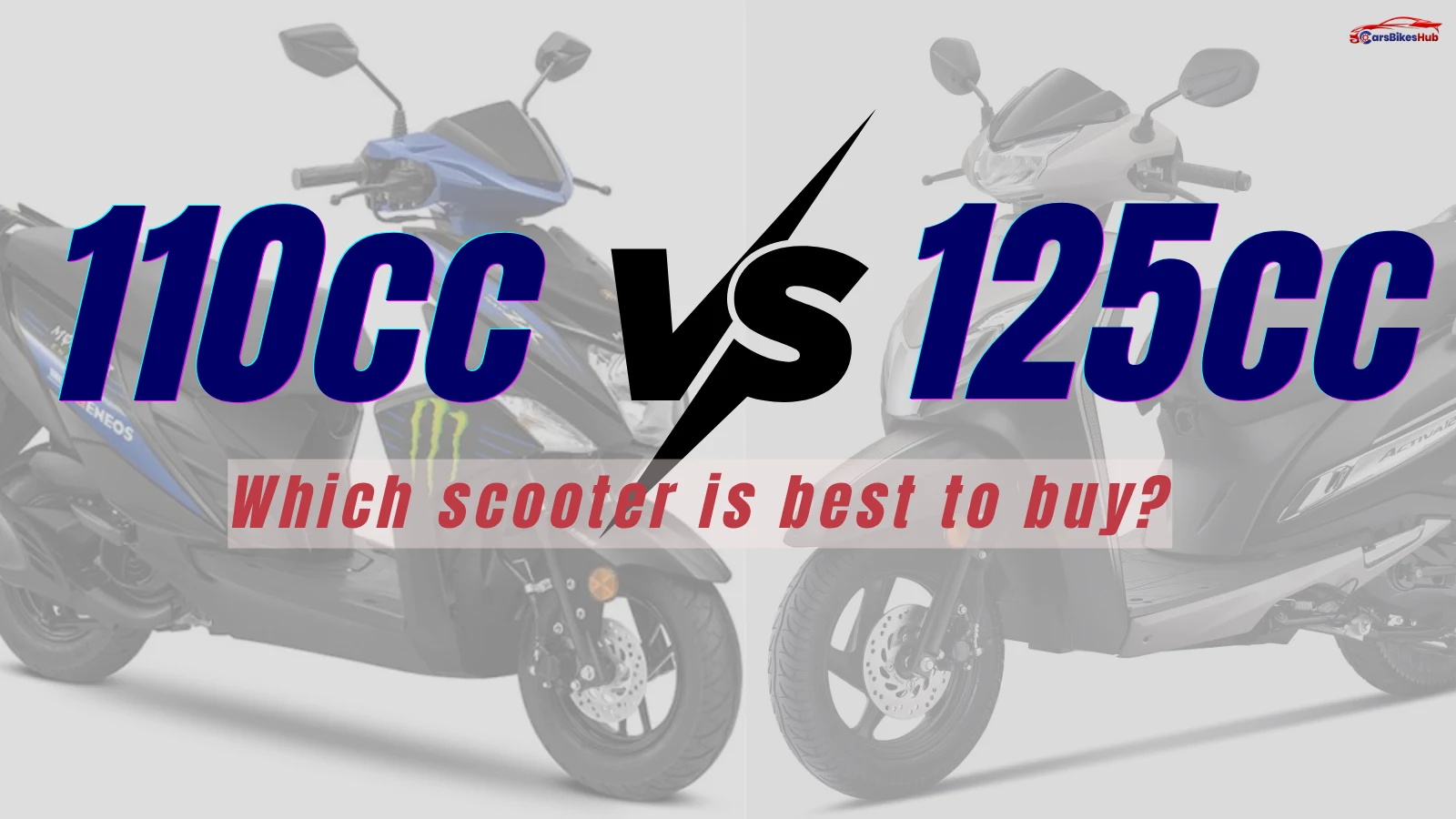
The question of 110cc vs 125cc scooter has been at the centre of almost every scooter buying conversation in India for the last decade. Walk into any Honda or TVS dealership, and the salesperson will almost immediately ask: “Sir, 110 or 125?” Most buyers freeze, not because the choice is complicated, but because nobody has clearly told them what the real-world difference actually is.
This guide breaks down the real differences between both engines so you can walk into that showroom knowing exactly what to buy.
What Does the CC Difference Actually Mean?
Cubic Centimetres or CC represents the displacement of the engine and denotes the sum of volumes of air-fuel mixture displaced per cycle by an engine. The difference in cubic centimetres between a 125cc engine and a 110cc engine is that the latter has a larger combustion chamber and thus produces greater power and torque per cycle.
In practice, the power gap between the two is smaller than most people expect. A Honda Activa 110 produces around 7.88 bhp while the Activa 125 puts out 8.3 bhp, a difference of less than half a bhp. Torque, however, tells a more useful story. The 125cc engine produces roughly 10 Nm of torque compared to about 8.7 Nm in the 110cc version. That extra torque is what you actually feel when you twist the throttle with a pillion on board or tackle a flyover in heavy traffic.
Mileage: The Number Every Indian Buyer Asks First
This is where the 110cc vs 125cc scooter debate gets interesting and slightly counterintuitive.
110cc scooters genuinely return better mileage in city conditions. The Honda Activa 110 delivers a real-world 50-55 kmpl in city traffic. A 125cc scooter like the Activa 125 or Suzuki Access 125 returns around 45-50 kmpl under the same conditions. That is a difference of roughly 5-8 kmpl.
Over a year of daily 30 km commuting, a 110cc rider saves approximately ₹2,500–₹3,500 in fuel costs compared to a 125cc rider. It is not a massive number, but it is real.
However, here is the catch: 125cc scooters are more fuel-efficient at higher speeds. On highways or long stretches where you can cruise at 60-70 km/h, the 125cc engine is working within its sweet spot; it does not have to strain. The 110cc engine, pushed to the same speeds, burns fuel less efficiently. So if your daily ride involves expressways, ring roads, or semi-urban stretches, the mileage advantage of the 110cc shrinks significantly.
Performance in Real Indian Conditions
When comparing the 110cc vs 125cc scooter on performance, the test is not a drag race. The real test is a Monday morning in a city, loaded with a 60 kg rider, a laptop bag, and a fuel tank that is half empty.
Under those conditions, the 125cc engine breathes easier. Overtaking an auto-rickshaw, holding speed on a bridge incline, or accelerating smoothly after a traffic light, the 125cc feels noticeably more relaxed. It does not feel strained, which also means the engine runs cooler and lasts longer under regular hard use.
The 110cc scooter handles city conditions perfectly well for solo riding. The moment you add a pillion or carry extra weight, you start to notice the engine working harder. The top speed of the 125cc scooter is also slightly higher compared to its 110cc cousin, at around 90–95 km/h against 80-85 km/h. Under normal commuting conditions, however, this makes no significant difference, unless you travel on highways occasionally or head out to the periphery during the weekends.
Price and Running Cost Comparison
| Factor | 110cc Scooter | 125cc Scooter |
| Ex-showroom price (approx) | ₹75,000 – ₹90,000 | ₹90,000 – ₹1,10,000 |
| Real-world mileage | 50–55 kmpl | 45–50 kmpl |
| Typical service cost | ₹500 – ₹800 | ₹700 – ₹1,000 |
| Insurance (annual approx) | ₹2,000 – ₹3,000 | ₹2,500 – ₹3,500 |
| Resale value after 3 years | Moderate–Good | Good–Very Good |
The upfront price difference between a 110cc and 125cc scooter is typically ₹8,000 to ₹15,00,0 depending on the brand and variant. Maintenance costs are slightly higher for 125cc models, marginally bigger engine parts and marginally higher service bills. Over three years of ownership, the total cost difference between the two works out to roughly ₹15,000-₹20,000 in favour of the 110cc.
That said, 125cc scooters hold resale value better in the used market. Buyers in the pre-owned segment actively prefer 125cc models because of their perceived performance advantage, which narrows the total ownership cost gap over time.
Who Should Buy a 110cc Scooter?
The 110cc vs 125cc scooter decision is not about which is objectively better; it is about who you are as a rider.
A 110cc scooter makes complete sense if your daily commute is under 20 km through city traffic, you primarily ride solo, fuel savings are a genuine priority, and you are a first-time rider who wants a light, easy-to-handle machine. The Honda Activa 110, Honda Dio, and TVS Scooty Zest 110 are outstanding examples of what this segment does best: reliable, efficient, unfussy urban transport.
I have seen close friends in Tier 2 cities ride 110cc scooters for six-plus years without a single major complaint. The engines are over-engineered for the loads they carry in normal city use, and that means fewer breakdowns and lower maintenance bills.
Who Should Buy a 125cc Scooter?
Choose a 125cc scooter if your daily distance to work is more than 20-25 km, you travel with a pillion or cargo, and you drive on highways, elevated roads, or inclined routes. Moreover, in the case when you need additional features, it is better to choose a 125cc scooter, as all modern 125cc scooters have disc brakes, alloy wheels, and Bluetooth facilities as their standard equipment. You can choose between the Honda Activa 125, Suzuki Access 125, Yamaha Fascino 125, and TVS NTorq 125 to pick the most suitable scooter for you.
It makes sense for those who plan on using their scooters for five years or more to buy the 125cc scooter due to its superior resale value.
The Honest Verdict
While it is impossible to say which of the two 110cc or 125cc scooters is the best, one thing can be said for sure: both models have what it takes to win for most Indian buyers in 2026. If budget is tight and city traffic is your only enemy, the 110cc is perfectly capable. If you ride long distances, carry a pillion regularly, or simply want a more rounded machine that handles India’s mixed road conditions with less effort, the 125cc is worth every extra rupee.
The price premium for a 125cc scooter has dropped significantly in recent years. With the gap between Activa 110 and Activa 125 sitting at under ₹15,000 in some variants, the 125cc option is more accessible than ever before. For most buyers who will keep their scooter for three or more years, the 125cc is the smarter long-term investment.
FAQs
Is the mileage difference between 110cc and 125cc scooters really significant in India?
In city conditions, 110cc scooters return 5-8 kmpl more than 125cc models. Over a year of daily commuting, this translates to roughly ₹2,500-₹3,500 in fuel savings, noticeable but not dramatic.
Which is better for riding with a pillion regularly, 110cc or 125cc?
A 125cc scooter is clearly better for pillion riding. The extra torque makes it significantly less strained on inclines and during overtaking with a second rider on board.
Do 125cc scooters require more maintenance than 110cc ones?
Marginally yes. Service costs are roughly ₹200-₹300 higher per visit for 125cc scooters. Over three years, the total additional maintenance cost is around ₹3,000-₹5,000, not a dealbreaker.
Which holds better resale value, a 110cc or a 125cc scooter?
125cc scooters generally command better resale prices in the used market. Buyers actively seek them out for their performance advantage, which helps 125cc models depreciate more slowly over 3-5 years.
Is a 125cc scooter worth the extra price in India in 2026?
For most buyers riding more than 20 km a day or planning to own the scooter for 4-5 years, yes. The price gap has narrowed considerably, and the 125cc offers better performance, features, and long-term value.