

























If you’ve been following India’s fuel story over the last few years, you already know the country has been quietly building toward something significant. The E20 milestone was one chapter. The showcase of India’s first flex-fuel car by Maruti Suzuki on June 4, 2026, a day before World Environment Day, is unmistakably the next one. And for anyone who watches the Indian auto market closely, this moment feels less like a surprise and more like an arrival that was always coming.
The Maruti Suzuki flex-fuel car is not just another product launch. It marks the first time a mainstream passenger carmaker in India has put a flex-fuel vehicle into commercial production, and the specs are more ambitious than many expected.
What Exactly Is a Flex-Fuel Car?
Before getting into the specifics, let’s first talk about what flex-fuel vehicles do. These cars can use a mix of petrol and ethanol, including E85, which is 85% ethanol and 15% petrol or even pure ethanol, called E100.
Ethanol is a renewable fuel produced primarily from agricultural sources like sugarcane, corn, and other biomass, making it a more environmentally friendly alternative to conventional fossil fuels.
What makes the Maruti Suzuki flex-fuel car stand out, though, is that the India-spec version isn’t just E85-capable. Union Minister Nitin Gadkari confirmed during a May 2026 event in Nagpur that the upcoming model will support E100, meaning it can operate on 100 per cent ethanol. That takes the Maruti Suzuki flex-fuel car beyond blended-fuel territory and into something closer to a pure biofuel vehicle.
The Models: WagonR and Fronx
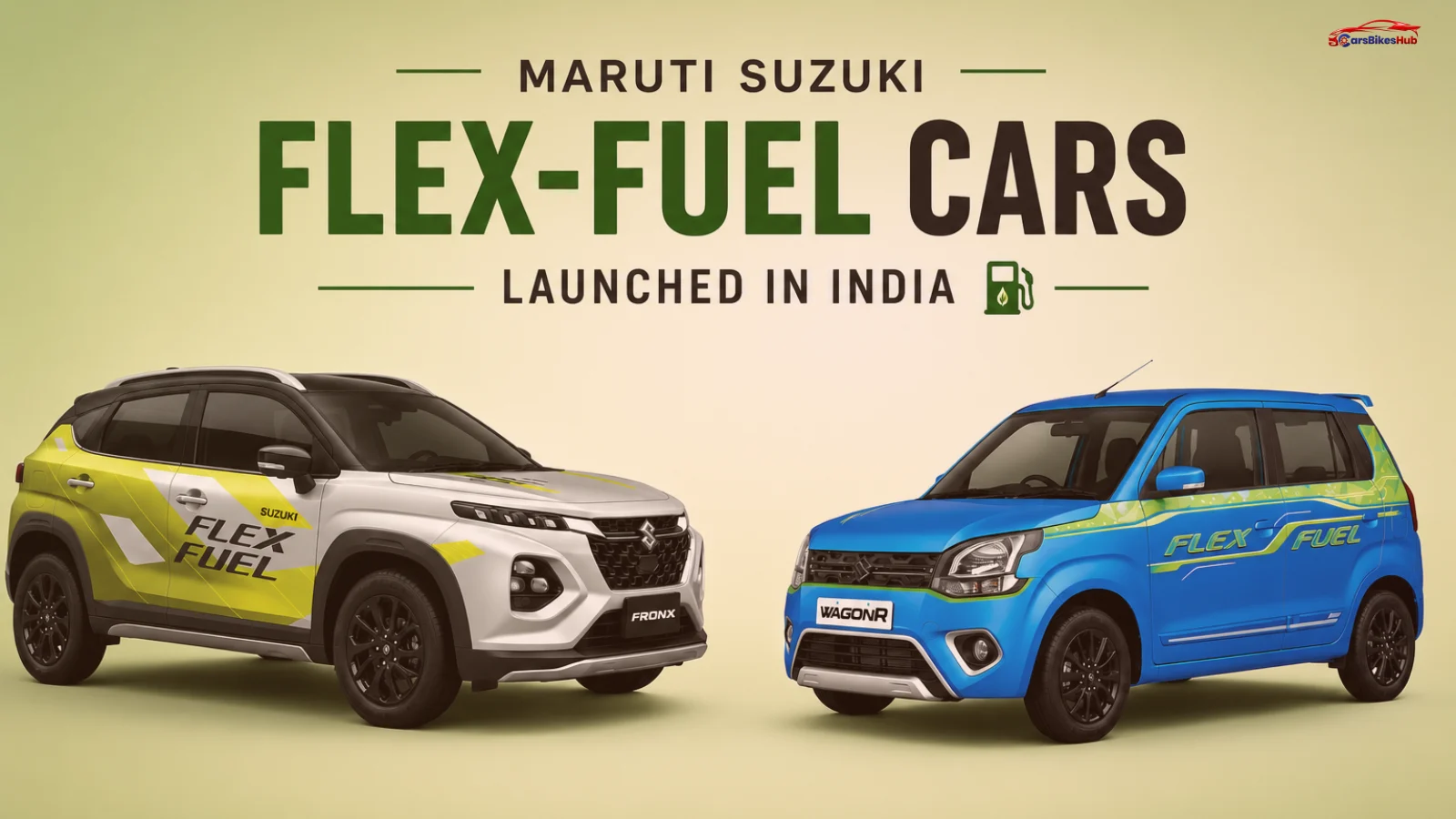
The event at Taj Palace in Delhi saw the production-spec flex-fuel versions of the WagonR and Fronx unveiled, with Union Minister for Road Transport and Highways Nitin Gadkari and Union Minister for Petroleum and Natural Gas Hardeep Singh Puri in attendance.
The WagonR is the stronger candidate for India’s first true flex-fuel vehicle that India can mass-market. It remains one of Maruti Suzuki’s highest-selling hatchbacks, has a wide urban customer base, and a flex-fuel prototype was already showcased at the Bharat Mobility Global Expo in Delhi in February 2024. If launched as anticipated, the WagonR becomes India’s first mass-market car capable of running entirely on ethanol.
The Fronx, on the other hand, brings the Maruti Suzuki flex-fuel car story into compact SUV territory. The Fronx FFV is expected to be powered by the familiar 1.2-litre K12 petrol engine, reworked to support ethanol blends from E20 up to E85, with power output expected to remain around 89 bhp and 113 Nm, similar to the standard petrol version but with calibration changes to handle higher ethanol content. The Fronx flex-fuel prototype had already made its appearance at the 2025 Japan Mobility Show.
The WagonR flex-fuel version will set you back about Rs 8 lakh ex-showroom. This makes it affordable for its usual customers, a key factor in ensuring this isn’t just a niche product for a select few.
What It Takes to Build a Flex-Fuel Car
The Maruti Suzuki flex-fuel car isn’t just a regular petrol car with some software adjustments. It requires a lot more than that. These vehicles need special fuel systems and parts that resist corrosion better. Plus, they’ve got modified ignition systems to handle the high levels of ethanol. See, ethanol, though cleaner, is way more corrosive and burns differently than petrol. That’s why the whole fuel setup, from tank to injector, needs major changes.
To safely handle ethanol’s corrosiveness, cars need upgrades. This includes special materials for fuel lines, injectors, seals, and fuel tanks, plus a recalibrated engine control unit. The ECU manages fuel delivery and ignition timing to match the specific blend.
Maruti has been preparing for this for years. As Rahul Bharti, Senior Executive Officer Corporate Affairs at Maruti Suzuki, stated on a quarterly earnings call: “We have the technology, whether it is for ethanol blending increase or for flex-fuel vehicles. We have the technology, and we’ll support the government whenever the need arises.”
Why Now? India’s Ethanol Story Is the Context
The Maruti Suzuki flex-fuel car doesn’t exist in isolation. It’s a direct response to where India’s energy policy has been heading. India went from just 1.5% ethanol blending in 2014 to 20% by November 2025, achieving the E20 target originally set for 2030, a full five years ahead of schedule. From April 1, 2026, E20 became mandatory nationwide.
The scale of what India has achieved on this front is worth pausing on. The E20 programme led to savings of approximately Rs 1.36 lakh crore in foreign exchange, a reduction of nearly 698 lakh tonnes in CO2 emissions, payments of Rs 1.96 lakh crore to distilleries, and disbursements of Rs 1.18 lakh crore to farmers across the country.
But here’s the thing: India’s 380+ distilleries have been so efficient that the country now produces more ethanol than the current vehicle fleet can handle under E20. The flex-fuel vehicle India is now pushing for is, in part, an answer to that surplus. And the policy direction is clear; the government is already considering higher blends up to E85, with a draft notification reportedly ready.
The Maruti Suzuki flex-fuel car, in this context, isn’t the finish line. It’s the starting point.
The Environmental Case: Real Numbers
This is where the Maruti Suzuki ethanol story gets genuinely interesting from an environmental standpoint. Studies show that using ethanol blends decreases CO2-equivalent emissions, fossil fuel consumption, and particulate matter formation. The effects get better with higher blend levels.
E85 fuel cuts CO2 emissions by about 22% compared to regular gas. Vehicles running on ethanol also produce 30% less carbon monoxide when they’re cars, and up to 50% less if they’re motorcycles. What’s more, hydrocarbons decrease by around 20% with ethanol-blended fuels.
For the lifecycle picture, grain-based ethanol reduces lifecycle emissions by 30-50% compared to petrol, depending on the production method. India’s E20 programme alone has already resulted in a net reduction of approximately 832 lakh metric tonnes of CO2 emissions. Moving to E100 vehicles at scale would multiply that impact substantially.
It’s worth noting that ethanol production does have some trade-offs; sugarcane cultivation increases land and water use, and distilleries using coal-fired heat reduce the environmental gains at the lower end. The honest assessment is that mid-to-high blends offer real environmental benefit, but the full payoff scales with how cleanly India produces its ethanol.
The Running Cost Advantage, And the Honest Caveats
One of the most common questions I see about flex-fuel vehicle India launches is whether they actually save money. The short answer: yes, but with conditions.
According to Adithya Jayakar, Joint Managing Director of auto components manufacturer UCAL Ltd, consumers could realistically expect a reduction of around 25 to 35 per cent in per-kilometre fuel expenses, provided ethanol remains competitively priced against petrol. For daily commuters and commercial users, that’s a meaningful number.
There is, however, an important caveat to understand. Ethanol has lower energy density than petrol, meaning you consume slightly more volume of ethanol to travel the same distance. The cost saving only holds if ethanol is priced low enough per litre to offset that volume difference. Right now, with India’s ethanol pricing policy still being shaped for E85 and E100, that’s a variable buyers should watch.
What is clear is that India imports nearly 88-89% of its crude oil. Every rupee worth of fuel that can be substituted with domestically grown ethanol is a rupee that stays in India’s economy and in farmers’ pockets.
Flex-Fuel vs EV vs CNG: Where Does It Fit?
This is a question worth answering directly because a lot of buyers will be weighing options.
Flex-fuel vs EV: Since the Maruti Suzuki flex-fuel car uses a conventional internal combustion engine with modified fuel systems, it doesn’t require charging infrastructure. You refuel at a pump, just as you always have.
The ownership experience is familiar. EVs offer lower running costs if you charge them at home, but they come with a big price tag of Rs 4 to 8 lakh and issues like range anxiety. Plus, charging spots are still growing outside of big cities. Flex-fuel vehicles provide a smoother transition for those not quite ready for electric cars.
Flex-fuel vs CNG: CNG has been India’s practical “greener” fuel option for a decade. It offers lower running costs than petrol, but the CNG cylinder eats up boot space and pump availability outside metros remains patchy.
Flex-fuel vehicles don’t require a separate tank, work with existing pump infrastructure (once E85/E100 stations expand), and offer comparable environmental credentials. The key difference is that flex-fuel’s fuel network is still being built, whereas CNG’s is more established in urban areas today.
The honest picture is that flex-fuel is unlikely to replace EVs in the long term; India’s EV momentum is real. But as a bridge technology that works with existing engine architecture, existing refuelling habits, and domestically produced fuel, the Maruti Suzuki flex-fuel car occupies a genuinely useful middle ground that EVs and CNG don’t fully cover.
Who Else Is Coming? The Bigger Flex-Fuel Wave
Maruti is first to market, but it won’t be alone for long. As Gadkari mentioned at the June 4 event, 12 companies have flex-fuel vehicles in development, including Mahindra, Tata Motors, and Toyota.
Tata Motors has confirmed its first flex-fuel passenger vehicle, most likely the Punch, could be ready by late 2026 or early 2027. The Punch flex-fuel prototype was showcased at the Bharat Mobility Expo 2025 and was capable of running on blends up to E85. The company’s MD and CEO, Shailesh Chandra, stated clearly: “By the end of this year or early next year, we should be ready with our flex-fuel product, at least one product.”
Mahindra is working on E30-compatible engines as a starting point, with its NU_IQ platform as the backbone for future flex-fuel development. The XUV 3XO is widely expected to be among its first flex-fuel products.
Gadkari also mentioned that his personal Toyota Innova has been running on bioethanol for the past 1.5 years, a detail that underlines how far along the technology already is among those close to the policy.
The Challenges That Still Need Answers
This isn’t a story without complications, and glossing over them wouldn’t be fair to anyone considering the Maruti Suzuki flex-fuel car.
- Fuel availability: E85 and E100 pumps are not yet available widely across India. The current network runs on E20. Building out E85 and E100 dispensing infrastructure at petrol stations requires separate storage tanks, upgraded dispensing systems, and capital investment from oil marketing companies. That will take time.
- Mileage: Ethanol’s lower energy density means you’ll consume more volume per kilometre compared to petrol. Buyers should understand that the per-litre mileage number will be lower, even if the per-kilometre cost works out cheaper when ethanol is priced right.
- Regulatory framework: While a draft notification for E85 fuel standards is reportedly ready, formal regulations for E85 and E100 vehicle testing and compliance are still being finalised. The Maruti Suzuki flex-fuel car is, unusually, entering the market before the fuel is fully available at scale, a bold bet that the supply side will follow.
- Food vs fuel: Critics have raised concerns that large-scale ethanol production from food crops like corn and sugarcane may put pressure on agricultural land and water resources. India is aware of this and is increasingly pushing second-generation ethanol from crop residues and damaged grains to address this tension.
Final Thoughts
The Maruti Suzuki flex-fuel car is a genuine milestone, not because the technology is entirely new to the world, but because of what it represents for India specifically. Maruti’s decision to launch a flex-fuel vehicle India can actually afford, rather than a concept car or a high-end experiment, is what gives this announcement its weight.
I think the most important thing to understand about this launch is the timing. India achieved E20 ahead of schedule. Its distilleries are producing surplus ethanol. Its farmers have become, as Minister Puri described it, “urjadatas” energy providers. And now, for the first time, there’s a production car that can actually use what the country produces at full concentration.
The WagonR has earned its place in millions of Indian households on the back of reliability and value. If that reputation now extends to a car that can run on domestically produced, farmer-grown fuel, this story is only just beginning.
FAQs
Which is the first flex-fuel car in India?
The Maruti Suzuki WagonR is widely expected to be India's first mass-market flex-fuel passenger car, unveiled on June 4-5, 2026. It is capable of running on any ethanol blend from E20 up to E100 (pure ethanol), making it a historic first in the Indian passenger vehicle segment.
What fuel does the Maruti Suzuki flex-fuel car use?
It can run on any blend from standard E20 petrol all the way up to pure E100 ethanol, making it fully fuel-flexible without requiring the driver to make any manual adjustments. The ECU detects the blend and calibrates automatically.
Will a flex-fuel car reduce my fuel costs?
Experts suggest potential savings of 25-35% per kilometre on running costs, provided ethanol remains competitively priced versus petrol. Since ethanol has lower energy density, per-litre mileage will be slightly lower, but the overall cost per kilometre can be meaningfully cheaper.
How does a flex-fuel car compare to an EV or CNG car?
Flex-fuel vehicles use familiar refuelling infrastructure and conventional engines, making them an easier transition than EVs. Compared to CNG, they don't sacrifice boot space to a separate cylinder, but the E85/E100 pump network is still being built out. Think of flex-fuel as a practical bridge between conventional petrol and full electrification.
When will other brands launch flex-fuel cars in India?
Tata Motors has confirmed its first flex-fuel vehicle, likely the Punch, by late 2026 or early 2027. Mahindra is working on E30-compatible engines with higher-blend models to follow. Toyota and Hyundai have also showcased flex-fuel prototypes, with the government indicating 12 companies in total are in development.