


























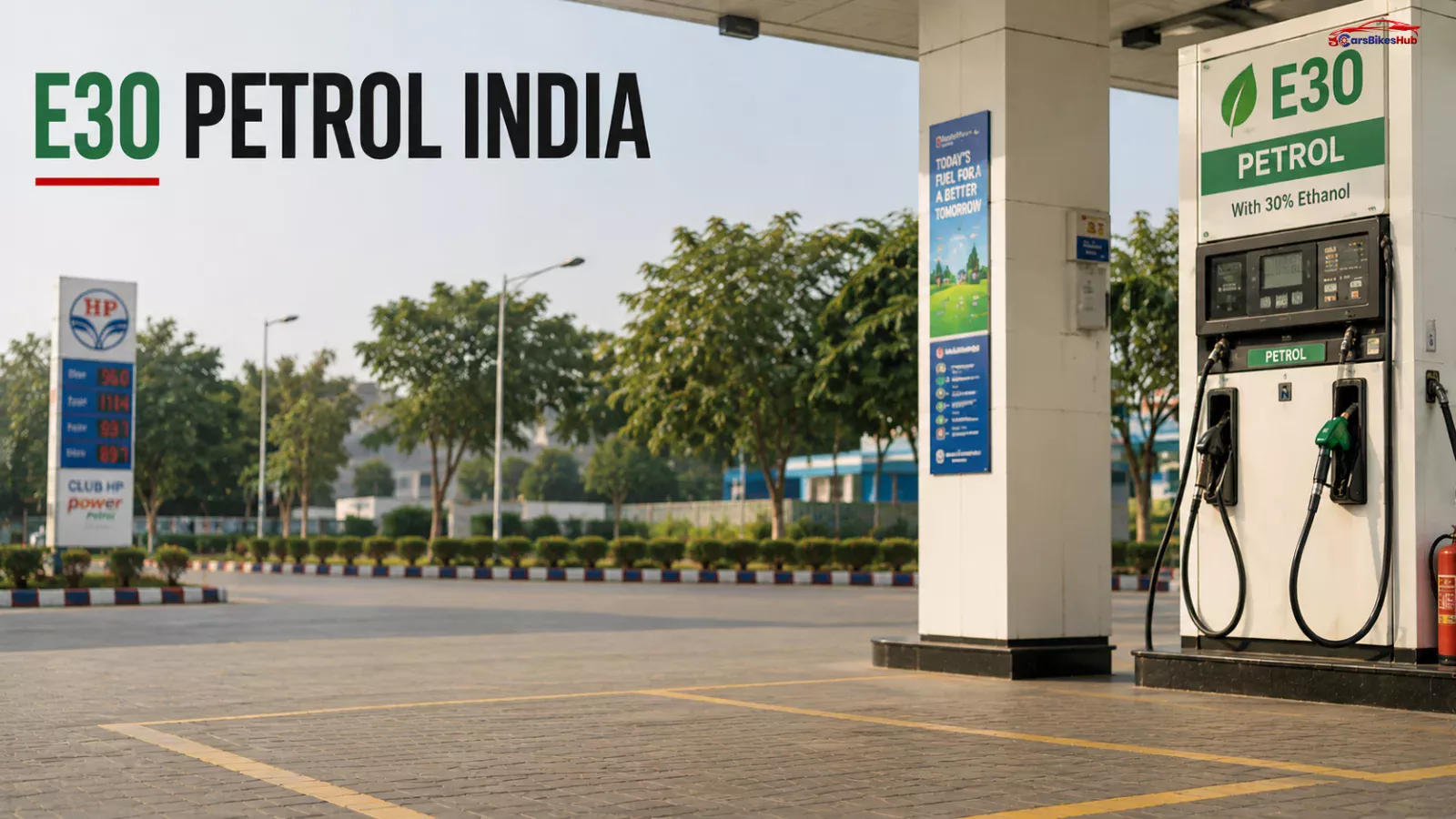
E30 petrol India developments this week have been big, and most car owners are still trying to make sense of it all.
In May 2026, the Bureau of Indian Standards (BIS) formally notified technical standards for E22, E25, E27, and E30 ethanol-blended petrol under a new regulation called IS 19850:2026. Then, on 11 June 2026, the Ministry of Finance waived central excise duty on all these higher blends, the first major tax incentive for fuel above E20. Within days, the story was everywhere.
Why? Because E20 petrol only became mandatory nationwide in April 2025, millions of Indian drivers are still adjusting to it. The idea of jumping to E30 petrol, with 30% ethanol, has triggered a flood of questions about engine safety, mileage loss, fuel pricing, and what it all means for buying a new vehicle.
Here’s a simple breakdown of what E30 petrol is, what just changed, and what it means for you as a vehicle owner in India.
What Is E30 Petrol, and How Is It Different from E20?
The “E” simply stands for ethanol, a biofuel made from sugarcane or food grains like maize. The number tells you how much ethanol is blended with regular petrol.
- E20 = 20% ethanol + 80% petrol (current national standard)
- E30 = 30% ethanol + 70% petrol (coming next)
India started with E5, moved to E10, and completed the nationwide E20 rollout in April 2025. The new BIS notification signals that E30 petrol in India is the government’s clear next destination, even if it isn’t at your fuel pump yet.
Why Is India Making This Move?
India imports over 85% of its crude oil, leaving the country exposed to global price volatility, a problem that’s grown worse with ongoing West Asia tensions. Higher ethanol blending directly reduces that dependence.
The benefits go beyond import bills. Ethanol is domestically produced, mostly from sugarcane, so higher blending means more income for Indian farmers and a smaller carbon footprint from vehicle exhaust. The programme has delivered measurable results: billions in saved foreign exchange and substantial direct payments to farmers over the past decade.
That’s why the government isn’t slowing down. E20 was always a milestone, not the finish line.
The Latest Developments: What Just Happened in June 2026
BIS Notifies E22-E30 Standards
On 15 May 2026, the Bureau of Indian Standards published IS 19850:2026, a new standard that formally defines fuel quality, octane ratings, sulphur limits, and safety norms for E22, E25, E27, and E30 blends. This is a regulatory signal, not a pump rollout; it gives oil companies, automakers, and suppliers the technical framework they need to begin preparing.
Excise Duty Exemption Announced
On 11 June 2026, the Ministry of Finance exempted all four higher blends from central excise duty. This is the first time a tax incentive of this scale has been applied to blends above E20, and it’s designed to make higher ethanol fuels commercially viable for oil marketing companies to produce and sell.
E85 Pilot Quietly Launched
Running alongside these developments, the government has also begun a pilot rollout of E85 fuel (85% ethanol, 15% petrol) at 48 public-sector fuel stations. E85 is expected to be priced around ₹20 per litre cheaper than E20, with a target of 5,000 stations by the end of 2027. For flex-fuel vehicle owners, this is a very meaningful development.
Will Your Car Actually Run on E30 Petrol?
The answer is different for every vehicle owner, and it mostly comes down to how old your car or bike is.
Newer Cars and Bikes (2023 Onwards)
Most vehicles manufactured and sold in India from 2023 onwards have been engineered for E20 compatibility. Automakers updated engine calibration, fuel injectors, seals, hoses, and valves during that transition. Several manufacturers have informally confirmed that their E20-compliant engines are already material-compatible with E30, meaning they have future-proofed the hardware in one go rather than doing it twice.
So if you’ve bought a car recently, chances are your engine can physically handle E30 petrol. The formal certification and calibration fine-tuning is what’s still pending.
Older Vehicles
For vehicles built before 2020, particularly older two-wheelers and entry-level cars, the concern is more real. These vehicles were designed for E5 or E10 fuel. Running them on E30 petrol long-term could:
- Accelerate wear on rubber seals and fuel lines not designed for high ethanol concentrations
- Causes slight cold-start difficulty, since ethanol has a lower vapour pressure than petrol
- Deliver a more noticeable mileage drop
The good news: according to the Society of Indian Automobile Manufacturers (SIAM), E20 does not pose an immediate engine safety risk even for older vehicles. The concern is more about cumulative wear over time with higher blends.
E20 Petrol vs E30 Petrol: What’s the Mileage Difference?
E20 petrol mileage impact is already well-documented, expect a drop of roughly 2-4% compared to pure petrol. A bike returning 50 km/litre on old petrol might return 48-49 km/litre on E20. The difference is real but small in daily use.
E30 fuel mileage will drop slightly more, since ethanol contains less energy per litre than petrol. Exact figures will vary by engine and driving style, but a 4-6% reduction compared to pure petrol is a reasonable expectation for most vehicles.
The key question is whether lower fuel prices offset the mileage loss, which brings us to the next section.
Will E30 Petrol Be Cheaper? Will It Save You Money?
This is what most readers actually want to know, and it’s one of the most misunderstood aspects of the whole debate.
Here’s the logic: ethanol is domestically produced and currently cheaper to blend than importing crude-derived petrol. The excise duty exemption announced on 11 June 2026 further reduces the cost burden on oil companies for producing higher blends. The E85 pilot is already priced at ₹20/litre, less than E20, a dramatic difference.
For E30 specifically, pricing hasn’t been officially announced yet. But the direction is clear: the government wants higher ethanol blends to be price-competitive, and the tax exemption is a strong step toward that.
The real-world equation for most buyers will come down to this:
- If E30 petrol is priced ₹3-5/litre cheaper than E20, the mileage loss of 4-6% is roughly cancelled out at current fuel prices
- If the price gap is larger, the E30 could actually work out cheaper per kilometre, even with lower mileage
- If there’s no price benefit at the pump, the mileage drop means higher running costs
Until official E30 pricing is declared, it’s worth watching this space closely before assuming E30 will cost you more.
What Does This Mean for Automakers?
E30 fuel compatibility is a significantly more involved engineering project than E20 was. Automakers need to address:
- Engine calibration: reconfiguring fuel maps and ignition timing for 30% ethanol
- Fuel system durability: ensuring pumps, injectors, and lines resist ethanol-related corrosion
- Material upgrades: rubber and plastic components that may degrade with sustained high-ethanol exposure
- Cold-start tuning: particularly relevant in northern India during the winter months
The Automotive Research Association of India (ARAI) has been officially tasked with studying the impact of E25 on engine life and efficiency in existing E10- and E20-compatible vehicles. Results from this study are expected before October 2026, when the government will review the timeline for higher blend mandates.
Flex-fuel vehicles, capable of running on anything from E0 to E85, are widely expected to gain significant traction in India over the next three to five years.
How Are Car Buyers Responding?
Honestly, with a fair amount of anxiety. A LocalCircles survey of over 28,000 prospective buyers across 311 districts found that 43% may delay or skip a new vehicle purchase in the next 12 months due to fuel roadmap uncertainty.
Their top concerns:
- Long-term engine health with E30 petrol
- Warranty validity at higher ethanol blends
- The mileage drop is eating into running cost savings
- Lack of clear communication from the government and automakers
What makes this striking is the backdrop: India’s auto market just hit a record; passenger vehicle registrations crossed 4 lakh units in a single month for the first time. The market is booming. But the fuel uncertainty narrative is creating a quiet undercurrent of hesitation among a significant group of buyers.
What Should You Do Right Now?
If you own a vehicle:
- Check your owner’s manual for the maximum ethanol blend your vehicle supports
- Ask your manufacturer or dealer specifically about E30 petrol compatibility
- Review your warranty terms, especially if you own a pre-2020 vehicle
- For older vehicles, inspect fuel lines and rubber seals periodically
If you’re planning to buy:
- Prioritise vehicles certified for E20 at a minimum
- Ask dealers directly: “Is this engine E30-ready?”
- Consider flex-fuel or CNG options for maximum future-proofing
The Road Ahead for E30 Petrol India
The government has confirmed that E20 remains the mandatory standard until at least October 2026, after which decisions on higher blends will follow ARAI’s studies and industry consultations. E22 is the most likely first step, possibly later this year, with E27 or E30 petrol rollout expected within the next few years.
The E30 petrol rollout in India will require more than just an engine update. It needs aligned infrastructure across 90,000+ fuel stations, consistent blending quality nationwide, clear labelling at pumps, and formal E30 certification for new vehicles.
Conclusion
For now, E20 remains the fuel most Indians will use every day. But the BIS notification, the excise duty waiver, and the E85 pilot launch all point in the same direction; India’s fuel future is already taking shape, faster than most expected.
Whether the transition to E30 petrol goes smoothly will depend on how well automakers certify their vehicles, how clearly the government communicates timelines, and whether the price at the pump gives ordinary buyers a genuine reason to embrace the change.
The technical groundwork has been laid. What comes next is about trust and transparency.
FAQs
Will my car run on E30 petrol?
Most cars sold in India from 2023 onwards are likely material-compatible with E30, though formal certification is still pending for many models. Vehicles built before 2020 may face mileage loss and long-term wear issues. Check your owner's manual or contact your manufacturer for confirmation.
What is the mileage impact of E30 fuel compared to E20?
E20 typically causes a 2-4% mileage drop versus pure petrol. E30 is expected to cause a slightly higher drop of around 4-6%, depending on engine tuning and driving conditions. Automakers are expected to optimise calibration to reduce this gap.
Is E30 petrol available at fuel stations in India right now?
No. As of June 2026, E30 is not available at retail pumps. The BIS has notified the technical standard, and excise duty has been waived, but a nationwide retail rollout has not been announced. E20 remains the current national standard.
Will E30 petrol be cheaper than E20?
Pricing hasn't been officially declared yet. However, the excise duty exemption and India's push for domestic ethanol suggest higher blends will be priced competitively. The E85 pilot is already ₹20/litre cheaper than E20, indicating the government intends to make higher blends affordable.
Should I buy a flex-fuel vehicle because of E30?
If long-term fuel flexibility matters to you, yes, a flex-fuel vehicle (FFV) can run on any ethanol blend from E0 to E85, making it the most future-proof option as India moves toward E30 and beyond. Affordable flex-fuel models are expected to enter the Indian market within the next two to three years.