


















Hyundai to make Tamil Nadu its EV hub is no longer just a rumour in the industry; it is now an official, declared strategy from one of India’s most important automakers. On June 4, 2026, Hyundai Motor India Ltd. (HMIL) formally reaffirmed that Tamil Nadu will be its flagship electric vehicle manufacturing base in India. If you have been tracking India’s EV transition, this announcement deserves your full attention.
I have been following Hyundai’s India plans for a while, and what strikes me about this move is how deliberately it has been built up. This is not a sudden pivot; it is the result of years of investments, partnerships, and product decisions that now paint a very clear picture of where Hyundai is heading.
From battery plants already running to affordable EVs on the way, here is everything you need to know about Hyundai’s Tamil Nadu EV hub.
Hyundai To Make Tamil Nadu Its EV Hub: Here Is Why
Tamil Nadu has long been called the Detroit of India, and the numbers back that up. The state accounts for around 35% of India’s total automobile industry. About 6% of all EVs sold across India come from Tamil Nadu buyers, signalling a strong consumer appetite for electric vehicles in the region.
For Hyundai, the answer to “why Tamil Nadu” was settled back in 1998 when it set up its first fully integrated car manufacturing plant outside South Korea in Sriperumbudur, near Chennai. That plant has since shipped over 3.7 million vehicles to more than 150 countries as of 2025. The infrastructure, the supplier network, the skilled workforce, it all already exists here. Turning Sriperumbudur into the Hyundai Tamil Nadu EV hub is a natural extension of what was already in place, not a reinvention.
The Rs 26,000 Crore Commitment
The financial scale of Hyundai’s commitment is what separates this from a routine announcement. HMIL has committed to invest over Rs 26,000 crore in Tamil Nadu between 2023 and 2032, part of its broader Rs 45,000 crore national investment plan.
The foundation was laid in May 2023 when Hyundai signed an MoU with the Tamil Nadu government, committing Rs 20,000 crore over 10 years specifically for EV production and its ecosystem. This was followed by an additional Rs 6,180 crore investment announced at the Tamil Nadu Global Investors Meet 2024.
These investments cover manufacturing expansion, EV development, localisation, charging infrastructure, and employment generation, all the pillars needed to make the Hyundai Tamil Nadu EV hub a self-sustaining operation rather than just a branding exercise.
The HE1i: Hyundai’s Most Important EV for India
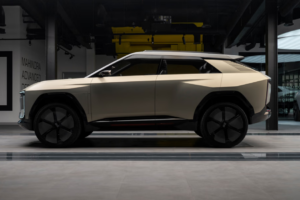
The centrepiece of this entire strategy is a compact electric SUV internally codenamed HE1i. HMIL MD & CEO Tarun Garg confirmed that Hyundai will roll out two new models from its Chennai facility this year, and one of them is this mass-market EV, the one that matters most for India’s volume segment.
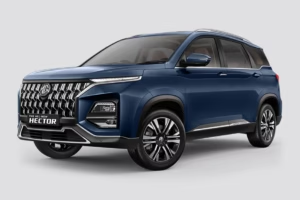
The HE1i is positioned in the sub-4 metre space, putting it directly against the Tata Nexon EV, Tata Punch EV, Mahindra XUV 3XO EV, and the Citroën eC3. This is the segment that Tata Motors has dominated with over 75% EV market share, and Hyundai is now taking direct aim at it.
Here is everything confirmed about the HE1i so far:
| Specification | Details |
| Codename | HE1i |
| Platform | E-GMP (K): same as Hyundai Inster globally |
| Battery Options | Standard Range (~42 kWh) and Long Range (~49 kWh) |
| Expected Range | Over 300 km on a single charge |
| Motors | 97 HP (Standard) / 115 HP (Long Range), 147 Nm torque |
| Production Plant | Sriperumbudur, Tamil Nadu |
| Battery Supplier | Exide Energy Solutions (locally sourced) |
| Features | Level 2 ADAS, OTA-capable infotainment |
| Expected Launch | Late 2026 / Early 2027 |
| Annual Production Target | ~65,000 units (including exports) |
The HE1i runs on Hyundai-Kia’s E-GMP (K) architecture, the same scalable platform that underpins the Inster EV sold in international markets. By pairing a proven global platform with locally sourced batteries, Hyundai is directly attacking the one barrier that has kept affordable EVs out of reach for most Indian buyers: price.
Localisation as the Price Weapon
Hyundai currently localises about 82% of its vehicle content in India and plans to push that number to 90% over the next five to six years.
For the HE1i specifically, battery packs will be sourced from Exide Energy Solutions, a subsidiary of Exide Industries, which is building India’s first giga battery cell plant in Bengaluru with a 12 GWh annual capacity, roughly 300 km from the Sriperumbudur plant. That tight supply chain keeps costs controlled and the “Made in India” claim genuinely credible.
Beyond batteries, Hyundai plans to increase sourcing from Tamil Nadu-based suppliers by around Rs 4,000 crore over the next five to six years, creating approximately 2,000 additional jobs while reducing import dependence. By the time the HE1i reaches showrooms, it is expected to be priced competitively against the Tata Punch EV’s entry price of around Rs 10.99 lakh, a segment Hyundai has never entered on the EV front before.
The Battery Plant Is Already Running
One important detail that often gets lost in the headline numbers: Hyundai has not been waiting to start. Hyundai Mobis India inaugurated its Electric Vehicle Battery System Assembly (BSA) Plant in Sriperumbudur in May 2025. Spread over 8.15 acres and located right next to the main vehicle manufacturing facility, it is already supporting battery assembly for the Hyundai Creta Electric.
This matters because it confirms that the Hyundai Tamil Nadu EV hub is not a future project; key infrastructure is already up and running. Hyundai has also been actively localising power electronics at the same site, building the technical depth needed to support multiple EV models simultaneously rather than ramping up from scratch each time.
The Charging Network: 100 Stations Across Tamil Nadu
No EV strategy holds up without a charging network to back it. Hyundai currently operates 39 DC fast-charging stations and 78 charging points across Tamil Nadu, and has committed to expanding this to 100 stations along major highway corridors across the state as part of its 2026 roadmap.
Notably, these stations are open to all four-wheeler EV users, not just Hyundai owners, which goes a long way in building genuine ecosystem credibility rather than a closed, brand-only network.
Skill Development: Building the Workforce
The June 2026 announcement also included a major skill development initiative in partnership with the Government of Tamil Nadu, aimed at preparing the state’s workforce for EV-specific roles covering battery systems, power electronics, and EV assembly.
The shift from ICE to EV manufacturing is not just about upgrading machines; it requires retraining people at scale, and Hyundai investing in that alongside physical infrastructure is what separates a serious long-term commitment from a production shift that stalls the moment the incentives run out.
Exporting to the World from Tamil Nadu
The Hyundai Tamil Nadu EV hub is not built just for India; it is also a global export platform. The Sriperumbudur plant has historically been one of Hyundai’s key export hubs, and that role continues with EVs. The HE1i will serve both the domestic market and multiple international markets.
Between the Creta Electric and the HE1i, Hyundai is targeting a combined annual production of approximately 90,000 units, with a meaningful share earmarked for export. That is what makes this more than a domestic manufacturing story. Tamil Nadu is being positioned as Hyundai’s EV production base for the world.
The Bigger Picture
Taken together, what Hyundai is building in Tamil Nadu is not a single factory decision or a one-product launch plan. It is a fully connected EV ecosystem, manufacturing, battery supply, charging infrastructure, workforce readiness, and export capacity all anchored in one state. The investment is real, the infrastructure is already partially live, and the products are close to market.
For India’s EV transition, the Hyundai Tamil Nadu EV hub adds a serious second player to a race that has been largely one-sided for too long. That is good for competition, good for pricing, and ultimately good for every Indian buyer who has been waiting for a credible, affordable electric SUV that does not ask them to compromise.
FAQs
What is the Hyundai Tamil Nadu EV hub plan?
Hyundai Motor India has officially designated its Sriperumbudur facility near Chennai as its flagship EV manufacturing base for India. The plan covers the HE1i compact EV, a battery assembly plant already operational, 100 EV charging stations, and a Rs 26,000 crore investment through 2032.
When will the Hyundai HE1i launch in India?
The HE1i is expected to launch in late 2026 or early 2027. It will be produced at Sriperumbudur, Tamil Nadu, with locally sourced batteries from Exide Energy Solutions.
How does the HE1i compare to the Tata Punch EV?
Both are sub-4 metre electric SUVs. The HE1i will offer 42 kWh and 49 kWh battery options, deliver over 300 km of range, and is expected to be priced competitively around the Tata Punch EV's starting price of Rs 10.99 lakh.
How much is Hyundai investing in Tamil Nadu for EVs?
Hyundai has committed over Rs 26,000 crore in Tamil Nadu between 2023 and 2032, covering manufacturing, EV development, localisation, charging infrastructure, and skill development.
Is Hyundai building EV charging stations in Tamil Nadu?
Yes. Hyundai currently operates 39 DC fast-charging stations across Tamil Nadu and has committed to expanding this to 100 stations along major highway corridors by the end of 2026. These are open to all four-wheeler EV users, not just Hyundai owners.