





















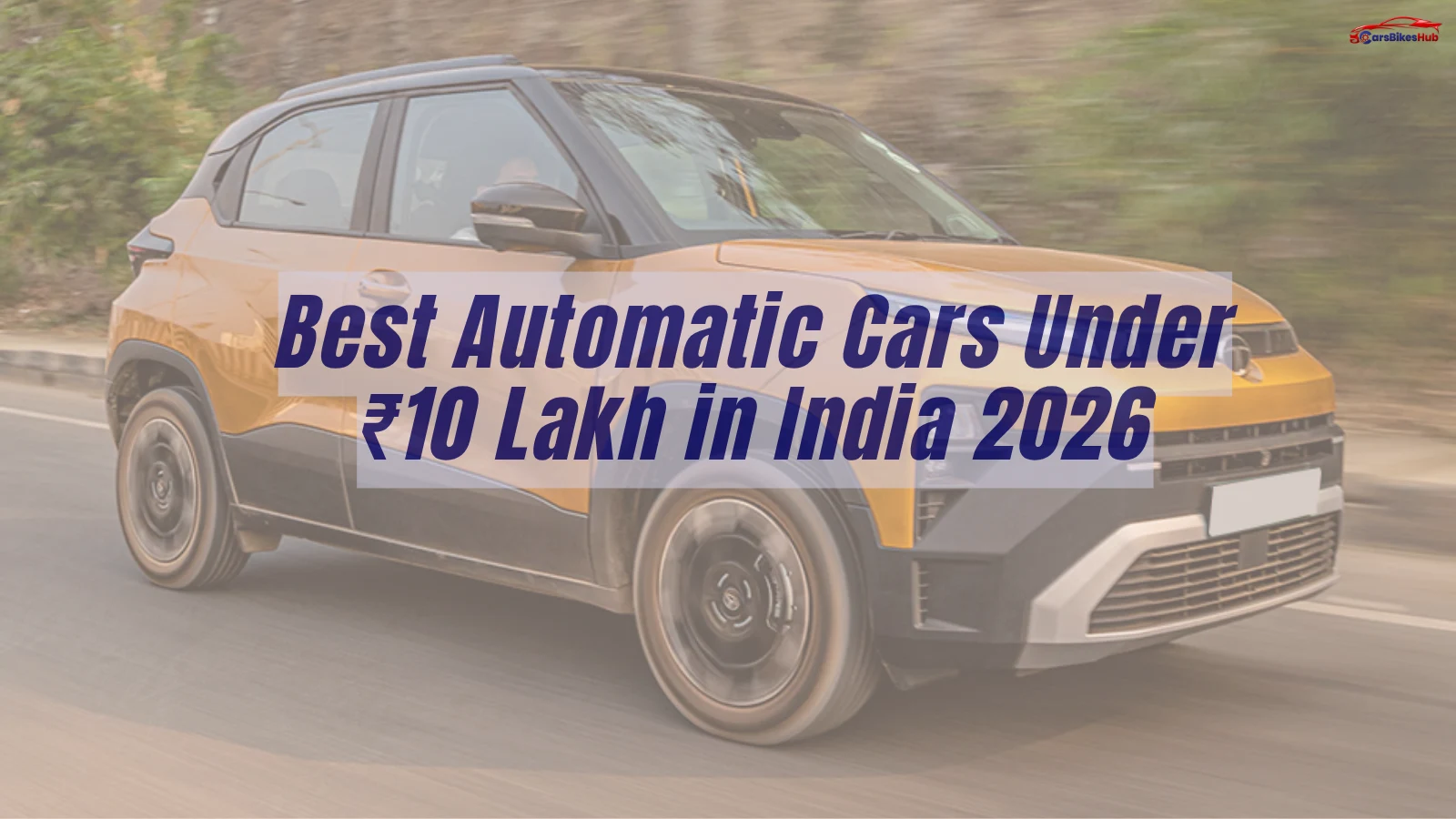
Buying your first automatic car sounds simple until you realise just how many choices you have. Buying your first automatic car sounds simple until you realise just how many choices you have. The real challenge isn’t finding an automatic car; it’s deciding which one offers the best balance of comfort, mileage, features and value for your money.
This guide shortlisted Best Automatic Cars Under ₹10 Lakh in India 2026, without relying on higher-priced variants that push beyond the limit. It also explains how AMT actually behaves in Indian traffic, and tells you honestly who should buy each car, and who should skip it.
Quick Comparison Table
| Car | Best For | Transmission | Claimed Mileage | Price Range (AMT/CVT) |
| Tata Punch | SUV stance + safety | 5-speed AMT | ~20 km/l | ₹7.55L- 8.15L |
| Maruti Dzire | Best mileage | 5-speed AMT | ~25.71 km/l | ₹7.62L- 9.31L |
| Hyundai Exter | Features per rupee | 5-speed AMT | ~19-20 km/l | ₹6.90L-9.41L |
| Maruti Baleno | Refinement + resale | 5-speed AMT | ~22.94 km/l | ₹8.25L- 9.17L |
| Maruti Swift | Peppy city driving | 5-speed AMT | ~25.75 km/l | ₹6.3L- 8.8L |
| Maruti WagonR | Family practicality | 5-speed AMT | ~24 km/l | ₹6L-8.5L |
| Hyundai Grand i10 Nios | Balanced daily driver | 5-speed AMT | ~20 km/l | ₹6.5L- 9L |
| Nissan Magnite | Budget SUV, safest AMT range | 5-speed AMT | ~19.9 km/l | ₹6.24L- 9.42L |
| Maruti Celerio | Cheapest automatic entry | 5-speed AMT (AGS) | ~26.68 km/l | ₹5.16L- 6.73L |
All prices are ex-showroom and cover the full automatic variant range for that car, not just the entry trim. Verify current pricing at your local dealership, as these shift with GST changes, discounts, and periodic revisions.
AMT vs CVT: What Actually Matters at This Price Point
Almost every car that comfortably stays under ₹10 lakh across its entire automatic range uses AMT, not CVT. That’s not a coincidence; AMT is the cheapest automatic technology to manufacture, which is exactly why it keeps prices close to the manual variant. While a few models in this price bracket do offer a CVT, they’re generally available only in select variants and often cost more than comparable AMT-equipped rivals.
Here’s the practical difference for a buyer, not a spec-sheet difference:
AMT is best if fuel efficiency and low maintenance cost matter more to you than outright smoothness. It’s noticeably cheaper to service than a CVT and doesn’t add much to the car’s price over the manual version. The trade-off is a brief pause and head-nod during gear changes, especially under hard acceleration, most noticeable at low speed and in first-to-second gear shifts.
CVT, where available in this budget in a fully qualifying trim, feels closer to a “proper” automatic: no jerks, continuous power delivery, but costs more upfront and can be pricier to service long-term.
If you mostly drive in the city at low speeds, AMT jerk is barely noticeable once you get used to it. If you do a lot of highway overtaking, you’ll feel the brief power interruption more, though current-generation AMTs (2024 onward) shift noticeably quicker than the units from 2016–2018 that gave AMT its bad reputation.
The 9 Best Automatic Cars Under ₹10 Lakh in India 2026
1. Tata Punch AMT: Best for SUV Stance and Safety
Price: ₹7.55 lakh (Pure+ AMT) to ₹8.15 lakh (top AMT trim)
The Punch carries a 5-star Bharat NCAP rating and 193mm ground clearance, genuinely confidence-inspiring on broken roads and speed breakers without feeling bulky to park. Higher AMT trims add a “Traction Pro” mode for light off-road or wet conditions, plus a 10.25-inch touchscreen.
Best for: First-time buyers and families who want SUV-like road presence and top safety ratings without stretching the budget.
Watch out for: AMT shift response can feel hesitant during quick overtakes on the highway. Cabin width is average for the segment.
2. Maruti Suzuki Dzire AMT: Best Mileage in the Segment
Price: ₹7.62 lakh (VXi AMT) to ₹9.31 lakh (ZXi+ AMT)
Maruti Suzuki Dzire AMT is the most fuel-efficient automatic in this list, with an ARAI-certified figure around 25.71 km/l. Carries a 5-star Global NCAP safety rating, and top trims add a segment-first electric sunroof, 360-degree camera, and wireless charger.
Best for: Daily commuters and high-mileage drivers who want a sedan boot and prioritise running cost above everything else.
Watch out for: Rear headroom is tighter than the WagonR or Punch. Ride height sits lower, which some buyers coming from SUVs find less confidence-inspiring on bad roads.
3. Hyundai Exter AMT: Best Features-per-Rupee
Price: ₹6.90 lakh (S AMT) to ₹9.41 lakh (SX(O) Connect AMT)
Hyundai has packed in an electric sunroof, a dual-camera dashcam, and steering-mounted paddle shifters on the AMT, unusual at this budget and genuinely useful for controlled engine braking on descents.
Best for: Feature-hungry buyers who want the most tech per rupee and value a taller seating position for city visibility.
Watch out for: The CNG variant is manual-only, so if you want CNG and automatic together, this one’s off the table. Rear seat is snug for three adults.
4. Maruti Suzuki Baleno AMT: Best Refinement and Resale
Price: ₹8.25 lakh (Zeta AMT) to ₹9.17 lakh (Alpha AMT)
Uses a smoother 4-cylinder petrol engine than the 3-cylinder units in several rivals. Top trims bring a 9-inch touchscreen, 360-degree camera, head-up display, and six airbags.
Best for: Buyers who want the smoothest-feeling AMT here, plus Maruti’s resale advantage and wide service network.
Watch out for: The Alpha AMT’s on-road price (~₹10.28 lakh with RTO and insurance) crosses ₹10 lakh even though the ex-showroom figure doesn’t; factor this in if you’re budgeting on-road, not ex-showroom.
5. Maruti Suzuki Swift AMT: Best for Peppy City Driving
Price: ~₹6.3 lakh to ₹8.8 lakh
Not the segment’s most refined automatic, but remains one of the most fun-to-drive small cars in India, with light steering and quick responses that make weaving through traffic easy.
Best for: Younger buyers and singles who prioritise a light, engaging drive over cabin space or feature count.
Watch out for: Rear seat and boot space are the tightest in this list, not ideal if you regularly carry three adults or a lot of luggage.
6. Maruti Suzuki WagonR AMT: Best Family Practicality
Price: ~₹6 lakh to ₹8.5 lakh
The tall-boy design maximises headroom and makes entry/exit genuinely easy, a real advantage for elderly family members or anyone loading groceries or children daily.
Best for: Small families who prioritise headroom, ease of access, and low running costs over styling.
Watch out for: Highway stability and cabin refinement at speed are average; wind noise picks up noticeably above 90 km/h.
7. Hyundai Grand i10 Nios AMT: Best Balanced Daily Driver
Price: ~₹6.5 lakh to ₹9 lakh
A well-rounded option with a refined AMT unit, comfortable ride quality, and Hyundai’s strong dealer network and after-sales support.
Best for: Buyers who want a dependable, no-drama daily driver with easy access to service centres in smaller towns too.
Watch out for: Boot space and top-end feature list are average for the class; it doesn’t lead on any single spec; it’s a generalist.
8. Nissan Magnite AMT: Best Budget SUV with a Fully Safe Price Range
Price: ₹6.24 lakh to ₹9.42 lakh (AMT only)
Note: The Magnite’s CVT range (₹9.25L–₹11.13L) crosses ₹10 lakh in its top trims, so this entry specifically covers the AMT lineup, which stays safely under budget throughout. The Magnite offers a leather-wrapped dashboard feel, 205mm ground clearance, and a 5-star Global NCAP rating- genuinely upmarket touches for the price.
Best for: Buyers who want SUV road presence and a premium-feeling cabin without pushing into CVT territory that risks crossing ₹10 lakh.
Watch out for: Owner reviews consistently flag the AMT as laggier than rivals like the Punch or Dzire. Nissan’s service network is thinner than Maruti’s, Tata’s, or Hyundai’s, especially outside major cities.
9. Maruti Suzuki Celerio AMT: Cheapest Way Into an Automatic
Price: ₹5.16 lakh (VXi AMT) to ₹6.73 lakh (ZXi+ AMT)
If your budget is tight, the Celerio AMT (Maruti calls it AGS) delivers the best mileage in this entire list, up to 26.68 km/l ARAI-certified, at the lowest automatic price point here, with nearly ₹3 lakh of headroom under the ₹10 lakh cutoff.
Best for: First-time buyers on a strict budget who want the lowest possible entry price into automatic driving, with class-leading fuel economy.
Watch out for: It’s a small car with a correspondingly small boot (313 litres) and basic feature set even at the top trim, no sunroof, no 360-degree camera.
Which Automatic Car Should You Buy Under ₹10 Lakh?
| If you want… | Buy… |
| Best overall balance | Tata Punch AMT |
| Best mileage | Maruti Dzire AMT |
| Most features for the money | Hyundai Exter AMT |
| Smoothest AMT + best resale | Maruti Baleno AMT |
| Most fun to drive | Maruti Swift AMT |
| Best for elderly or first-time drivers | Maruti WagonR AMT |
| Lowest-stress all-rounder | Hyundai Grand i10 Nios AMT |
| SUV feel without CVT price risk | Nissan Magnite AMT |
| Lowest price to enter automatic driving | Maruti Celerio AMT |
For most Indian buyers, the Tata Punch AMT is the strongest all-rounder, with safety, ground clearance, and reasonable running costs in one package. If mileage is your single biggest priority, the Maruti Dzire AMT leads the segment outright. If you’re working with a genuinely tight budget, the Maruti Celerio AMT gets you into automatic driving for under ₹7 lakh with class-leading efficiency.
Should You Buy an Automatic Car Under ₹10 Lakh?
Who should buy one: Daily commuters stuck in heavy traffic, first-time drivers who find clutch control stressful, elderly or physically limited drivers, and anyone whose city involves frequent stop-start driving (Bengaluru, Mumbai, Delhi-NCR, Pune, Hyderabad).
Who should avoid it, or wait: Buyers who drive almost exclusively on open highways with light traffic may not see enough benefit to justify the ₹40,000-₹70,000 premium AMT typically adds over the equivalent manual variant.
Buyers who tow, carry very heavy loads regularly, or drive frequently on steep ghat roads may prefer a torque-converter automatic over an AMT, since AMT’s brief power interruption during shifts is more noticeable under load, though options with that gearbox type are rare below ₹10 lakh.
Alternatives to consider if your budget can flex slightly:
The Renault Kiger’s entry-level CVT trims and the Honda Amaze’s base V CVT both still qualify under ₹10 lakh individually; they’re worth cross-shopping if you’re comfortable sticking strictly to those lower trims and not tempted by the higher, pricier ones. If your budget stretches to ₹10-11 lakh, the Skoda Kylaq’s Classic+ AT (from ₹9.25 lakh, a proper torque-converter automatic) and the Tata Nexon AMT open up more power and refinement.


FAQs
Is AMT reliable in the long run, or does it wear out faster than a manual gearbox?
AMT uses the same clutch and gearbox internals as a manual car, with an actuator handling the clutch and gear changes; mechanically it's not more fragile. The actuator can need attention after 60,000–80,000 km of heavy city use, but this is a manageable, occasional cost, not a common failure point in current-generation AMTs from Maruti, Tata, and Hyundai.
Does an AMT car cost significantly more to maintain than a manual?
Routine service costs (oil, filters, brake pads) are nearly identical. The only real difference shows up if the AMT actuator or clutch assembly needs replacement, which is occasional, not routine. AMT remains far cheaper to maintain long-term than a CVT.
Will AMT mileage actually match the claimed ARAI figures in real city traffic?
Expect roughly 10–15% lower than ARAI figures in heavy stop-start traffic with AC running, true of nearly every car, automatic or manual. The Dzire and Celerio tend to hold up closest to their claimed numbers among cars in this list.
Should I buy the automatic now, or wait for prices to drop?
Automatic variants rarely see meaningful price drops; if anything, features get added over time, and prices creep up slightly with facelifts. If a car meets your needs today, waiting mostly costs you time, not money saved.
Which automatic car under ₹10 lakh has the best resale value?
Maruti Suzuki models (Dzire, Baleno, Swift, Celerio) traditionally hold resale value best in India due to service network reach and low running costs, followed closely by the Tata Punch, which has built strong resale demand on its safety reputation.