





























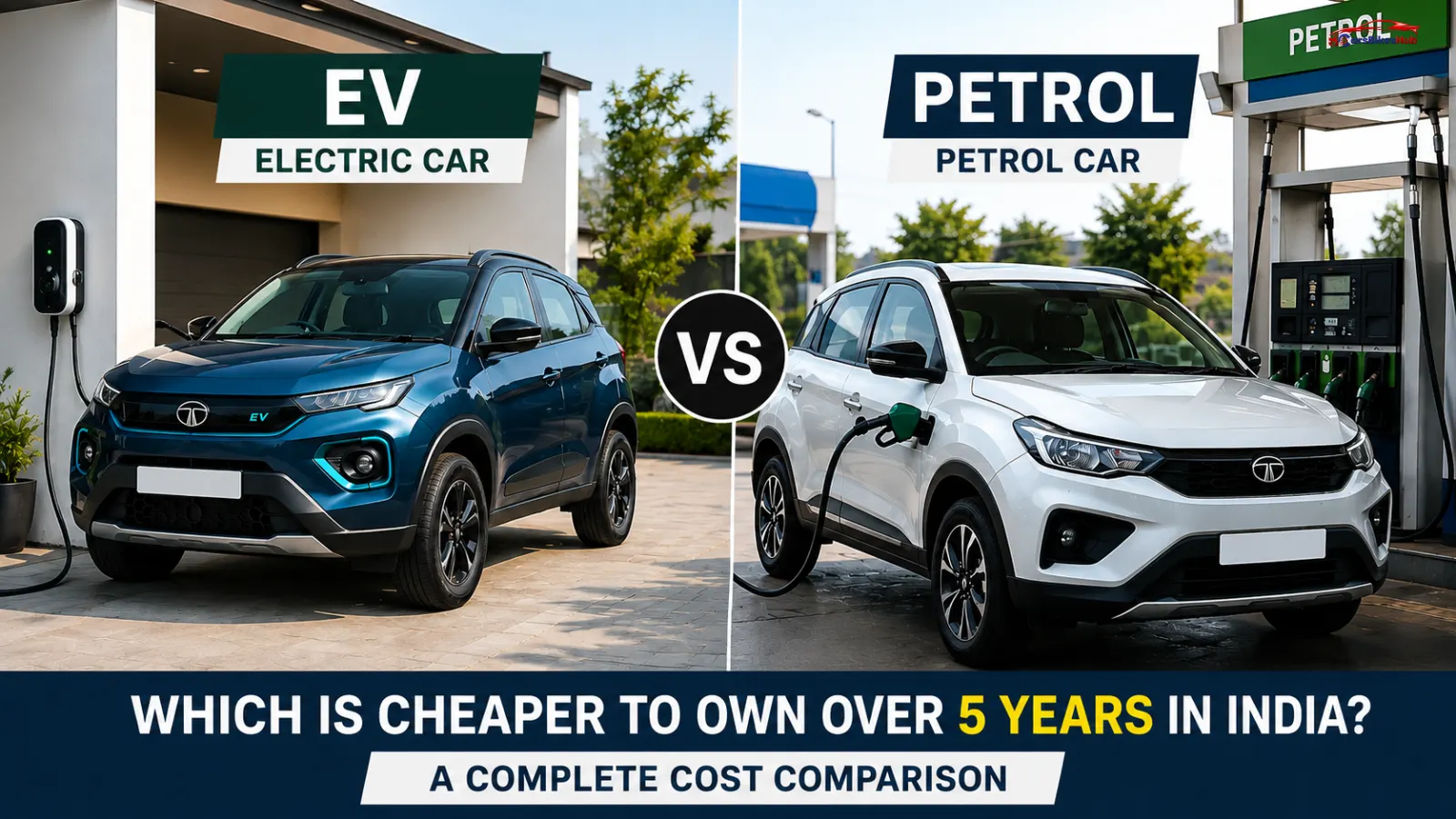
If you’re planning to buy a new car today, the biggest question isn’t just how much it costs to buy; it’s how much it’ll cost to own. Walk into any showroom, and the price tag feels like the whole story. It isn’t. Fuel or electricity bills, servicing, insurance, and how much the car is worth when you sell it all quietly add up over the years you actually drive the thing.
Five years is a realistic window to judge this. It’s long enough to move past the “new car glow,” short enough to be still relevant when most Indian buyers upgrade or resell, and it happens to be the period covered by most manufacturer warranties. In this article, we’ll walk through every real cost of owning an EV vs. a petrol car in India, not just the fuel savings everyone talks about, so you can decide with numbers, not assumptions.
Note: The calculations in this article use Delhi as a representative example, because it has one of India’s most comprehensive EV policies and transparent fuel and electricity pricing. Actual ownership costs will vary depending on your state, annual mileage, and the vehicle you choose.
EV vs Petrol Car at a Glance
| Factor | Petrol Car | Electric Car |
| Purchase price | Lower upfront | 25–35% higher upfront (before incentives) |
| Running cost/km | Higher (~₹6/km) | Much lower (~₹1.3/km) |
| Maintenance | Regular servicing, oil changes, more moving parts | Minimal — no engine oil, fewer wear parts |
| Insurance | Generally lower premium | Higher premium, partly offset by lower third-party rates |
| Resale (5 years) | Better retained value today | Weaker resale, improving as market matures |
| Fuel/charging access | Available everywhere instantly | Home charging is easy; public charging still patchy |
| Convenience | No range anxiety, quick refuelling | Best for owners with home/office charging access |
| Best for | High-mileage highway users, uncertain charging access | City commuters with a fixed parking spot and charger |
What Does “Cost of Ownership” Actually Mean?
The purchase price is just the entry fee. What you actually pay to keep a car on the road over five years includes depreciation (the value the car loses each year), servicing and repairs, fuel or electricity, insurance premiums, and in some cities, road tax. A car that looks cheaper on the showroom floor can end up costing more once you add these up, and vice versa. That’s the lens this guide uses throughout.
Assumptions Used for This Comparison
- Vehicle: Tata Nexon Petrol vs Tata Nexon EV (30 kWh MR)
- Ownership period: 5 years
- Annual driving: 12,000 km
- Location: Delhi
- Charging: Home AC charging only
- Fuel and electricity prices: July 2026
While this comparison uses the Tata Nexon as a representative example, the exact cost difference will vary depending on the vehicle, state incentives, and your driving pattern.
Purchase Price Comparison
Take the Tata Nexon as an example, since it’s sold in both petrol and EV form and is one of India’s best-selling models in each category. In Delhi, the base petrol Nexon has an estimated on-road price of around ₹9.5-10.2 lakh, while the base Nexon EV (30 kWh Medium Range) is priced at roughly ₹13.7 lakh on-road.
That gap has just narrowed, though. The Delhi EV Policy 2026, which came into effect on 1 July 2026, gives a 100% waiver on road tax and registration fees for battery electric vehicles priced up to ₹30 lakh (ex-showroom). For the base Nexon EV, that wipes out roughly ₹63,000 in RTO charges, bringing the effective on-road price down to about ₹13.05 lakh.
The policy also offers a scrapping incentive of up to ₹1 lakh for private buyers who scrap an old BS-IV or older petrol/diesel car when switching to an EV. However, there’s no direct purchase subsidy for private electric cars otherwise. Other states have their own EV policies with varying levels of tax waivers, so check your state’s rules before assuming a discount.
Even after these waivers, most EVs still cost more upfront than their petrol equivalents. Financing narrows this gap into a manageable monthly EMI difference, but the initial investment remains higher. Not every EV carries such a large upfront premium, though — the gap varies significantly depending on the model and the state incentives available to you.
Running Cost Comparison
For most buyers, this is the point where EV ownership begins to make financial sense.
Petrol in Delhi is currently priced at about ₹102/litre. A petrol Nexon returning a realistic 17 km/l works out to roughly ₹6.0 per km.
An EV like the Nexon EV MR, with a real-world efficiency of about 6 km per kWh, costs far less to run, if you’re charging at home. Delhi’s domestic electricity is heavily subsidised for the first 400 units a month, but EV charging typically pushes a household well past that slab. At a realistic effective rate of ₹8/unit for the additional consumption, that works out to roughly ₹1.3 per km, under a quarter of the petrol cost.
| Petrol Nexon | Nexon EV (home charging) | |
| Cost per km | ₹6.0 | ₹1.3 |
| Monthly cost (1,000 km) | ₹6,000 | ₹1,330 |
| Annual cost (12,000 km) | ₹72,000 | ₹16,000 |
| 5-year running cost (60,000 km) | ₹3,60,000 | ₹80,000 |
Assumption: 12,000 km/year average driving, Delhi petrol and electricity rates as of July 2026, home AC charging only.
Home Charging Costs
Unlike a petrol pump, home charging needs upfront setup. A 7.2 kW AC wallbox charger, including installation, typically costs ₹15,000–20,000, a one-time expense most owners recover quickly through fuel savings. It’s a straightforward exercise for anyone with a private parking spot and access to a dedicated electrical line.
Apartment dwellers is where this gets complicated. Not every housing society allows charger installation in common parking, and shared meters can make the economics murkier. If you live in an apartment without guaranteed charger access, factor in more frequent (and more expensive) public charging before you commit to an EV.
Charging time also matters practically, even if it doesn’t show up on a cost sheet: a full home charge on AC power takes several hours, which is fine overnight but not something you can do on a quick errand the way you’d fill a petrol tank in five minutes.
Maintenance & Servicing
Petrol engines have hundreds of moving parts- pistons, valves, a timing chain, an exhaust system all of which need periodic servicing, oil changes, and eventual wear-part replacement. Over five years, this typically adds up to ₹30,000–40,000 in scheduled servicing and consumables for a compact SUV like the Nexon.
EVs have a fraction of these moving parts. There’s no engine oil, no clutch, no exhaust, and regenerative braking reduces brake pad wear significantly. Real owner-reported first-service costs for the Nexon EV run as low as ₹1,500–2,000. Over five years, total EV maintenance for a comparable vehicle is realistically in the ₹12,000-18,000 range, less than half of the petrol equivalent.
The trade-off: EV-specific repairs (motor, battery management electronics) that fall outside standard servicing can be expensive, and not every mechanic in every town is equipped to handle them yet. Authorised service network coverage is a real consideration outside major cities.
Insurance Costs
EV insurance premiums tend to run higher than petrol equivalents, largely because the battery, the single most expensive component, pushes up the vehicle’s Insured Declared Value (IDV). For the base Nexon EV in Delhi, first-year comprehensive insurance runs close to ₹55,000, noticeably higher than a comparable petrol Nexon.
There is a partial offset: the insurance regulator mandates a 15% discount on third-party premiums for EVs, recognising their lower environmental impact. Even so, over a five-year ownership period, expect EV insurance to add up to roughly ₹15,000–20,000 more than petrol, largely driven by battery replacement cost concerns baked into premium calculations.
Battery Ownership
The battery is the EV owner’s biggest long-term question mark, and the biggest source of fear. Most EVs sold in India today carry an 8-year or 1,60,000 km battery warranty as standard, and some manufacturers, including Tata on select Nexon EV variants, now offer lifetime high-voltage battery warranties to first owners, a direct response to buyer anxiety about replacement costs.
Real-world degradation data, especially from more heat-stable LFP-chemistry packs increasingly used in Indian EVs, suggests batteries hold up better than the “dead battery in five years” myth implies. That said, India still lacks a standardised battery health certification system, which makes it harder for buyers and resellers to verify a used EV’s actual condition, something to watch as the market matures rather than a reason to avoid EVs altogether.
Resale Value & Depreciation
This is the area where petrol cars still have a clear edge for now. Petrol and diesel vehicles in India typically retain 55–65% of their value after three years. EVs, by contrast, currently retain something closer to 40–55% over the same period, and depreciation is front-loaded: the steepest drop happens in years one to two as buyers stay cautious about unproven battery health and rapidly improving EV technology makes older models feel dated fast.
Mass-market EVs from established brands with strong local service networks, Tata and MG in particular, are showing better resale retention than niche or premium imports, and this gap is expected to narrow as India’s used-EV market matures and battery-health reporting becomes standardised. Buying an EV today means accepting some resale uncertainty as the price of being an early mover.
Hidden Costs Buyers Often Forget
Beyond the obvious line items, a few costs catch buyers off guard on both sides:
- Petrol side: fuel price volatility (prices can and do rise sharply on global crude movements), and the opportunity cost of time lost at fuel stations over years of ownership.
- EV side: home charger installation, the cost and inconvenience of public/DC fast charging for road trips, potential apartment/society restrictions on charger installation, and the psychological “battery replacement” discount buyers apply when negotiating resale.
- Both: accessories, extended warranties, and in petrol’s case the risk of tightening emission norms affecting resale in the years ahead.
Real 5-Year Ownership Cost
Putting it all together for our example, a Tata Nexon petrol vs Nexon EV MR, both bought and driven in Delhi, 12,000 km a year:
| Cost head | Petrol Nexon | Nexon EV (MR) |
| On-road purchase price | ₹10,00,000 | ₹13,05,000 |
| Fuel/electricity (5 yrs) | ₹3,60,000 | ₹80,000 |
| Maintenance (5 yrs) | ₹35,000 | ₹15,000 |
| Insurance (5 yrs) | ₹1,20,000 | ₹1,40,000 |
| Home charger (one-time) | — | ₹15,000 |
| Total outflow | ₹15,15,000 | ₹15,55,000 |
| Estimated resale value (5 yrs) | ₹4,50,000 | ₹4,57,000 |
| Net 5-year ownership cost | ₹10,65,000 | ₹10,98,000 |
All figures are illustrative estimates based on stated assumptions (Delhi prices, July 2026 fuel/electricity rates, 12,000 km/year, home AC charging); actual costs will vary by city, driving pattern, and model.
At this specific mileage, the petrol Nexon is marginally cheaper over five years once the higher EV purchase price and softer resale are factored in. But this flips quickly with higher usage, which brings us to the number that matters most.
Break-even Analysis
The real question isn’t “which is cheaper” in the abstract; it’s “at what point does the EV’s running-cost advantage cancel out its higher purchase price?”
Using the numbers above: the EV costs roughly ₹3.05 lakh more upfront, plus a modest net addition from insurance and the home charger, offset slightly by lower maintenance. That works out to a net extra cost of about ₹3.2 lakh to go electric. Against a running-cost saving of roughly ₹4.7 per km, the break-even point lands at approximately 68,000-70,000 km of driving.
For someone driving 12,000 km a year, that’s a break-even period of just under six years, meaning over a strict 5-year window, petrol edges ahead. But for anyone driving 15,000 km a year or more (a fairly typical figure for daily office commuters or families with a single primary car), the EV becomes cheaper well within the 5-year ownership period, and the gap only widens the longer you keep the car. The more you drive, the sooner an EV recovers its higher upfront cost; that’s why annual mileage is often the single biggest factor in deciding whether an EV makes financial sense.
Which One Should You Buy?
- Daily city commuters with home/office charging: EV, low running costs stack up fast in stop-start city traffic where petrol engines are least efficient.
- High-mileage users (15,000+ km/year): EV; this is where the running-cost advantage overwhelms the purchase price gap fastest.
- Highway and long-distance drivers: Petrol (or consider a long-range EV); public charging infrastructure on highways is improving but still inconsistent.
- Apartment residents without guaranteed charger access: Petrol unless your society explicitly supports EV charging; the convenience gap can outweigh the savings.
- Families with two cars: A mixed approach EV for the city runabout, petrol/diesel for the highway car is increasingly common and sensible.
- Occasional or low-mileage drivers: Petrol at low annual mileage, you’re unlikely to reach the break-even point within a typical ownership cycle.
- Office commuters in metros with EV-friendly policies (like Delhi): EV tax waivers and low running costs make the case stronger than ever.
Final Verdict
Neither option is universally “better”; the right answer depends on how much you drive, where you park, and how long you plan to keep the car. Petrol still wins for occasional drivers, highway-heavy users, and anyone without dependable charging access. EVs win convincingly for high-mileage city commuters with a home or office charger, especially in cities like Delhi where 2026’s tax waivers have narrowed the upfront price gap.
If your driving habits fall somewhere in between, base your decision on your actual annual mileage. More than any other factor, it’s what determines whether an EV or a petrol car makes better financial sense over time.





FAQs
Is an EV cheaper than a petrol car in India?
Only over higher annual mileages. At low-to-moderate usage (under ~13,000 km/year), a petrol car often works out cheaper over five years once the EV's higher purchase price and softer resale are accounted for.
How much does an EV save in 5 years?
It depends heavily on annual mileage. At 12,000 km/year, savings are minimal or even negative once purchase price and resale are included; at 15,000–20,000 km/year, savings can run into several lakh rupees.
Is EV maintenance really cheaper?
Yes, typically less than half the cost of petrol servicing over five years, thanks to far fewer moving parts and no engine oil changes.
Do EV batteries need replacement after five years?
Not typically. Most batteries are warrantied for 8 years or 1,60,000 km, and real-world degradation data suggests most packs retain the majority of their capacity well beyond five years of normal use.
Is home charging cheaper than public charging?
Yes, significantly. Home AC charging on a domestic electricity connection costs a fraction of what DC fast charging at public stations typically costs per unit.