


























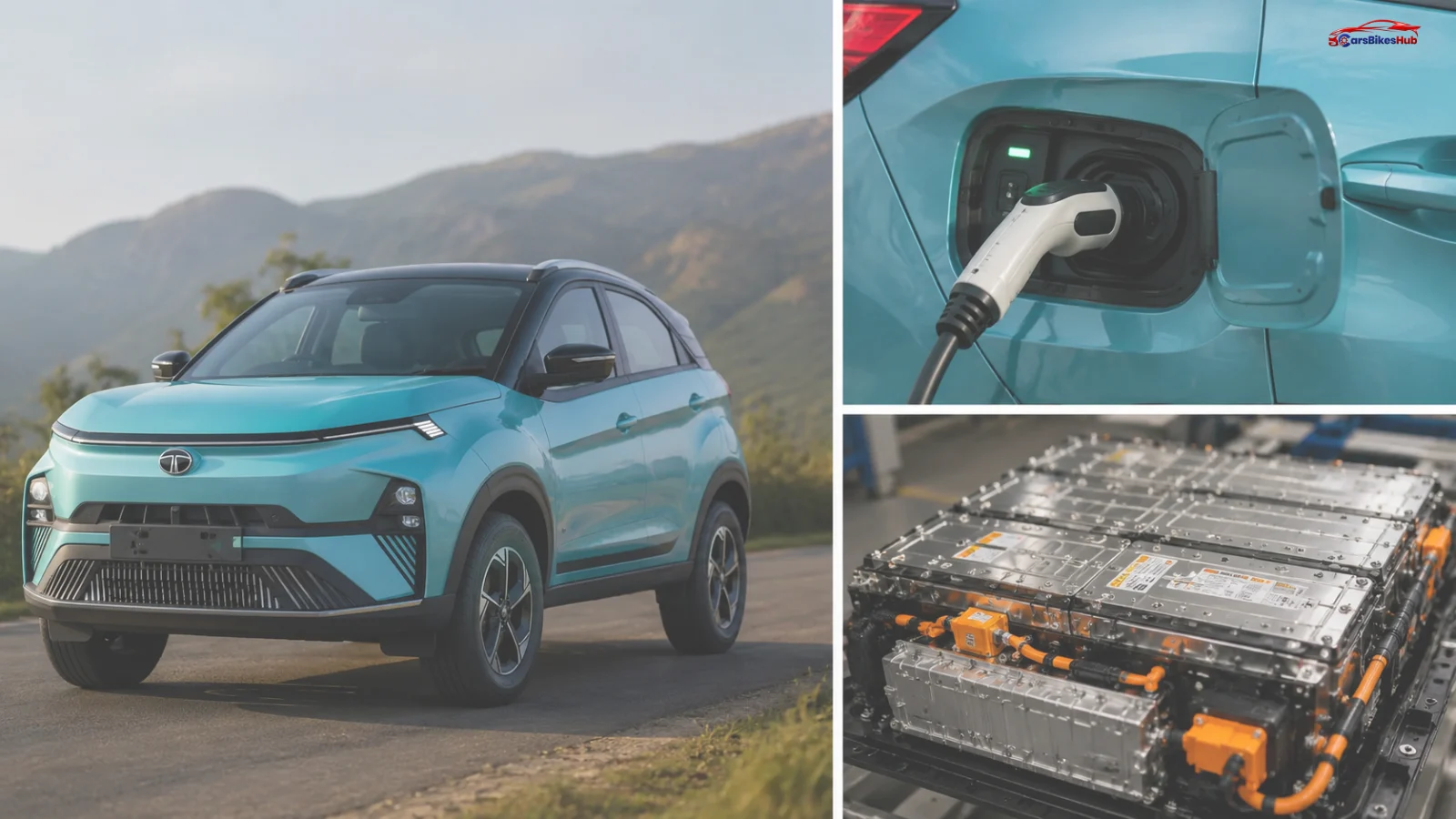
One of the biggest questions people ask before buying a Tata Nexon EV isn’t about range or charging speed; it’s about the battery. If it ever needs replacing, how much will the Tata Nexon EV battery replacement cost, and is it really as scary as the internet makes it sound?
It’s a fair worry. The battery is the single most expensive part of any electric car, and a handful of viral owner stories about seven-lakh-rupee replacement bills haven’t helped. But the real answer is more nuanced, and, for most buyers, far less alarming than those headlines suggest.
This article breaks down everything a Nexon EV owner or prospective buyer actually needs to know: how long the battery is built to last, what Tata’s warranty really covers, what a replacement costs today, and whether the battery should influence your decision to buy one at all.
Tata Nexon EV Battery at a Glance
| Detail | Information |
| Battery chemistry | Lithium Iron Phosphate (LFP) on current Nexon.EV 45 kWh; earlier Prime/Max used Lithium-ion (NMC-type) cells |
| Battery capacity | 30.2 kWh (older Prime), 40.5 kWh (older Max), 45 kWh (current Nexon. EV long-range) |
| Standard HV battery warranty | 8 years or 1,60,000 km, whichever comes first |
| Lifetime battery warranty (45 kWh, first owner) | 15 years from first registration, unlimited km, private use only |
| Warranty for second owner | Reverts to 8 years / 1,60,000 km from original registration date |
| Claimed real-world lifespan | 10–15 years or roughly 2–3 lakh km with normal care |
| Estimated replacement cost (out of warranty) | Roughly ₹5.5–8 lakh depending on pack size, excluding labour and taxes |
| Fast charging | DC fast charging supported; frequent use adds some extra stress on the pack. |
Keep in mind that Tata has not published an official retail price list for a standalone battery pack. The figures above are estimates built from service-centre quotes, owner experiences, and industry cost-per-kWh benchmarks, not a fixed catalogue price.
How Long Does the Tata Nexon EV Battery Last?
Lithium batteries don’t fail suddenly like a phone screen cracking. They degrade gradually, losing a small percentage of their original capacity every year as they go through charge-discharge cycles.
For the Nexon EV, that means:
- After 5 years: Most owners can expect to retain roughly 85-92% of original capacity under normal use, translating to a modest but noticeable drop in real-world range.
- After 8 years: This lines up with the end of the standard warranty period. Tata’s terms guarantee the pack won’t fall below 70% state of health during this window; most well-maintained batteries perform noticeably better than that floor.
- After 10 years: Degradation continues at a slower pace. Many EV batteries worldwide are still functioning at 70–80% capacity a decade in, which is usable for daily city and highway driving, just with reduced range.
Climate matters too. Indian summers, especially in northern and central India, put more thermal stress on batteries than temperate climates. Tata’s liquid-cooled battery packs are designed to manage this, but consistently parking in direct sun or relying heavily on DC fast charging in peak heat can accelerate wear slightly faster than average.
Tata Nexon EV Battery Warranty
Tata backs the Nexon EV’s high-voltage battery with two possible coverage structures, depending on the variant and ownership history:
Standard HV battery warranty: 8 years or 1,60,000 km, whichever occurs first, on all Nexon EV variants. If the battery’s state of health drops below 70% within this window due to a manufacturing issue, Tata will repair or replace it, restoring it to at least 80% state of health or its pre-repair level, whichever is higher.
Lifetime HV battery warranty (Nexon.ev 45 kWh only): Introduced for the Nexon. ev 45 kWh in mid-2025, this extends coverage to 15 years from first registration with unlimited kilometres, for the first private owner. It does not apply to commercial use, taxis, or fleet vehicles, and the vehicle must stay connected to Tata’s telematics system and follow the prescribed service schedule to remain eligible.
What isn’t covered: accident damage, flood or fire damage, unauthorised modifications, third-party chargers causing damage, and normal wear that stays within the warranted state-of-health threshold. If a used Nexon.EV 45 changes hands, the lifetime warranty typically reverts to the standard 8-year/1,60,000 km terms for the new owner, unless the ownership transfer is properly registered with Tata.
This warranty structure matters enormously for the cost conversation below, because it means most owners are extremely unlikely to ever pay for a battery out of their own pocket during a normal ownership period.
Tata Nexon EV Battery Replacement Cost
This is the number everyone actually wants: what happens if you do need a battery replacement after the warranty lapses.
Based on service-centre quotes shared by owners and cross-referenced across Indian EV publications, here’s the realistic range:
| Battery pack | Estimated replacement cost (parts only) |
| 30.2 kWh (older Prime) | ₹5.5–7 lakh |
| 40.5 kWh (older Max) | ₹7–9 lakh |
| 45 kWh (current long-range) | Likely in a similar or slightly higher band, though Tata hasn’t published an official figure yet |
A few important caveats:
- These figures typically exclude labour, GST, and fitment charges, which can add a meaningful amount on top.
- Tata does not officially publish a battery price list; the numbers above come from real service-centre quotes reported by owners, so they can vary by city and dealership.
- Battery prices in India have historically moved in one direction: down, as local cell manufacturing scales up. A replacement needed eight or ten years from now will very likely cost less in real terms than these current estimates.
Do You Really Need a Battery Replacement?
Here’s the reassuring part: the overwhelming majority of Nexon EV owners will never pay for a full battery replacement.
Battery degradation happens gradually, not all at once. A pack rarely “dies” outright; it simply holds a bit less charge each year. Genuine early failures, like the widely shared case of a Nexon EV battery needing replacement at 68,000 km, are outliers tied to unusually high daily mileage and specific usage patterns, and in that instance the owner was still comfortably within the warranty period, so it cost them nothing.
For a typical owner driving 40–60 km a day, the battery is likely to comfortably outlast the 8-year warranty and continue performing well into the second decade of ownership, with a gradual, manageable dip in range rather than a sudden failure requiring replacement.
What Affects Battery Life?
Several factors affect battery life:
- Fast charging frequency: It’s okay to have an occasional DC fast charge, but using it for every single charge produces more heat and strain than AC home charging.
- Deep discharge cycles: Deeply discharging your battery by running down to almost 0% every day and topping up to 100% strains the battery more than operating it between 20-80%.
- Extreme heat: High temperature along with fast charging can be one of the most harmful to the battery in Indian weather conditions.
- Charging habits: Charging during the night while stationary at home with AC power is easier on the battery than regular fast charging during travels.
- Storage: Leaving the car parked at very high or very low charge for extended periods isn’t ideal for long-term cell health.
- Software updates: Tata releases regular updates for the battery management system, which help improve the efficiency of the system and the health of the system. Updating your car regularly is recommended.
- Driving style: Aggressive acceleration and high-speed driving draw more current and generate more heat than smooth, moderate driving.
Battery Repair vs Battery Replacement
Not every battery issue means swapping the entire pack. The Nexon EV’s battery is built from multiple modules, and depending on the fault, a service centre may be able to address a problem at the module or component level rather than replacing the whole unit.
Repair is typically possible when: the issue involves wiring, connectors, the battery management system, cooling components, or a single faulty module rather than widespread cell degradation across the pack.
Full replacement becomes necessary when: there’s significant capacity loss across the whole pack, physical damage to the battery casing, or a fault that affects the structural integrity or safety of the unit.
In practice, the typical service process starts with a full diagnostic scan of the battery’s state of health, followed by a decision on whether a targeted repair or complete replacement is the safer, more cost-effective route. Costs for module-level repairs are generally a fraction of full pack replacement, though exact figures depend on what’s actually faulty.
Running Costs After Battery Ageing
Even as a battery ages, the Nexon EV usually remains cheap to run compared to a petrol equivalent.
- Range loss: A battery at 85% state of health simply means roughly 15% less range on a full charge, not 15% worse performance overall.
- Charging costs: These don’t change meaningfully with age; you’re paying for the same electricity per kWh, just getting slightly fewer kilometres per charge.
- Performance: Acceleration and drivability typically stay consistent for most of the battery’s life, with noticeable performance drop-off only in the later stages of significant degradation.
- Ownership impact: Even a battery that has aged to 70–75% capacity still makes for a usable daily city car; it simply suits shorter commutes better than long highway hauls.
Battery Recycling
As Nexon EV batteries begin reaching end-of-life in larger numbers over the coming years, recycling and second-life reuse are becoming a bigger part of India’s EV ecosystem. Retired EV battery packs that no longer hold enough charge for driving can often be repurposed for stationary energy storage, and dedicated battery recycling facilities are expanding across India to recover valuable materials from cells that are truly spent.
This growing infrastructure should, over time, also help bring down the net cost of replacement packs, since recovered materials feed back into new battery production.
Ownership Tips
- Charge at home on AC power for daily use, and save DC fast charging for longer trips.
- Try to keep the battery between roughly 20–80% charge for routine use rather than habitually running it to 0% or 100%.
- Park in shade or covered parking where possible, especially during peak summer months.
- Keep up with software updates pushed by Tata, as these often include battery management improvements.
- Get periodic battery health checks, particularly as the warranty period approaches its end.
- Service the car only at authorised Tata EV centres to keep warranty eligibility intact.
Should Battery Cost Stop You From Buying a Nexon EV?
Who should buy it: Anyone with a predictable daily commute, access to home or workplace charging, and a typical ownership horizon of 5–8 years. For this buyer, fuel savings alone can offset a large part of the EV’s higher upfront price well before battery ageing becomes a real concern.
Who might think twice: Buyers planning to keep the same car for 12–15+ years and drive very high annual mileage, since that’s the profile most likely to actually reach the point where a paid battery replacement becomes relevant.
The bottom line: For the vast majority of Indian buyers, the battery replacement cost is a legitimate long-term consideration, not a reason to avoid the car. The warranty, especially the newer lifetime coverage on the 45 kWh variant, substantially reduces the real-world risk.
Final Verdict
Should buyers worry about Tata Nexon EV battery replacement cost? A little awareness is healthy; outright worry isn’t necessary. Battery degradation is slow and predictable, Tata’s warranty coverage is among the strongest in the Indian EV market today, and most owners will never personally pay for a full pack replacement.
Combined with lower running and maintenance costs compared to petrol SUVs, the Nexon EV remains a sound long-term purchase for typical Indian ownership patterns, as long as buyers go in with realistic expectations rather than fear-driven ones.





FAQs
How much does a Tata Nexon EV battery replacement cost in India?
Based on service-centre quotes and owner experiences, expect roughly ₹5.5–9 lakh depending on pack size, before labour and taxes. Tata has not published an official fixed price.
How long does the Tata Nexon EV battery last?
Realistically, 10–15 years or around 2–3 lakh km with normal care, though the exact figure depends on charging habits, climate, and driving style.
Does the Tata Nexon EV come with a lifetime battery warranty?
Yes, the Nexon EV 45 kWh variant gets a 15-year, unlimited-km lifetime HV battery warranty for the first private owner, introduced in 2025. Other variants get the standard 8-year/1,60,000 km warranty.
What happens if the battery degrades below 70% during the warranty period?
Tata will repair or replace it under warranty, restoring it to at least 80% state of health or the pre-failure level, whichever is higher.
Can Tata replace individual battery modules instead of the whole pack?
In many cases, yes. If the fault is isolated to specific components like wiring, connectors, or a single module, targeted repair is often possible instead of full replacement.