











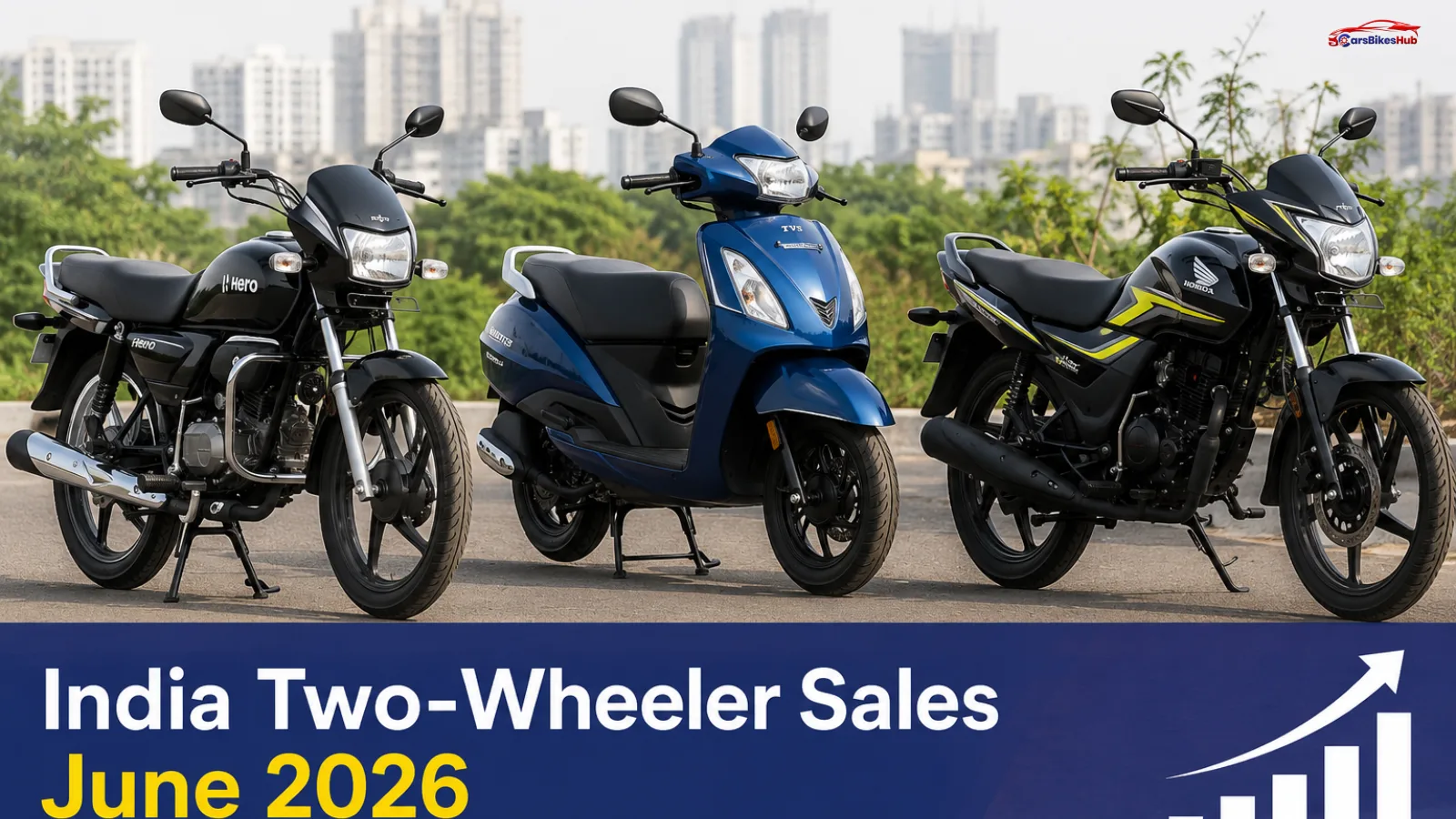
June is usually a quiet month for India’s two-wheeler industry; the festive rush is months away, and dealers are mostly working through routine stock cycles. This June was different. A leadership shuffle that industry watchers have predicted for years finally showed up in the numbers; EV buyers came back to showrooms after a subsidy-driven lull, and one manufacturer crossed a sales milestone it had never touched before.
The biggest talking point wasn’t Hero’s decline or Honda’s steady climb; it was TVS. Hero MotoCorp remained India’s domestic sales leader, with Honda close behind. But when domestic dispatches and exports are combined, TVS Motor Company finished June with the highest overall volume among Indian two-wheeler manufacturers. That’s a milestone that reflects the company’s growing global footprint as much as its success in the domestic market.
Here’s what actually moved the market in June, why it moved, and what it signals for the months ahead.
June 2026 at a Glance
- TVS became India’s largest two-wheeler manufacturer by combined domestic and export sales, not domestic sales alone.
- Hero MotoCorp remained India’s No. 1 in domestic sales, despite a year-on-year dip.
- Honda narrowed its domestic gap with Hero to under 34,000 units.
- Electric two-wheelers recorded their second-strongest month ever.
- Royal Enfield crossed 1 lakh domestic units for a second consecutive month.
India Two-Wheeler Sales June 2026 At a Glance
| Brand | Domestic Sales | Exports | Total Sales | YoY Growth | MoM Growth | |
| Hero MotoCorp | 5,02,890 | 38,269 | 5,41,159 | -4.24% | -6.31% (domestic) | |
| Honda (HMSI) | 4,68,956 | 59,325 | 5,28,281 | ~13% (domestic) | ~2% (domestic) | |
| TVS Motor | 4,11,014 | 1,54,403 | 5,65,417 | +47% | +6.88% (domestic) | |
| Bajaj Auto (2W) | 1,66,956 | 2,22,439 | 3,89,395 | +30% | Decline | |
| Royal Enfield | ~1,02,933 | 11,102 | ~1,14,035 | +33.75% (domestic) | +9.37% (domestic) | |
| Suzuki | 91,264 | 23,766 | 1,15,030 | +21% | -17.05% (domestic) |
Domestic figures are company-reported wholesale dispatches for June 2026 compared with June 2025 and May 2026. FADA’s retail registration count for the industry, a different measure based on actual vehicle registrations rather than dispatches to dealers, came in at 18,28,458 units for June, up 21.22% year-on-year.
Biggest Winners of June
TVS Motor Company is the clear story of the month. Domestic dispatches crossed 4 lakh units for the first time, and when exports are folded in, TVS’s total of 5,65,417 units pushed it past both Hero and Honda for overall volume, a first in the company’s history. The growth wasn’t limited to one segment either: motorcycles grew 42%, and scooters grew 53% year-on-year, meaning the gains weren’t propped up by a single hot model.
Exports of 1,54,403 units meant TVS shipped far more overseas than Hero and Honda combined managed between them, with demand spread across Africa, Latin America, ASEAN and West Asia. A newly refreshed Ntorq 125 lineup and continued dealer expansion for the company’s premium Paddock network added momentum on the domestic side. This wasn’t driven by one blockbuster launch; it was broad-based growth across motorcycles, scooters and exports, making it more sustainable than a temporary spike.
Honda had a quieter but meaningful win: it closed the gap with market leader Hero to just 33,934 units in the domestic market, down sharply from a 77,173-unit gap just one month earlier. Honda’s growth is coming from consistent double-digit gains rather than any single new launch, which suggests steady share capture rather than a one-off spike.
Royal Enfield crossed the 1-lakh domestic sales mark for a second straight month, growing nearly 34% year-on-year. The company is riding a wave of new and refreshed launches, and June also marked the start of deliveries for its first electric motorcycle, the Flying Flea C6, a signal that Royal Enfield intends to defend its premium positioning even as the market electrifies.
Bajaj Auto posted the fastest overall company growth among the legacy players, with total sales (including commercial vehicles) up 28% year-on-year, driven by a 47% jump in exports. Two-wheeler exports alone rose 49% to 2,22,439 units, reinforcing Bajaj’s long-standing position as India’s largest two-wheeler exporter even as its domestic 2W growth was more modest at 12%.
Suzuki grew a solid 21% year-on-year in total sales, with domestic dispatches up 23%, even though the absolute numbers dipped from May’s total.
Brands That Lost Momentum
Hero MotoCorp is the only major manufacturer to post a year-on-year domestic decline in June, down 4.24% from June 2025 and down 6.31% from May. This isn’t really a demand story; Hero remains the largest two-wheeler brand in the country by a wide margin, and it recently updated two of its bestselling commuter models, the Passion+ and Super Splendour XTEC 2.0.
The decline looks more like a base-effect and channel issue: Hero had an unusually strong May, and a chunk of that strength likely came from dealers restocking ahead of expected summer demand rather than end consumers buying in June. When wholesale dispatches run ahead of retail sales for a month or two, a correction the following month is normal. It’s also worth noting that Hero’s numbers include its Vida electric scooter brand, which is now growing fast enough to be cushioning what would otherwise be a steeper decline in the company’s core ICE business.
Bajaj Auto and Suzuki both saw sequential (month-on-month) declines compared to a strong May, though both remained in growth territory year-on-year. Bajaj Auto’s month-on-month decline isn’t unusual because export shipments don’t happen at the same pace every month. A quieter month is often followed by a stronger one. Suzuki’s June numbers tell a similar story, with sales easing after a strong May rather than indicating a significant drop in buyer demand.
Best-Selling Bikes & Scooters
| Segment | Model |
| Mass-Market Scooter | Honda Activa |
| Premium Motorcycle | Royal Enfield Classic 350 |
| Commuter Motorcycle | Hero Splendor+ |
| Electric Scooter | TVS iQube |
On the scooter side, TVS’s Jupiter 125 and Ntorq 125 continued to be strong volume drivers, helped by the mid-month refresh, while Honda’s Activa nameplate remains the segment benchmark that every rival scooter is still measured against.
In motorcycles, TVS’s Apache range and Raider commuter model contributed heavily to the brand’s 42% motorcycle growth, while Hero’s updated Passion+ and Super Splendour XTEC 2.0 are aimed squarely at defending its commuter stronghold. Bajaj’s upcoming revamp of its entire Classic Pulsar lineup, expected in the coming months, is being positioned to shore up a segment where the brand has ceded some ground to newer entrants.
Electric Two-Wheeler Performance
June was one of the strongest months on record for India’s electric two-wheeler segment, and the numbers explain why: the segment logged its second-highest monthly sales total ever, trailing only March 2026. Cumulative electric two- and three-wheeler sales for the first half of CY2026 reached 9,70,611 units, already 72% of the entire 1.34-million-unit record set in all of CY2025.
TVS retained its position as the largest electric two-wheeler player, with the iQube and Orbiter range crossing the 1-million cumulative sales milestone during the month, only the second manufacturer, after Ola Electric, to hit that mark.
Bajaj Auto’s Chetak posted its second-highest month ever too, growing roughly 80% year-on-year and becoming the third Indian e-2W brand to cross 800,000 cumulative sales, with the gap to TVS narrowing steadily month after month.
Ather Energy also logged its second-best month, crossing 30,000 units for only the second time, on the back of continued demand for its family-oriented Rizta scooter, which itself crossed 300,000 cumulative sales.
Hero’s Vida brand had its best growth story of the month: deliveries jumped roughly 175% year-on-year, pushing Vida’s market share into double digits for the first time and putting Hero on track for its first-ever 200,000-unit annual EV milestone.
Ola Electric, once the segment’s runaway leader, continues its slow recovery; June marked its fifth straight month of sequential growth, even though volumes were still down year-on-year and its market share has fallen from roughly 19% a year ago to about 8% now.
Smaller players like Greaves Electric Mobility’s Ampere brand and Simple Energy posted triple-digit percentage growth off a low base, evidence that the segment’s “long tail” is also finding buyers.
Two structural forces are doing most of the work here. First, petrol prices rose through May after multiple hikes, nudging fence-sitting scooter buyers toward EVs on pure running-cost logic. Second, the segment is maturing past its early-adopter phase; the buyers driving this growth increasingly look like everyday commuters rather than EV enthusiasts, and the brands winning are the ones with the widest dealer and service networks (TVS, Bajaj, Hero), not necessarily the ones with the flashiest tech.
What These Sales Numbers Actually Mean
Strip away the brand names, and June 2026 tells a fairly coherent story about where Indian two-wheeler demand is heading.
Rural and semi-urban demand remains the industry’s backbone. Hero’s dip and Honda’s steady climb are both playing out largely in the commuter segment that rural and semi-urban buyers dominate. The fact that overall FADA retail registrations grew a strong 21.22% even as wholesale numbers were mixed suggests real consumer demand at the ground level is healthier than the wholesale figures for any single brand might suggest in isolation.
Exports have become a genuine growth engine, not a side business. TVS overtaking Hero and Honda on combined volume, and Bajaj posting a 47-49% jump in two-wheeler exports, both point to the same thing: Indian two-wheeler manufacturing is increasingly serving global markets, not just the domestic one. For buyers, this mostly matters indirectly; it gives manufacturers more pricing power and scale to invest in new models, since they’re no longer solely reliant on the ebbs and flows of the domestic festive cycle.
Premium and mid-size motorcycles are holding up well. Royal Enfield’s continued 100,000-plus monthly domestic run and its move into electric motorcycles with the Flying Flea C6 both suggest that buyers moving up from entry-level commuters are still willing to spend, even as overall consumer sentiment in the broader economy has been mixed.
EV adoption is shifting from novelty to necessity. With the segment already at 72% of last year’s full-year volume by the halfway mark of CY2026, and legacy dealer-network-backed brands like TVS, Bajaj and Hero pulling ahead of pure EV-first startups like Ola, the electric two-wheeler story in India increasingly looks like a story about distribution and after-sales trust rather than novelty tech.
Financing and affordability continue to matter more than headline growth rates. The brands growing fastest- TVS, Royal Enfield, and the top EV players are generally the ones offering either strong dealer financing tie-ups or attractively priced mid-range variants (the sub-1-lakh EV segment in particular is where the next wave of volume is expected to come from).
Key Takeaways
- TVS Motor overtook Hero and Honda in combined domestic-plus-export volume for the first time in June 2026, driven by record exports and broad-based growth across motorcycles and scooters.
- Hero MotoCorp remains India’s largest two-wheeler brand by domestic volume but posted the only year-on-year decline among major manufacturers this month.
- Honda continued narrowing its gap with Hero, cutting the difference to under 34,000 units.
- Royal Enfield crossed 1 lakh domestic units for a second consecutive month and began deliveries of its first electric motorcycle.
- Bajaj Auto and Suzuki both grew strongly year-on-year despite sequential dips from a strong May.
- India’s electric two-wheeler segment logged its second-best month ever, with TVS, Bajaj Chetak, Ather and Hero Vida all posting standout growth.
- Ola Electric continues a gradual recovery but has lost significant market share compared to a year ago.
- Exports are increasingly central to who “wins” a given month; a brand’s domestic and combined rankings can now tell very different stories.
Final Verdict
On the surface, June 2026 looks like business as usual: Hero and Honda at the top of the domestic charts, TVS a strong third. But the moment exports enter the picture, the real story emerges: TVS Motor is now India’s largest two-wheeler manufacturer by total volume, a milestone that would have seemed unlikely even two or three years ago.
Hero’s dip looks more like a channel correction than a demand problem, but it does need its upcoming launches and Vida’s EV growth to translate into a rebound over the next couple of months. For buyers, the immediate takeaway is that competition across every price band, from budget commuters to premium motorcycles to electric scooters, is intensifying, which typically means more new launches, sharper pricing and better financing offers in the months ahead.


FAQs
Which company sold the most two-wheelers in India in June 2026?
On domestic sales alone, Hero MotoCorp remained number one. But including exports, TVS Motor Company had the highest total volume, at 5,65,417 units.
Which two-wheeler brand grew the fastest in June 2026?
TVS Motor Company posted the strongest growth among the major manufacturers, with total sales up 47% year-on-year.
Why did Hero MotoCorp's sales decline in June 2026?
Hero's domestic dispatches fell year-on-year and month-on-month, largely reflecting a correction after an unusually strong May, rather than a fundamental drop in consumer demand.
Did electric two-wheeler sales increase in June 2026?
Yes. June was the segment's second-best month on record, with cumulative first-half sales for 2026 already at 72% of all of 2025's volume.
Which company led electric two-wheeler sales in June 2026?
TVS retained the top spot with its iQube and Orbiter range, with Bajaj Chetak and Ather Energy close behind; Hero's Vida brand posted the fastest growth of the major players.