
























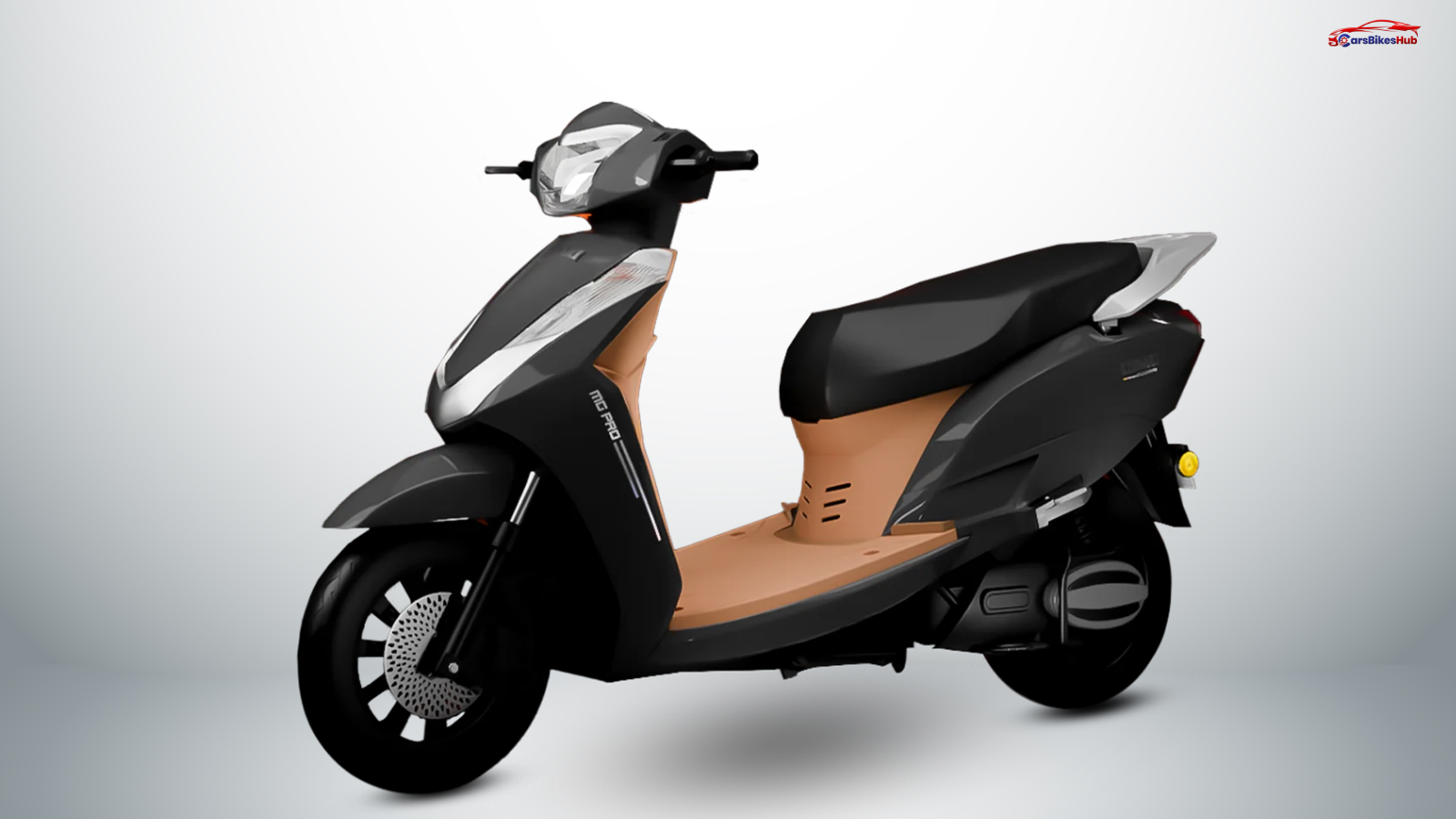
Affordable electric scooters are becoming more capable every year, but choosing one isn’t just about the claimed range anymore. The new Komaki MG Pro V promises a metal body, a LiFePO₄ battery and a sub-₹75,000 price tag, but do these features actually make it a better buy than rivals from Ola, TVS, Bajaj, Ampere and Hero Vida?
Buying an electric scooter is about more than specifications. This article explains what the Komaki MG Pro V offers in day-to-day riding, ownership and long-term value before you make a decision.
Komaki MG Pro V at a Glance
| Parameter | Detail |
| Ex-showroom price | ₹73,999 |
| Motor | 2.2 kW BLDC hub motor |
| Battery | LiFePO₄ (lithium iron phosphate) |
| Claimed range | 90–100 km |
| Top speed | 50–60 km/h |
| Charging time | Approx. 4–5 hours (full charge) |
| Brakes | Front disc, rear drum |
| Suspension | Telescopic front, dual shock rear |
| Warranty | Standard Komaki EV warranty (battery and motor covered; confirm exact tenure at dealership) |
| Best for | First-time EV buyers and city commuters prioritising price over brand pedigree. |
What’s New?
The MG Pro V isn’t a brand-new nameplate; Komaki sold an earlier MG Pro V around ₹69,999 with a plastic-bodied design back in late 2024. What’s launched now, alongside a more premium MG Pro+, is essentially a re-engineered version built around two specific changes: an all-metal body replacing the fibre panels used on most scooters in this price band, and a switch to LiFePO₄ cells instead of the graphene or standard lithium-ion packs Komaki uses lower in its range.
The company’s own framing is that affordability shouldn’t mean compromising on construction quality; features like metal bodywork and long-life batteries have traditionally been reserved for pricier scooters from established brands.
Komaki MG Pro V Price in India
At ₹73,999 ex-showroom, the MG Pro V undercuts nearly every mainstream rival by a significant margin. Factor in RTO registration and insurance, and expect an on-road price somewhere in the ₹80,000–₹84,000 range depending on your city. EV registration costs are typically lower than for petrol scooters since most states waive road tax on electric vehicles.
For context, the step-up MG Pro+ is priced at ₹79,999 and trades some top speed parity for a considerably longer claimed range (150+ km) and bigger under-seat storage. If your daily commute is genuinely short, under 30 km round trip, the MG Pro V’s lower price is easy to justify. If you routinely ride longer distances or want more of a range buffer, the ₹6,000 premium for the MG Pro+ is worth considering before you commit.
Where the MG Pro V Sits in Komaki’s Lineup
Komaki currently sells three distinct scooters under the “MG Pro” naming lineage: the base MG Pro (₹53,999–59,999, offered with either a Graphene or LiFePO₄ battery), the MG Pro V reviewed here (₹73,999, metal body, LiFePO₄), and the MG Pro+ (₹79,999, metal body, LiFePO₄, longer range).
These are separate models with their own listings and spec sheets, not trim levels you pick within a single MG Pro V purchase. However, Komaki’s shared naming and some aggregator sites do loosely group them as a “family.”
The step from the base MG Pro to the MG Pro V is almost entirely about build materials and battery chemistry rather than added features; both use similar dashboards, connectivity, and storage concepts. Buyers who don’t care about the metal body and are fine with a shorter-lived graphene cell can save nearly ₹20,000 by sticking with the standard MG Pro. Those who want the sturdier build without paying for the MG Pro+’s bigger range are the target audience for the MG Pro V specifically.
Battery, Range & Performance
The 90-100 km claimed range is an ideal-condition figure, measured under Indian testing cycles that assume steady speeds, no traffic stops, and a single rider. In real city riding, stop-start traffic, air-conditioning-adjacent heat, and two-up riding occasionally, expect closer to 55–70 km on a full charge.
That’s still comfortably enough for a daily commute of 25-35 km with charging every couple of days, but it’s not a scooter you want to push toward the edges of its range regularly.
The 2.2 kW BLDC hub motor and 50–60 km/h top speed put this scooter squarely in commuter territory rather than performance territory. Acceleration off the line is adequate for city traffic and keeping pace with other two-wheelers, but this isn’t a scooter that will feel quick on an open stretch, and highway merging above 55 km/h will feel strained. If your commute includes stretches of open road at higher speeds, this is a genuine limitation to weigh against the price advantage.
Charging & Running Costs
A full charge takes roughly 4-5 hours on a standard home socket, which fits comfortably into an overnight charging routine. At typical residential electricity rates, a full charge costs somewhere in the ₹15-25 range depending on your state’s tariff, working out to a running cost of roughly ₹0.20-0.30 per kilometre, a fraction of what a petrol scooter costs to run at current fuel prices.
LiFePO₄ chemistry is the more relevant running-cost consideration here, more so than the charging bill itself. LiFePO₄ cells are generally more thermally stable and tend to retain usable capacity over more charge cycles than standard lithium-ion or graphene packs, which matters for how gracefully your range holds up three or four years into ownership.
That said, “generally more durable” chemistry doesn’t remove the need to check Komaki’s specific battery warranty terms at the point of purchase; cell chemistry alone doesn’t tell you what happens if the pack degrades or fails within the warranty period.
Ride & Comfort
Telescopic front suspension paired with dual rear shocks should deliver reasonably composed handling over city roads and moderate bumps, though the tuning on Komaki’s scooters in this segment has historically prioritised a firm, stable ride over outright plushness; expect some harshness transmitted through on sharper potholes. The riding platform is described as spacious, which should help with foot positioning for taller riders and make it easier to carry a bag between your feet.
Given the family-commuter positioning shared across the MG Pro line, pillion comfort should be reasonable for short trips, though scooters at this price point rarely match the two-up comfort of pricier, longer-wheelbase rivals like the Bajaj Chetak or TVS iQube. If pillion riding is a frequent, not occasional, part of your use case, a test ride with a passenger before buying is worth the extra effort.
If possible, take a test ride over broken roads before booking. Ride comfort and suspension tuning are highly subjective, and a short test ride can reveal more than specifications ever will.
Design & Build Quality
The headline change on the MG Pro V is the shift from fibre body panels to an all-metal construction, which Komaki positions as a durability upgrade. Metal panels are generally more resistant to cracking from minor impacts, harsh sun exposure over years, and the general wear of Indian road conditions compared to fibre-reinforced plastic.
Does the metal body actually make a difference? In practical terms, yes, but with a caveat. Metal panels typically hold up better against scrapes, minor tip-overs, and long-term UV degradation than plastic ones, which can matter for resale value and how the scooter looks after two or three monsoons.
However, metal also adds weight and can be more prone to dents (versus flexing back into shape, as plastic sometimes does) and rust if the paint is chipped and not touched up. It’s a genuine upgrade for buyers planning to keep the scooter long-term in harsher conditions, but it’s not an unambiguous win over fibre-bodied rivals in every scenario.
Features & Technology
App connectivity for real-time battery health and range monitoring is useful day-to-day rather than a gimmick, since it helps you plan charging around actual remaining range instead of guessing. The anti-theft lock and remote locking add real security value for street parking. A repair/service switch and self-diagnosis with onboard sensors can help catch developing issues (like sensor faults or battery irregularities) before they become breakdowns.
The “vivid smart dash” and cosmetic styling touches are pleasant but don’t change your ownership experience in any functional way. Mobile charging ports are convenient but not a differentiator versus rivals, most of which now offer similar conveniences.
Safety
The MG Pro V’s front disc brake is a meaningful safety upgrade over drum-only setups still found on cheaper scooters, offering better stopping power and modulation, particularly in wet conditions. Combined with telescopic front suspension, the braking and handling package should feel confidence-inspiring for city speeds.
Where this scooter is behind pricier rivals is the absence of features like ABS or combined braking systems that some competitors in the ₹85,000-plus segment now offer; worth checking directly with your dealer, as advertised safety features can vary slightly by variant and by the time you’re reading this.
Ownership Experience
Komaki’s biggest asset on paper is its dealer network. The company states that it has a network of over 1,000 authorised dealerships spread across more than two dozen states, which matters enormously for after-sales service and spare parts availability in Tier-2 and Tier-3 towns where legacy brands and EV-only start-ups sometimes have thinner coverage.
Buyers should verify the service capability of their nearest outlet before purchasing rather than assuming national numbers apply evenly everywhere. Since Komaki’s service quality can vary by dealership, checking customer reviews of your nearest service centre before buying is a good idea; it’s a five-minute search that can save a lot of frustration later.
Resale value is the honest weak spot for any newer or less-established EV brand compared to a Bajaj, TVS, or even Ola at this point; the second-hand EV scooter market in India is still maturing, and buyers should go in expecting resale value to be a smaller consideration than it would be for a petrol scooter, regardless of which brand they choose.
Rivals
| Scooter | Price (approx., ex-showroom) | Best For |
| Ola S1 X | ₹85,000-90,000 | Performance and charging network |
| TVS iQube | ₹1.13-1.15 lakh | Reliability and ride refinement |
| Bajaj Chetak | ₹1.06-1.11 lakh | Premium build and comfort |
| Hero Vida VX2 | ₹99,490 outright (from ~₹44,990-74,000 under BaaS) | Battery swapping / BaaS flexibility |
| Ampere Magnus | ₹89,900-94,900 | Family commuting |
Ola S1 X: Faster and longer-range, backed by Ola’s charging network, but priced well above the MG Pro V and with a mixed reputation for after-sales consistency.
TVS iQube: A more mature, higher-quality product with better ride refinement and a strong service network, but roughly 50% pricier.
Bajaj Chetak: Known for solid build quality and a comfortable ride; a better long-term bet if budget stretches that far.
Ampere Magnus: A reasonable family-scooter alternative, though the MG Pro V undercuts it substantially on price for similar use cases.
Hero Vida VX2: Vida’s removable battery and Battery-as-a-Service model change the running-cost math entirely and are worth comparing directly if you’re open to a different ownership structure.
The clearest takeaway: nothing else at this price point offers a metal body and a LiFePO₄ pack together. Everything that beats the MG Pro V on range, speed, or brand trust costs meaningfully more.
What Makes the Komaki MG Pro V Different?
The sturdier feel of the metal panels versus a typical fibre-bodied budget scooter, and the reassurance of app-based battery monitoring, are both things you interact with daily.
Phrases like “premium build quality” and “confidence-inspiring” in press material are aspirational framing around what is, functionally, a well-specified commuter scooter rather than a luxury product. The metal body and LiFePO₄ battery are real, meaningful upgrades, but they don’t put this scooter in direct competition with a TVS iQube or Bajaj Chetak in terms of overall polish, just in terms of specific component choices.
Should You Buy It?
Buy it if: your daily commute is under 30–35 km, you want a lower upfront cost than the big brands, and you value durability features like a metal body and a longer-lasting battery chemistry over outright range or top speed.
Skip it if: you regularly ride longer distances, want strong resale value, need highway-capable speeds, or you’re prioritising a mature service and charging ecosystem over sticker price.
Best suited for: first-time EV buyers, budget-conscious city commuters, and small families who want a scooter that feels sturdier than typical budget offerings without stretching into the ₹85,000-plus bracket.
Consider another scooter if:-
- You ride more than 50 km every day.
- You frequently travel on highways.
- You value resale above purchase price.
- You want a more mature service network.
- You prefer a stronger brand reputation.
Final Verdict
The Komaki MG Pro V earns its place in the conversation for one clear reason: it brings two components- a metal body and a LiFePO₄ battery- usually found on pricier scooters down to a sub-₹75,000 price point. That’s a legitimate value proposition, not just a marketing claim. But it doesn’t erase the gap in range, speed, resale confidence, and after-sales maturity that separates Komaki from more established EV players.
If your use case fits a modest daily commute and price is your primary constraint, the MG Pro V is a sensible, well-specified choice. If you can stretch the budget by ₹10,000–₹15,000, though, it’s worth cross-shopping the Ampere Magnus or Vida VX2’s BaaS variants before finalising.



FAQs
Is the Komaki MG Pro V worth buying?
Yes, for buyers with short daily commutes who want a durable, well-equipped scooter at a lower price than mainstream brands; less so if you need long range or higher speeds.
Is the Komaki MG Pro V claimed 90–100 km range realistic?
Not in daily city use. Expect roughly 55–70 km in real-world traffic conditions, with the full claimed range achievable mainly under steady, ideal riding conditions.
How long does it take to charge the Komaki MG Pro V?
Around 4–5 hours for a full charge from a standard home socket.
What's the battery warranty on the MG Pro V?
Confirm exact terms with your Komaki dealer at the time of purchase, as warranty coverage details can vary by variant and update over time.
Is Komaki a reliable brand?
Komaki has a large dealer network across India, which helps with service access, though its long-term reliability track record is still shorter than established two-wheeler manufacturers like TVS or Bajaj.