










Hero MotoCorp has committed another ₹1,000 crore to Ather Energy, a move that has generated plenty of headlines. But if you’re planning to buy an electric scooter, the bigger question isn’t how much Hero is investing; it’s whether that investment changes anything for buyers. While it won’t transform the scooters on sale overnight, it could influence the future of Ather and Hero’s EV ambitions.
Here’s what has been officially confirmed, what it means for buyers, and what remains speculation.
Quick Overview
| Buyers want to know | Quick answer |
| Will this launch new scooters? | Not immediately; no product tied to this specifically |
| Will Ather improve over time? | Likely, as growth capital funds R&D and expansion |
| Will Hero Vida continue? | Yes, there’s no sign of it slowing down |
| Should I wait to buy? | Not for this reason alone |
| Does this affect current owners? | Mostly reassuring, in terms of long-term stability |
| Does this affect pricing? | No indication of that |
What Has Hero MotoCorp Actually Announced?
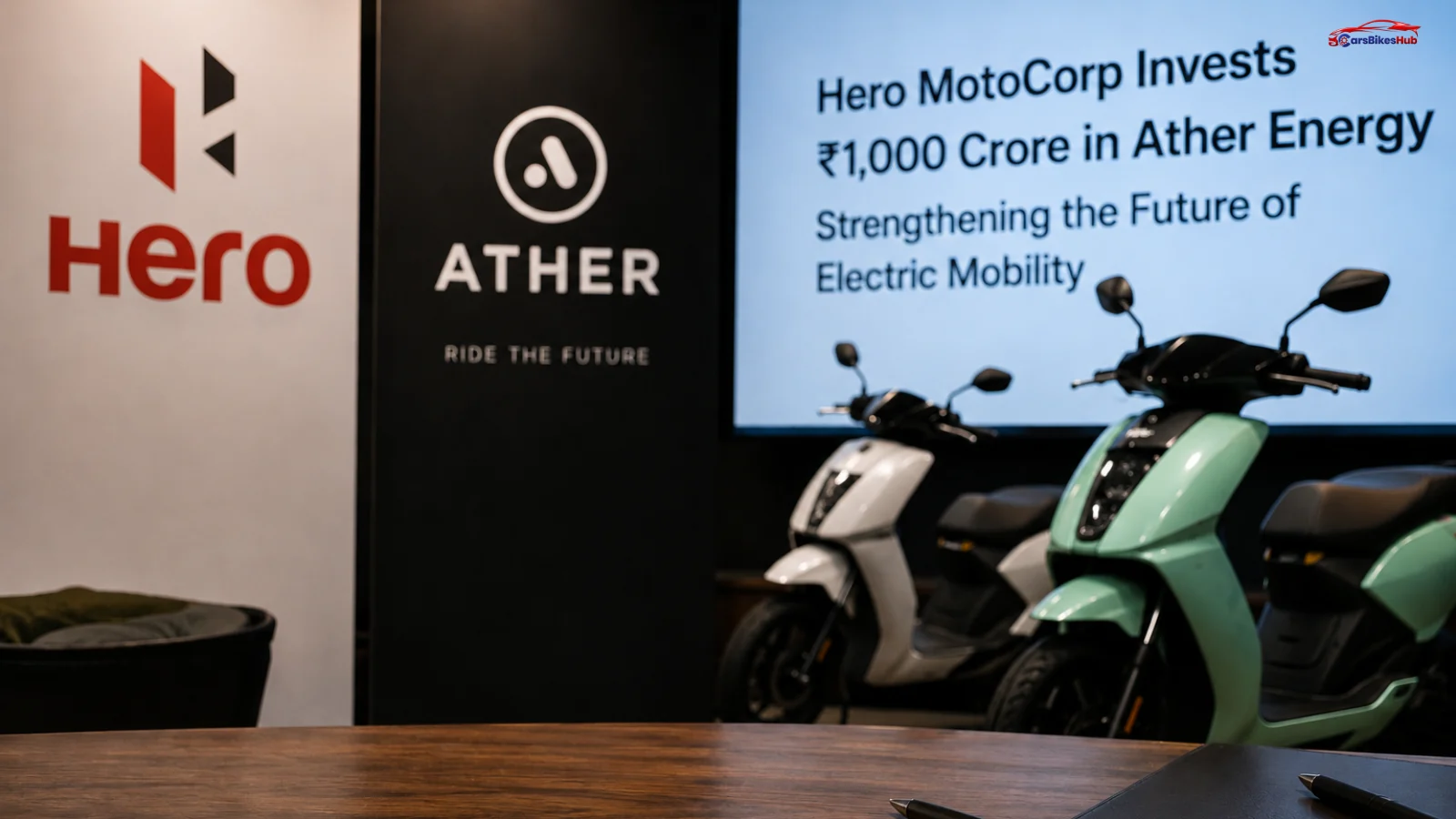
On July 14, 2026, Hero’s Committee of Directors approved an additional investment of up to ₹1,000 crore in Ather Energy. The money goes in as cash, through a preferential allotment, Hero subscribing to new shares or securities that Ather itself issues, rather than buying shares from someone else on the market.
Hero already owns 29.48% of Ather on a fully diluted basis (as of June 30, 2026), so this is really about an existing investor putting in more, not a new relationship forming. Because of that existing stake, the deal counts as a related-party transaction, which is a standard regulatory classification rather than anything unusual. Hero has said no promoters or promoter-group entities have a personal stake in it.
The deal still needs sign-off from Ather’s own board and shareholders, and is expected to close within about 15 days once that final approval comes through.
Understanding why Hero made this investment helps explain whether it could have any real impact on future electric scooters and long-term ownership.
Why Is Hero Putting More Money In?
Hero hasn’t given a detailed public rationale beyond backing Ather’s growth, but the context isn’t hard to read. Ather has grown quickly; its revenue has more than doubled over the past two years, and it recently widened its lineup with the Rizta, a family-focused scooter aimed at a broader buyer base than its earlier performance models.
Scaling that kind of growth costs money: more manufacturing capacity, more service centres, continued work on batteries and software. Hero, as Ather’s largest strategic backer, is a natural source for a chunk of that funding. It also lets Hero keep a stake in a fast-growing, listed EV player without betting everything on Vida alone.
Anything beyond this-, predictions about shared platforms or the two brands eventually merging in some way- is analyst speculation. Neither company has said anything of the sort.
What Does This Mean for Buyers?
This is the part that actually affects a buying decision.
The clearest, most direct benefit is financial confidence. A lot of the hesitation around buying from a young EV company comes down to a fair worry: will they still be around in five or seven years to honour warranties and keep parts available?
A well-funded backer with a near-30% stake has every reason to keep Ather stable, and that’s a genuine reassurance for anyone thinking long-term about ownership costs.
Beyond that, don’t read too much into it. The ₹1,000 crore is growth capital, not a product roadmap. It should support continued expansion of Ather’s charging network, service footprint, and software development at roughly the pace it’s already going, but there’s no new scooter, no service tie-up with Hero dealerships, and no price change attached to this specific announcement. If any of that happens later, it’ll come as its own separate news.
Will This Improve Ather Ownership Over Time?
For people who already own an Ather, or are close to buying one, here’s how this likely plays out across the things that actually matter day to day:
Software. Ather has a solid track record with over-the-air updates through Atherstack, and continued R&D funding supports that continuing. No changes expected in the near term either way.
Charging. Ather Grid should keep expanding as part of normal business growth, funded partly by rounds like this one. No new charging commitments have been announced specifically because of this investment, though.
Service network. Growth capital typically goes toward exactly this: more centres, faster turnaround. Nothing concrete has been promised yet, but it’s a reasonable expectation given the funding purpose.
Resale value. A financially stronger backer generally helps buyer confidence, which tends to support resale over time. It’s one factor among several, not a guarantee.
Battery technology and accessories. No specific announcements, but continued funding supports the kind of steady iteration Ather has shown in the past.
None of this changes how your scooter rides or performs tomorrow. It mostly changes how confident you can feel about the company behind it sticking around.
What About Hero Vida?
A fair question: if Hero keeps funding Ather, is Vida being sidelined?
There’s nothing to suggest that. Hero has continued developing and selling Vida scooters alongside this investment, and nothing in the announcement points to Vida being wound down or folded into Ather.
The more reasonable read is that Hero is running two brands with different jobs: Vida aimed at value-conscious, mass-market buyers, and Ather (an independently listed company) competing in the premium, tech-forward segment. At the moment, Hero appears to be pursuing a dual-brand EV strategy rather than choosing one over the other. Whether the two eventually converge in some way is genuinely unknown, and worth treating as speculation until either company says otherwise.
Could This Lead to Better Hero and Ather EVs in the Future?
Nothing specific has been announced, but it’s worth understanding why a deeper financial tie can still matter for product quality down the line, even without a formal merger of technology or teams.
Hero gets closer visibility into Ather’s battery management and software work by staying a large shareholder, the kind of expertise that’s expensive and slow to build from scratch. Manufacturing scale is another area where a bigger, better-funded Ather indirectly benefits Hero’s own EV ambitions, since a stronger supplier and component ecosystem in India helps every brand sourcing from it, Vida included.
None of this guarantees shared platforms or joint development. But it’s a reasonable, non-speculative way to think about why Hero keeps backing Ather financially rather than simply competing with it; the two companies’ growth is genuinely linked, even if their product lines stay separate for now.
Should You Buy an Ather Now or Wait?
Buy now if an Ather model already fits your budget, range needs, and features today. This investment doesn’t change any of that in the near term, and there’s a case for feeling more confident about the company’s staying power right now, not less.
Wait if you were specifically hoping this news meant a new model or price drop is coming; that hasn’t been confirmed, so it’s not a solid reason to hold off. It’s also worth waiting a bit if you’re curious how competitors respond over the next couple of quarters, purely for comparison shopping.
For most buyers evaluating an Ather scooter on its current merits, this announcement shouldn’t move the decision much either way.
Does This Change the Competition?
TVS continues to compete directly with Ather and Vida through its iQube range, and a better-funded Ather likely keeps that rivalry sharp rather than easing it.
Bajaj, expanding its Chetak lineup, faces similar pressure to keep investing in scale and R&D as rivals get more capital behind them.
Ola Electric, which has had a rockier run on service and quality perception, may feel added pressure to show it has the same kind of financial and operational stability.
Honda and Suzuki, both relatively late to India’s electric two-wheeler market, will be watching how fast the established players scale before deciding how aggressively to compete on price and features.
Hero Vida keeps operating as a separate line aimed at a different buyer, at least for now.
For buyers, more capital in the segment generally means more competition on price and features over time. It doesn’t change what’s available to buy this week, but it’s a reasonable sign of where the market is heading.
Final Verdict
If you were planning to buy an Ather scooter next month, this investment alone isn’t a reason to change your timeline. It strengthens confidence in Ather’s future rather than changing the value of the scooter you can buy today.
Treat it as useful background, not a buying signal. If Hero or Ather follows this up with an actual product or service announcement, that’s when it’ll be worth revisiting your decision.




FAQs
Why did Hero MotoCorp invest more money in Ather Energy?
To support Ather's growth, manufacturing, R&D, and infrastructure after two years of sharp revenue growth.
Does Hero MotoCorp own Ather Energy?
Hero holds 29.48% of Ather's fully diluted capital as of June 30, 2026, making it Ather's largest strategic investor, though not a majority owner.
Is this a new partnership between Hero and Ather?
No. Ather has been an associate company of Hero for years; this is an additional investment in an existing relationship.
Will Ather scooters change because of this investment?
Nothing has been confirmed. It's growth capital, not a product announcement.
Will Hero MotoCorp increase its stake in Ather again?
There's no official confirmation of further investment beyond this round. Any future increase would depend on Hero's strategic decisions and the usual regulatory approvals.