























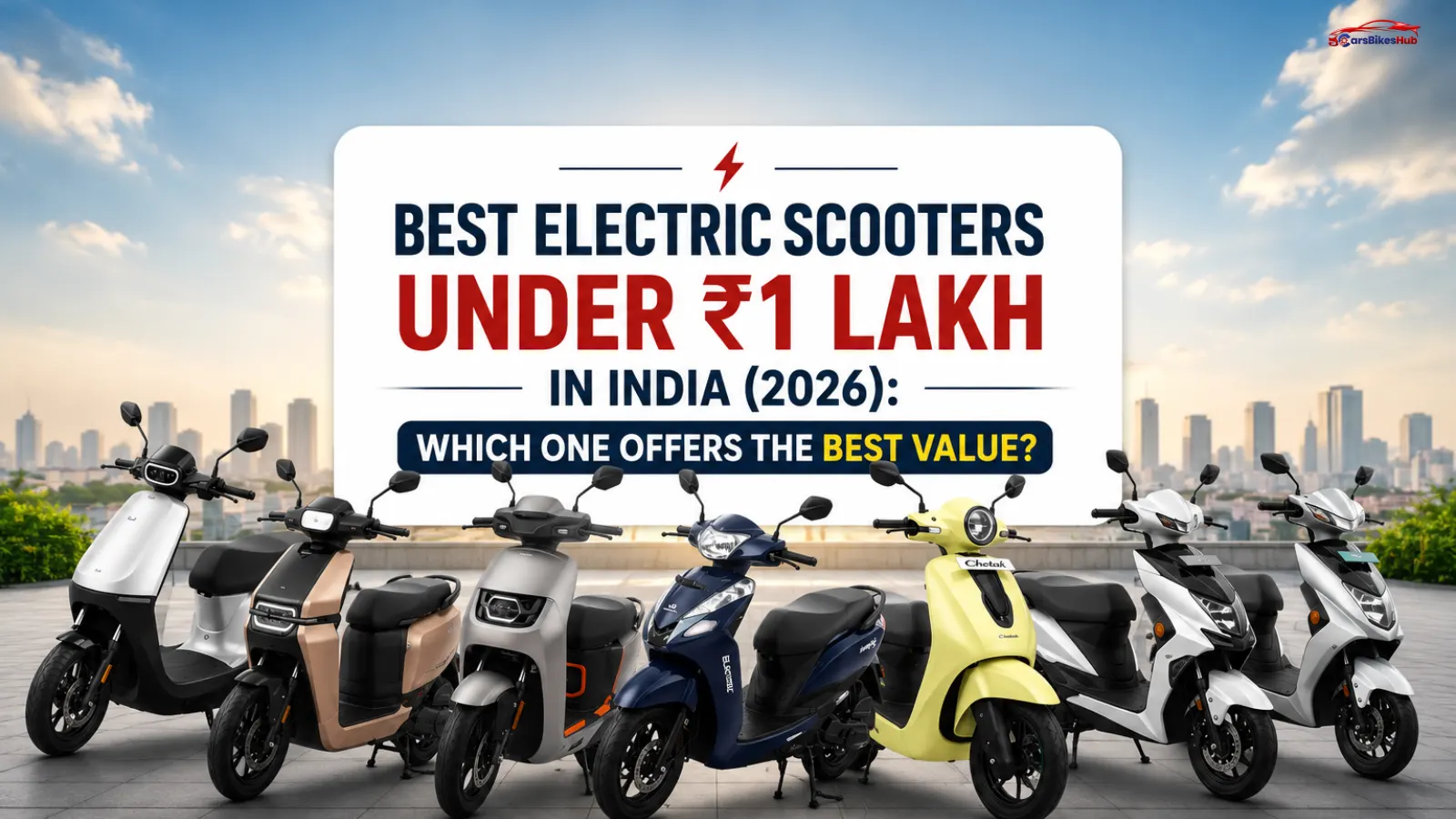
With petrol prices staying high and electric scooters becoming more affordable, many buyers now have one simple question: which are the best electric scooters under ₹1 lakh that actually offer the best value? The answer isn’t as straightforward as picking the one with the biggest claimed range. Service support, charging convenience, battery warranty and real-world usability often matter far more over the next five years of ownership than any number on a spec sheet.
Some scooters promise long claimed range but skimp on brakes and build quality. Others come from brands with barely any service centres near you. A few only look affordable until you check what the “under ₹1 lakh” price actually includes.
This article skips the top-10 ranking approach. Instead, it walks through every scooter that genuinely sits at or near the ₹1 lakh mark in 2026, what each one is actually good at, and who should buy which one. Prices, ranges, and specs mentioned below are ex-showroom figures gathered from manufacturer listings and dealer sources as of July 2026; always confirm the final on-road price at your nearest dealership, since state RTO charges, insurance, and local subsidies change the number you’ll actually pay.
Quick Comparison Table
| Scooter | Starting Price (ex-showroom) | Claimed Range | Real-World Range (est.) | Charging Time (0-80%) | Top Speed | Best For |
| Ola S1 X | ₹79,999 | 108–242 km | 75–170 km | ~4-5 hrs | 101–125 km/h | Value seekers wanting max range |
| TVS Orbiter | ₹84,500 | 86–158 km | 60–110 km | ~2.5-4 hrs | 68 km/h | Delivery riders, storage-focused buyers |
| Bajaj Chetak C2501 | ₹91,399 | 113 km | 80–90 km | ~2.5 hrs | 63 km/h | Buyers who want Bajaj’s service network |
| Hero Vida VX2 Go | ₹79,490 | 92–142 km | 65–100 km | ~1 hr (fast charge) | 70 km/h | Apartment dwellers needing home charging |
| Ampere Magnus EX | ₹84,900 | 80–121 km | 55–80 km | ~5-6 hrs | 50–53 km/h | Slow-and-steady family commutes |
| Komaki X One | ₹34,999 | 60–150 km | 40–100 km | ~4-5 hrs | 25–60 km/h | Tightest budgets, students, license-free riding |
| iVOOMi S1 | ₹54,999 | 75–110 km | 50–75 km | ~2-4 hrs | 55–58 km/h | First-time EV buyers on a modest budget |
Real-world range is always lower than the claimed IDC (Indian Driving Cycle) figure. Treat the claimed number as a lab result and the real-world estimate as what you’ll actually see with a rider on board, in city traffic, with the AC-heavy Indian climate working against the battery. None of the brands on this list publishes independently instrumented real-world range data, so the estimates above are based on a combination of owner-reported figures from user reviews and the typical 30-40% gap between claimed and real-world range seen across this segment, not a lab test. Confirm with a test ride on your own route before you commit.
Best Electric Scooters Under 1 lakh Summary
If you’re short on time, here’s the quick version:
- Best Overall: Ola S1 X, the strongest all-round mix of range, performance and features
- Best Value: TVS Orbiter, the most practical feature set without crossing ₹1 lakh
- Best Range: Ola S1 X (4 kWh variant), highest real-world range in this bracket
- Best Service Network: Bajaj Chetak and TVS Orbiter — both lean on decades-old dealer infrastructure
- Best for Students: Komaki X One, licence-free below 25 km/h, priced under ₹40,000
- Best Family Scooter: Bajaj Chetak C2501, comfortable ride, dependable service backup
The full reasoning behind each of these picks is in the sections below.
A Closer Look at Each Scooter
Ola S1 X
Price:
The Ola S1 X starts at roughly ₹79,999–84,999 for the base 2 kWh variant and goes up to around ₹1.15 lakh for the 4 kWh variant, depending on the dealership and state. The larger-battery S1 X Plus variants push past ₹1.2 lakh, so if you want to stay under ₹1 lakh, you’re looking at the 2 kWh or 3 kWh trims.
Real-World Range:
Ola claims up to 242 km on the 4 kWh pack and 108 km on the base 2 kWh pack. In real-world city riding with a single rider, expect closer to 65-70% of the claimed figure, so somewhere between 75 km and 170 km depending on variant, riding mode, and how often you use Sport mode.
Highlights:
The quickest scooter on this list; higher variants get an 11 kW motor with a genuinely fast 0-40 km/h sprint, and top speed ranges from 101-125 km/h. A full charge takes 4-5 hours, with no bundled home fast-charging (Ola relies on its own hypercharger network in select cities). On the features side: a 5-7 inch touchscreen with navigation, Bluetooth music, OTA updates, a 34-litre boot that fits a full-face helmet, and reverse mode for tight parking.
Things to consider:
Ola’s after-sales service has been the most talked-about weak point for this brand for a few years now. Response times and parts availability vary sharply by city, strong in metros, patchy in smaller towns. The fixed (non-removable) battery also means you can’t charge it away from where the scooter is parked. Skip the Ola S1 X if you don’t have a dependable service centre nearby, if you need a removable battery for indoor charging, or if you live in a tier-3 town where Ola’s presence is still thin.
Verdict:
The best value-for-range scooter on this list, but only if your city has dependable Ola service. If you’ve had a mixed experience with Ola service in your area, weigh that against the range advantage before deciding.
TVS Orbiter
Price:
The Orbiter starts at around ₹84,500 ex-showroom for the base V1 (1.8 kWh) variant, with the larger V2 (3.1 kWh) variant priced from roughly ₹95,000 to just over ₹1.1 lakh depending on the city. A Battery-as-a-Service (BaaS) option can bring the upfront price down to under ₹60,000, with a separate monthly battery subscription.
Real-World Range:
TVS claims 86 km on the smaller battery and up to 158 km on the bigger pack. Expect real-world range in the 60-110 km band, which comfortably covers most urban commutes without daily charging anxiety.
Highlights:
Not a quick scooter; top speed tops out at 68 km/h, tuned for efficiency over acceleration, and rated for only modest inclines. Charging takes around 2 hours 20 minutes to 80% on the smaller battery (a bit longer on the bigger pack), faster than most rivals here. A genuinely useful 34-litre boot fits two helmets, a 14-inch front wheel handles potholes better than the 12-inch wheels most rivals use, and cruise control plus reverse parking assist are unusual at this price.
Things to consider:
No disc brake option on either variant; you’re relying on drum brakes front and rear, a real compromise for Indian roads. Charging speed and range trade-offs mean this isn’t the scooter for long daily commutes. Skip the Orbiter if performance and quick acceleration matter to you, or if you specifically want a disc brake for extra stopping confidence.
Verdict:
Not the most exciting scooter here, but arguably the most dependable one to actually own for years, thanks to TVS’s service network. The lack of a disc brake is a genuine drawback worth test-riding around before you buy.
Bajaj Chetak C2501
Price:
The entry Chetak C2501 launched at around ₹91,399–96,400 ex-showroom, positioned as Bajaj’s answer to the sub-lakh demand created by the Orbiter and Vida VX2. Higher C35-series variants with bigger batteries go well past ₹1.2 lakh.
Real-World Range:
Bajaj claims 113 km IDC range on the C2501’s 2.5 kWh battery. Real-world figures from owners of the broader Chetak range typically land around 80-90 km for the smaller-battery variants, enough for most urban commutes but not much more.
Highlights:
Top speed is a modest 63 km/h, not built for speed, but delivers a smooth, planted ride helped by the metal body Chetak is known for. Charging takes around 2 hours 25 minutes on the standard charger to 80%, quick for this segment. A 25-litre boot, LED lighting, Bluetooth with music playback, and a USB charging port round it out; to keep costs down, the C2501 uses a simpler reverse-LCD console instead of a TFT screen, and a conventional key instead of a smart key.
Things to consider:
Storage is smaller than most rivals here (25 litres versus 33-34 litres on the Orbiter and Ola S1 X), and the fixed battery means no home charging flexibility if you don’t have dedicated parking. Skip the Chetak C2501 if boot space is a priority or if you don’t have dedicated parking near a charging point.
Verdict
The Chetak’s core appeal, a proper metal body and Bajaj’s unmatched service network, now comes at a genuinely accessible price. It’s not the longest-range or most feature-loaded scooter here, but it’s likely the easiest one to live with for years.
Hero Vida VX2 Go
Price:
The VX2 Go starts at ₹79,490 ex-showroom for the base 2.2 kWh variant, going up to roughly ₹99,490 for the 3.4 kWh Go variant. A Battery-as-a-Service scheme can bring the upfront cost down further, with usage-based battery charges on top.
Real-World Range:
Hero claims 92 km on the base variant and up to 142 km on the larger-battery Go variant. Expect real-world figures in the 65-100 km range depending on the pack you choose and how much Eco mode you use.
Highlights:
Top speed is around 70 km/h with 6 kW peak power and 26 Nm torque, adequate for city use without feeling gutless at signals. The VX2’s standout feature is its removable battery, which charges fast, reaching 80% in under an hour at Vida’s network of 4,600+ charging stations or via a standard socket at home, genuinely useful if you don’t have a dedicated parking-area charging point, since you can carry the battery indoors like a large power bank. A 33.2-litre boot, TFT display, connectivity features, and OTA updates round out the package.
Things to consider:
No ABS on this variant, and the smaller 2.2 kWh battery’s real-world range is on the lower side for anyone commuting more than 20-25 km one way. Carrying a battery pack indoors daily is convenient but does add a bit of physical effort compared to plug-and-charge scooters. Skip the VX2 Go if you regularly travel 50+ km in a day, or if you’d rather not deal with carrying a battery pack indoors.
Verdict:
If home charging access is your biggest constraint, the VX2 Go’s removable battery solves a real problem that most rivals on this list don’t address at all.
Ampere Magnus EX
Price:
The Magnus EX is priced from around ₹84,900 to roughly ₹1.05 lakh depending on variant and state incentives.
Real-World Range:
Ampere claims figures ranging from 80 km to 121 km across different battery configurations reported by dealers, though real-world range for most owners sits closer to 55-80 km, on the lower end for this price bracket.
Highlights:
The slowest scooter in this list, with a top speed of just 50-53 km/h and a modest 1.2-2.1 kW motor, built for gentle city commuting, not overtaking on the highway. A full charge takes 5-7 hours, noticeably slower than most rivals here. On the plus side: a removable 2.2-2.3 kWh lithium-ion battery, CBS braking, and a 5-year or 20,000 km warranty on the motor, controller, and battery pack one of the longer warranty periods in this segment.
Things to consider:
Performance and charging speed both lag behind newer rivals. There’s no touchscreen, app connectivity, or navigation; this is a back-to-basics scooter. Skip the Magnus EX if you want quick charging, touchscreen connectivity, or anything beyond gentle, short-distance city riding.
Verdict:
The long warranty period is a genuine plus, but the slow charging and modest performance make this a scooter for buyers who prioritise simplicity and low running costs over anything flashy.
Komaki X One
Price:
The Komaki X One is the most affordable scooter on this list by a wide margin, starting at ₹34,999 for the base Graphene variant and going up to roughly ₹59,999-63,000 for the top Ace/Prime variants.
Real-World Range:
Claimed range varies wildly across the five variants, from 60 km on the base Graphene pack to 150 km on the top 2.2 kWh variant. Real-world figures typically run 30-40% lower, so treat the top-end claim as an optimistic ceiling.
Highlights:
The base variants are capped at 25 km/h, which under Indian regulations means no driving licence or registration is required, a genuine draw for younger riders or those without a licence. The Ace and Prime variants unlock 50-60 km/h but then require standard registration and a licence like any other scooter. A full charge takes around 4-5 hours, varying by battery size. Features include GPS tracking, an anti-theft alarm, a digital instrument cluster, reverse mode, and a remote lock system- a surprisingly generous list for the price.
Charging Time:
Around 4-5 hours for a full charge, varying by battery size.
Things to consider:
This is a budget brand with a genuinely small dealer footprint. Komaki currently operates through a limited number of authorised dealers concentrated in specific states, and the battery warranty on some variants is as short as one year. Build quality and long-term reliability are considerably less proven than the mainstream brands on this list. Skip the X One if you’re not near an authorised Komaki dealer, or if a short battery warranty on the entry variants worries you more than the low price appeals to you.
Verdict:
Excellent value if your budget is the primary constraint and you’re comfortable with a smaller service network. Just don’t expect Ola- or TVS-level backup if something goes wrong.
iVOOMi S1
Price:
The iVOOMi S1 ranges from roughly ₹54,999 to ₹79,999 depending on the variant, with some sources listing a top trim closer to ₹85,000.
Real-World Range:
Claimed range spans 75-110 km across variants; real-world range is typically 50-75 km, adequate for shorter city commutes.
Highlights:
A modest 1.2 kW motor delivers a top speed of 55-58 km/h, enough for city traffic, not built for highway stretches. Charging takes around 2-4 hours depending on variant, with the company advertising a lightweight charger designed for portability. A swappable battery on select variants, a digital instrument console, LED lighting, and a 3-year warranty on the battery pack round out the package- a genuinely long warranty period for a budget brand.
Things to consider:
Build quality reviews are mixed compared to the bigger, more established brands here, and iVOOMi’s service network, while growing, is still smaller than Ola’s, TVS’s or Bajaj’s. Skip the iVOOMi S1 if you need a proven, wide service network or if your daily commute regularly exceeds 50-60 km.
Verdict:
A reasonable middle-ground pick if your commute is short and your budget sits comfortably below ₹80,000, but check local service availability before committing.
Which Scooter Is Best For Different Buyers?
| Category | Pick | Why |
| Best for Students | Komaki X One | Base variants are genuinely licence-free (capped at 25 km/h) and start under ₹40,000, the most accessible option for younger riders or first-time buyers. If a licence isn’t a barrier, the iVOOMi S1 offers a bit more speed and range for a modest price increase. |
| Best for Office Commutes | Ola S1 X | Higher-range variants suit anyone commuting 20-30 km one way, thanks to the best real-world range-per-rupee on this list. If your city has strong Ola service support, this is the easiest recommendation for daily office use. |
| Best for Families | Bajaj Chetak C2501 | Balances a comfortable ride, decent storage, and Bajaj’s dependable service network, important when a scooter is doing double duty for groceries, school runs, and daily commutes. |
| Best Real-World Range | Ola S1 X | Larger-battery variants top this list on real-world range, though you’re paying close to the ₹1 lakh mark to get there. |
| Best Service Network | Bajaj Chetak / TVS Orbiter | Both brands lean on decades of petrol-scooter dealer infrastructure that EV-only brands simply can’t match yet. |
| Best Value for Money | TVS Orbiter / Hero Vida VX2 Go | Both offer a strong mix of range, features and backing brand reliability without crossing ₹1 lakh for their most useful variant. |
| Lowest Running Costs | Ampere Magnus EX / Komaki X One | All electric scooters here cost a fraction of petrol per kilometre, but these two have the lowest purchase price, which matters if upfront cost is your biggest constraint rather than range. |
| Best Features | Ola S1 X / TVS Orbiter | Ola leads on tech, touchscreen, navigation, OTA updates. TVS Orbiter wins on practical everyday features like cruise control and the largest boot space in this segment. |
Running Costs
Electric scooters cost meaningfully less to run than petrol scooters, but the exact savings depend on your local electricity tariff and how often you charge at home versus a paid public charger. Learn how electricity costs compare with petrol in our EV Running Costs guide.
| Expense | Approximate Cost |
| Full charge (2-3 kWh battery) | ₹15–25 |
| Cost per km (electric) | ₹0.15–0.25 |
| Cost per km (petrol scooter, for comparison) | ₹2.5–4 |
| Annual service | ₹1,500–3,000 |
| Battery warranty | 1–5 years, varies by brand |
| Battery replacement (eventual) | ₹25,000–45,000 |
Figures assume home charging at a typical ₹7-8/unit tariff; public fast chargers cost more. Battery warranty varies widely by brand; check the exact terms for your variant, not the brand’s general claim, since eventual battery replacement is the highest long-term cost you’ll face and should weigh as much in your decision as the purchase price. See our EV Battery Warranty Explained, Battery Replacement Cost, and EV Insurance guides for more.
Final Verdict
There’s no single “best” electric scooter under ₹1 lakh; the right choice depends entirely on what you’re optimising for.
If you want the most range and performance for your money, and you live somewhere with reliable service support, the Ola S1 X is hard to beat on paper. If service network and long-term dependability matter more to you than outright range, the Bajaj Chetak C2501 and TVS Orbiter lean on decades of dealer infrastructure that newer EV-only brands simply haven’t built yet.
If you don’t have dedicated home charging access, the Hero Vida VX2 Go‘s removable battery solves a problem most rivals on this list ignore. If your budget is the single biggest constraint, the Komaki X One gets you into an electric scooter for well under ₹50,000, with the trade-off being a smaller service network and shorter warranty.
Ride less than 20-25 km daily in a city with decent charging access, and almost any scooter on this list will serve you well. Ride longer distances, or live somewhere without predictable charging, and the choice narrows quickly to range and charging flexibility as your priorities. Test-ride your shortlist before deciding; claimed specs only tell part of the story, and how a scooter feels on your actual daily route matters more than any number on a brochure.
The cheapest electric scooter isn’t always the most affordable to own. The right choice is the one that fits your daily routine, charging setup and local service network, not just your budget.



FAQs
Which electric scooter under ₹1 lakh has the best range?
The Ola S1 X offers the highest claimed and real-world range in this price bracket, particularly in its 3 kWh and 4 kWh variants.
Which scooter has the best warranty?
The Ampere Magnus EX offers one of the longest warranty periods in this segment at 5 years or 20,000 km on the motor, controller and battery.
Can I charge an electric scooter at home?
Yes, as long as you have access to a standard 5A or 15A power socket near your parking spot. Removable-battery scooters like the Hero Vida VX2 let you charge the battery indoors even without dedicated parking-area access.
How much does it cost to charge an electric scooter?
A full charge for a typical 2-3 kWh battery costs roughly ₹15-25 at average residential electricity rates, translating to about ₹0.15-0.25 per kilometre.
Is an electric scooter cheaper than a petrol scooter to run?
Yes, significantly. Running costs per kilometre are roughly 10-15 times lower on electricity compared to petrol at current fuel prices, though the maintenance and replacement cost of the battery should be factored into long-term ownership costs.