























Imagine buying a new bike that can run on a fuel costing nearly ₹20 less per litre than petrol. Sounds like an easy way to cut running costs, right?
That is exactly the promise behind flex fuel bikes. As India pushes towards ethanol-blended fuels and manufacturers begin launching E85-compatible motorcycles, many buyers are wondering whether this technology is genuinely worth considering in 2026.
However, lower fuel prices do not always translate into lower running costs. Before you decide whether a flex fuel bike is best for you, it is important to understand how the technology works, its benefits, drawbacks, and whether it actually makes financial sense for Indian riders.
What Is a Flex Fuel Bike?
A flex fuel bike is simply a motorcycle that runs on a mixture of petrol and ethanol fuel. As opposed to a standard petrol motorcycle, which is typically optimised to use a certain blend of fuel, a flex fuel motorcycle will be able to operate with a range of fuel types, ranging from E20 (20% ethanol), E85 (85% ethanol) or even more ethanol in the fuel, depending on the motorcycle manufacturer
The engine management of the bike adjusts the rate of fuel input and combustion depending on the ethanol composition in the fuel tank. This makes it possible for the bike rider to change the fuel blend without having to make any adjustments manually to the bike.
One of the main purposes of flex fuel technology is to lessen the reliance on traditional petrol and support the use of alternative fuels that are environmentally friendly and sustainable.
How Does Flex Fuel Technology Work?
The key difference between a flex fuel bike and a regular bike lies in three areas.
ECU calibration: Ethanol has different combustion properties from petrol. The flex fuel ECU is programmed to automatically accommodate such differences. Whenever there are changes in the proportion of ethanol, the fuel/ignition settings of the engine management system adjust fuelling and ignition timing accordingly.
Upgraded fuel system: Ethanol is highly corrosive. than petrol. Standard rubber fuel hoses, seals, and components can degrade with high concentrations of ethanol blends. Flex fuel bikes use ethanol-resistant materials throughout.
Fuel sensors: More advanced flex fuel systems use an ethanol content sensor to detect the blend ratio in real time. In Hero’s case, their use of the Splendor+ and HF Deluxe utilises the calibration of the ECU instead of installing a fuel sensor to maintain a reasonable cost for a commuter segment motorcycle.
Which Flex Fuel Bikes Are Currently Available in India?
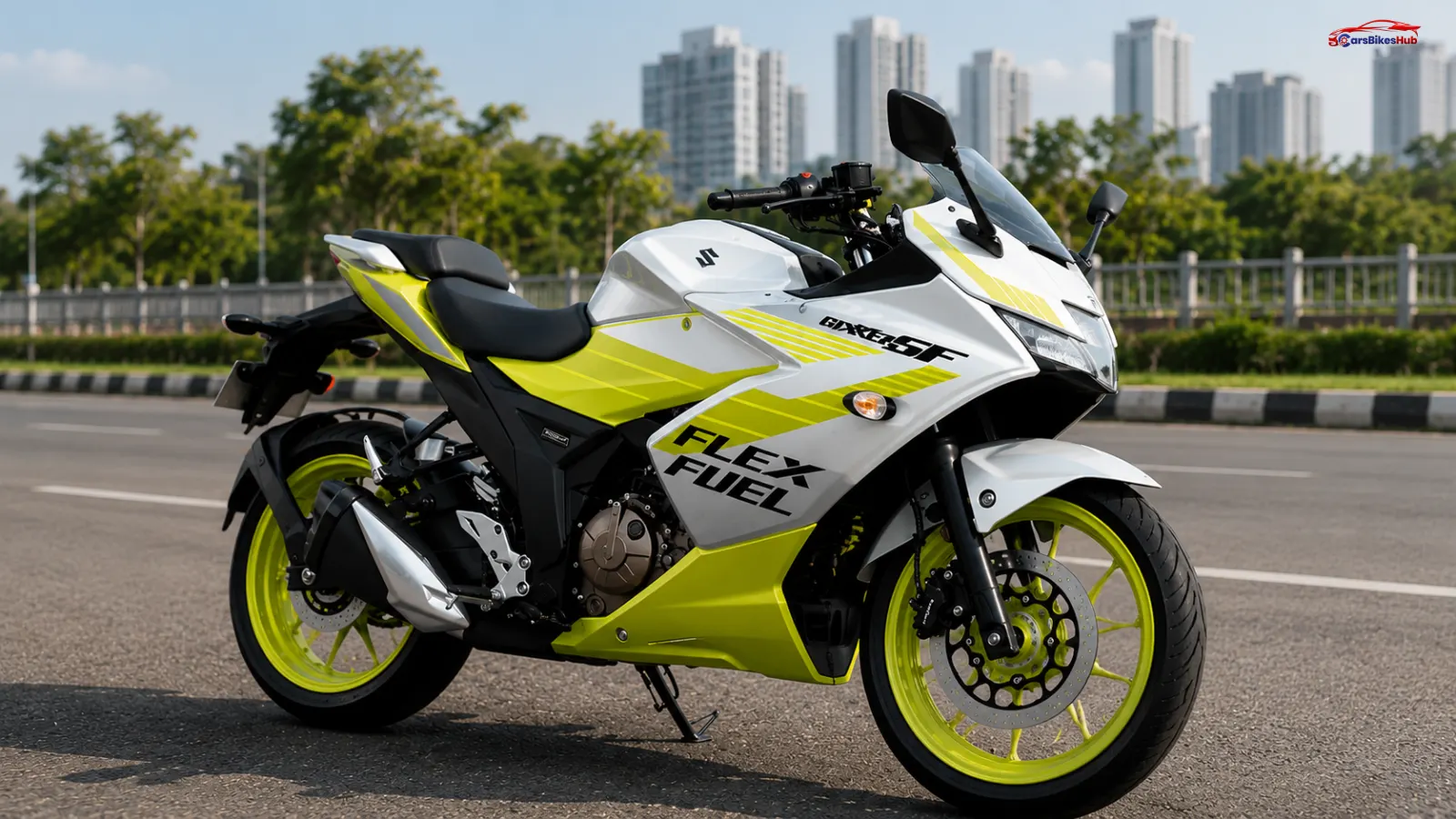
As of June 2026, there are only three models available, namely: the Suzuki Gixxer SF 250 FFV, Hero HF Deluxe Flex Fuel, and Hero Splendor+ Flex Fuel.
Hero HF Deluxe Flex Fuel: The bike costs ₹72,792 ex-showroom Delhi. Compatible with ethanol blends from E20 to E85. Gets a revised ECU, upgraded fuel pump, secondary fuel filter, digi-analogue cluster, side-stand engine cut-off, and tubeless tyres.
Hero Splendor+ Flex Fuel: Priced at ₹82,710 ex-showroom. Additionally gets Hero’s i3S idle stop-start system and alloy wheels. Costs roughly ₹5,000 more than the standard Splendor+.
Suzuki Gixxer SF 250 FFV: Targets a different segment: the 250cc sports tourer buyer rather than the mass-market commuter.
Hero plans to introduce flex fuel versions across more of its lineup. Both commuter models are initially being rolled out in Delhi and select regions of Maharashtra, with a nationwide rollout planned after that.
What About E85 Fuel Availability?
This is currently the biggest practical problem with buying a flex fuel bike.
The government plans to make E85 available at 500 petrol stations by the end of 2026, with the initial phase covering 50-100 fuel stations across the Delhi-NCR, Mumbai, Pune, and Nagpur corridors. The network is expected to expand to approximately 5,000 stations across major cities by the end of 2027.
As of now, availability is concentrated in Delhi, where E85 is priced at ₹82.12 per litre, roughly ₹20 cheaper than regular E20 petrol.
If you live in a Tier 2 or Tier 3 city, E85 may not reach a pump near you for another 12-24 months. A flex fuel bike can still run on regular E20 petrol, so you are never stranded. But you will not see the fuel cost benefits until E85 is actually available at your local pump.
Will a Flex Fuel Bike Actually Save You Money?
One of the biggest reasons people are interested in flex fuel bikes is the possibility of spending less on fuel. But will switching to E85 actually reduce your monthly running costs?
Another important thing to realise is that cheap fuel does not mean low costs. The amount of energy produced by ethanol is lower than that of petrol; consequently, more fuel is required by a motorcycle to be burned while operating on E85.
When your motorcycle’s mileage decreases by 25-30% while operating on E85, the low fuel prices may not compensate for the extra fuel consumption. The amount of savings will vary depending on the price of fuel in your town, your riding style, and the particular motorcycle you ride.
Whether a flex fuel bike will save you money will depend primarily on two aspects: the cost gap between petrol and E85 and the reduction in mileage when ethanol-based fuel is used.
Benefits of a Flex Fuel Bike
Fuel flexibility: The bike runs on anything from E20 to E85. The bike can run on different ethanol-petrol blends, allowing owners to use the fuel that is most readily available in their area.
Potentially lower running costs: In case of reliable access to E85 and the price difference is significant enough, running costs could be lowered in the long run.
Lower emissions: The government states that E85 can reduce greenhouse gas emissions by up to 61% compared with petrol, a genuine advantage for environment-conscious buyers.
Slightly better performance on E85: The use of increased amounts of ethanol in the fuel means that this type of motorcycle will enable reduced reliance on imported crude oil while also enabling the production of environmentally-friendly and more locally produced fuels.
Future-proofing: With an increase in blending of ethanol and the availability of E85 in future, buyers of flex fuel bikes have a definite advantage already.
What Are the Drawbacks of a Flex Fuel Bike?
Lower mileage on E85: Higher percentage ethanol may lower the efficiency of the engine, and this can be a drawback for those who want a bike that gives good mileage.
Limited E85 availability right now: Outside Delhi and parts of Maharashtra, E85 is simply not available yet.
Price premium: Flex fuel variants currently cost more than their standard petrol counterparts. Whether the additional cost is worth paying depends on the availability of fuel, running costs, and how much you ride.
Long-term maintenance uncertainty: Flex fuel bikes are relatively recent innovations in India. Because of that, there is little data available about their long-term maintenance, reliability, and resale value compared to conventional petrol bikes.
Should You Buy a Flex Fuel Bike in 2026?
Buy one if:
- You commute by bike every day in cities like Delhi, Mumbai, Pune, or Nagpur, where the availability of E85 is highest or improving quickly
- You ride 40+ km per day, and fuel costs are a primary concern
- You are buying a new commuter bike anyway, and the price premium is small relative to the total cost
- You believe petrol prices will keep rising and want fuel flexibility built in
Who Should Avoid a Flex Fuel Bike?
A flex fuel motorcycle may not be the right choice for everyone.
Consider skipping one if:
- E85 fuel is unavailable in your city right now
- You prioritise maximum mileage above everything else
- You ride very short distances and will not recover the higher purchase price
- You are already considering an electric two-wheeler for city commuting
- You plan to sell the motorcycle within a few years and prefer a predictable resale value
What to consider instead:
- Hero Splendor+ (standard E20): lower upfront cost, same proven reliability
- TVS iQube or Bajaj Chetak: if you have a short urban commute and charging access
- Honda Shine 125: strong mileage and dependable ownership without the flex fuel complexity
What Could the Future of Flex Fuel Bikes Look Like?
India is targeting higher ethanol adoption as part of its strategy to reduce crude oil imports and promote cleaner transportation. As ethanol infrastructure expands, more manufacturers are expected to introduce flex fuel motorcycles across commuter and premium segments.
Over the next few years, buyers can expect:
- Availability of E85 fuel across cities and on highways
- More flex fuel motorcycles across different segments
- Ethanol-compatible motorbike engine technology
- Better fuel efficiency from future flex fuel powertrains
- Increased government support for alternative fuels
Flex fuel bikes are unlikely to compete with electric bikes, but they can provide an alternative for those interested in clean fuel usage without having to set up a charging infrastructure.
Conclusion
The flex fuel bikes provide an interesting option as opposed to petrol bikes and purely electric motorbikes. They have flexibility in terms of fuel choice, lower emissions, and are consistent with India’s strategy on ethanol.
Consumers need to understand that E85 is not necessarily going to lead to savings in operating costs. Fuel availability, mileage differences, and local pricing of fuel will decide if flex fuel bikes make financial sense.
For riders living in regions where E85 infrastructure is expanding, a flex fuel bike could be a future-ready purchase. For others, waiting until fuel availability improves may be the more practical decision.
FAQs
Can I use regular petrol in a flex fuel bike?
Yes. Flex fuel bikes are designed to run on any ethanol blend from E20 to E85. If E85 is unavailable at your local pump, you simply fill up with regular E20 petrol. You are never forced to find E85 to use the bike.
Will a flex fuel bike give lower mileage than a regular bike?
Running on E20, mileage is comparable to standard bikes. Running on E85, expect a drop of around 25–30%. The lower pump price of E85 partially offsets this, but the net saving depends on how wide the price gap is and how much you ride.
Is E85 available across India?
Not yet. As of June 2026, E85 availability is limited to select outlets in Delhi. The government has targeted 500 outlets by December 2026 and 5,000 by the end of 2027. Buyers outside major metros should wait until E85 reaches their city before treating the fuel savings as a real benefit.
What changes make a bike flex fuel compatible?
Primarily a recalibrated ECU, an upgraded fuel pump, ethanol-resistant fuel lines and seals, and a secondary fuel filter. Hero made over 30 component changes on the Splendor+ and HF Deluxe to achieve E85 compatibility.
Is a flex fuel bike better than an EV for daily commuting?
For short urban commutes with reliable charging access, an EV generally offers lower running costs. A flex fuel bike makes more sense for longer daily distances, in cities where EV charging is limited, or for buyers who prefer not to deal with charging routines. The two technologies target slightly different buyer profiles.