


























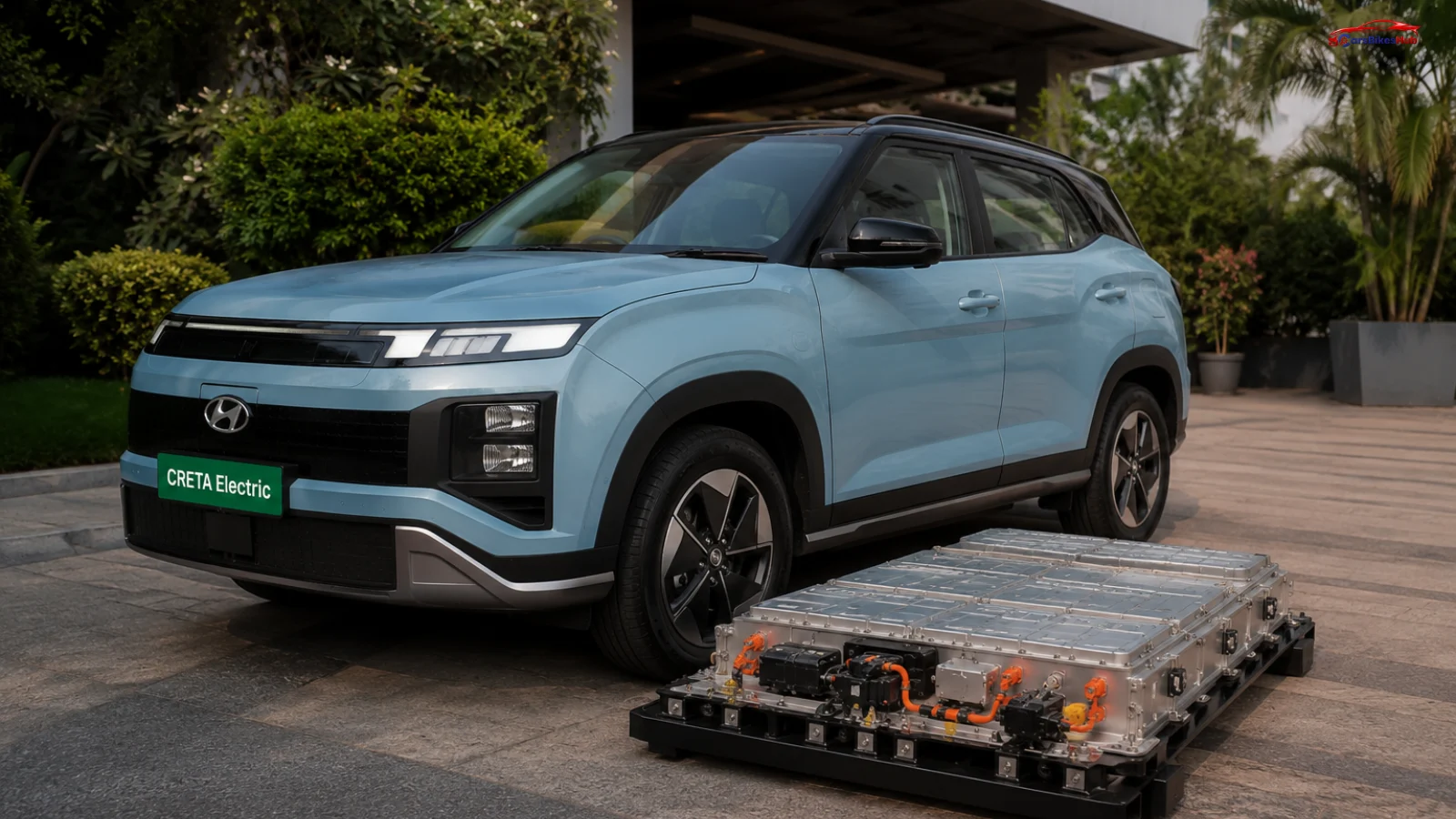
Buying an electric SUV isn’t just about range or charging anymore. For many buyers, the biggest question comes years after the purchase: what happens if the battery needs replacing? If you’re considering the Hyundai Creta EV Battery Replacement Cost, here’s what the real costs, warranty and long-term ownership picture look like.
This article answers both questions honestly, using what Hyundai has officially confirmed and clearly separating that from industry and dealer estimates that are floating around the internet.
Quick Overview
| Parameter | Detail |
| Battery options | 42 kWh (Standard Range) and 51.4 kWh (Long Range) |
| Battery chemistry | Lithium-ion, liquid-cooled pack, BMS derived from the Hyundai IONIQ 5 |
| Official battery warranty | 8 years / 1,60,000 km, whichever comes first |
| Warranty transferable? | Yes, for the remaining period, to a second owner |
| Expected real-world lifespan | 8–10+ years with normal care (industry estimate, not Hyundai-confirmed) |
| Official replacement price | Not published by Hyundai |
| Estimated replacement cost (independent sources) | Roughly ₹5–7 lakh for the full pack, including labour |
| Module-level repair confirmed by Hyundai? | Not officially confirmed |
| Should buyers worry? | Not enough to avoid the car, but go in informed |
Will Every Hyundai Creta EV Need a Battery Replacement?
For the vast majority of buyers, battery replacement is unlikely to become an ownership concern during the time they keep the vehicle.
Lithium-ion batteries don’t fail suddenly like a phone battery bloating up. They degrade gradually, a slow, predictable loss of usable capacity as the chemical cells inside age with every charge cycle. A battery that started at 100% capacity might realistically be around 90–92% after five years of normal use, and continue declining slowly after that. This is normal for every EV on the road today, not a Creta-specific issue.
The myth buyers carry over from smartphones and laptops is that batteries “die” and need swapping every few years. In practice, EV battery packs are engineered very differently; they’re actively cooled, electronically managed, and built with far more headroom than a phone battery.
With proper maintenance, industry estimates suggest the pack can last 8-10 years, with gradual degradation of roughly 1-2% per year. At that rate, most owners will trade in or sell the car long before the battery becomes a genuine problem.
The real trigger for replacement isn’t age by itself; it’s whether degradation crosses a threshold that meaningfully hurts range and performance. For the vast majority of owners driving a typical 10,000–15,000 km a year, that threshold is unlikely to be reached inside the warranty period, let alone right after it.
Hyundai Creta EV Battery Warranty
This is the number that actually matters more than any replacement-cost estimate, because it determines who pays if something does go wrong early.
The Hyundai Creta Electric comes with a 3-year unlimited kilometre vehicle warranty, an 8-year/1.6 lakh kilometre battery warranty, and 3 years of complimentary roadside assistance. This 8-year/1,60,000 km cover applies uniformly; it’s consistent across both the 42 kWh and 51.4 kWh battery trims. On top of this, Hyundai offers up to 5 years of its Shield of Trust package for running repairs and maintenance, along with an optional 7-year extended warranty.
Importantly, the battery warranty is transferable to a second owner for the remaining warranty period, a genuinely useful detail if you plan to sell the car within the warranty window, since it protects resale value rather than resetting or voiding on transfer.
What the warranty covers: manufacturing defects and battery capacity dropping below a defined health threshold before the 8-year/1,60,000 km mark, whichever arrives first.
What it typically doesn’t cover: damage from accidents, unauthorised modifications, use outside Hyundai’s recommended charging and care guidelines, or normal gradual degradation that stays within the acceptable range Hyundai defines (this threshold hasn’t been officially published by Hyundai; independent sources estimate cover kicks in once capacity loss crosses roughly 30%, but treat that specific number as an estimate, not a confirmed figure).
Should this warranty give buyers confidence? Yes, with one caveat. Eight years and 1.6 lakh km comfortably outlasts the period during which most owners keep a car, and it matches the warranty length offered on most EVs sold in India today. The caveat is what happens after the warranty ends, which is where the real ownership question lies, and where Hyundai currently offers less reassurance than a couple of its rivals (more on that below).
What Is Hyundai Battery-as-a-Service (BaaS) and How Does It Work?
If battery cost anxiety is the main thing holding you back, Hyundai’s newest ownership model is worth understanding before you look at replacement-cost estimates at all.
Battery-as-a-Service (BaaS) separates the car from the battery. Instead of paying for the battery pack upfront as part of the car’s price, you buy the Creta Electric at a lower starting price of ₹10.99 lakh ex-showroom and pay for the battery separately through a per-kilometre EMI starting at ₹3.9/km. In effect, you’re renting the battery rather than owning it outright.
If you’re on BaaS, battery degradation and replacement become Hyundai’s problem, not yours; the battery isn’t your asset to repair or replace; it’s a subscribed service. This doesn’t just lower the upfront price; it structurally removes the exact worry. The trade-off is the ongoing per-km cost over years of ownership, so it’s worth running the numbers against outright purchase for your specific usage before choosing.
Hyundai Creta EV Battery Replacement Cost
Hyundai has not published an official, fixed price for a standalone battery pack replacement outside warranty. This is standard practice across the industry; manufacturers rarely publish out-of-warranty component prices upfront because costs vary by battery variant, labour, region, and how the case is assessed at the service centre.
What Hyundai has confirmed is the cost of ownership at the front end: the Creta Electric launched at an ex-showroom price of ₹17.99 lakh. Hyundai’s newer Battery-as-a-Service option changes this calculation entirely by making the battery a subscription rather than a one-time cost.
Estimated replacement cost (not officially confirmed)
Independent EV publications and dealer sources put the Creta Electric’s out-of-warranty battery replacement cost in the following range. Treat these as informed estimates, not Hyundai-confirmed pricing:
| Battery variant | Estimated pack-only cost | Estimated total with labour/logistics |
| 42 kWh (Standard Range) | ₹4.0-4.4 lakh | ₹5.0-5.5 lakh |
| 51.4 kWh (Long Range) | ₹5.0-5.4 lakh | ₹5.5-7.0 lakh |
Why prices vary so much between sources: battery cell prices fluctuate with global lithium-ion supply, dealer labour and calibration charges differ by city, and whether a claim needs a full pack swap versus a partial repair changes the bill significantly. None of these figures should be read as a quote; they’re a directional range to help you budget mentally, not a number to hold a dealer to.
Can Hyundai Replace Individual Battery Modules?
This is one of the more misunderstood parts of EV ownership, and it matters because it directly affects your worst-case bill.
An EV battery pack isn’t one giant sealed block; it’s built from multiple smaller modules (which are themselves made of individual cells) housed inside a single pack casing. In theory, if only one or two modules develop a fault, only those modules need replacing rather than the entire pack. In practice, whether this is offered depends entirely on the manufacturer’s official service policy, tooling, and diagnostic capability at the service centre.
Hyundai has not officially confirmed whether module-level repair is available for the Creta Electric in India, as opposed to a full pack swap. Some independent workshops and industry commentators suggest partial module replacement is technically feasible on lithium-ion packs of this type, but this is not the same as Hyundai offering it as a standard authorised-service option.
What this means practically: until Hyundai publishes a clear module-repair policy, assume that an out-of-warranty claim could mean a full pack replacement rather than a cheaper partial fix, and budget accordingly. If module-level repair does become standard practice, it would meaningfully lower worst-case replacement costs; this is worth asking your service advisor about directly if you’re weighing this decision today.
What Affects Battery Life?
Degradation rate isn’t fixed; how you use and charge the car has a real, measurable effect on how gracefully the battery ages.
- Charging habits: Regularly charging to 100% and letting the battery sit at full charge for long periods accelerates wear. Keeping daily charging closer to an 80% cap, and only charging to 100% before a long trip, is the single most effective habit for longevity.
- Fast charging frequency: DC fast charging is quick and convenient, but relying on it constantly generates more heat and stress on the cells than slower AC charging. Use fast charging when you need it, not as your default daily routine.
- Climate: Extreme heat is harder on lithium-ion cells than cold. India’s summer conditions make the liquid-cooled thermal management system genuinely important; it’s one reason the Creta Electric’s cooling system, carried over in principle from Hyundai’s global EV platforms, matters more here than in milder climates.
- Driving style: Aggressive acceleration and hard regenerative braking cycles generate more heat than smooth, moderate driving. This affects short-term efficiency more than long-term battery health, but gentle driving helps both.
- Storage: If the car will sit unused for weeks, storing it at a mid-range charge level (rather than fully charged or fully depleted) is better for the pack.
None of this requires obsessive behaviour; it’s the EV equivalent of not redlining a petrol engine every day. Reasonable, everyday care is enough.
Signs Your Battery May Need Inspection
Most owners will never see any of these, but it’s worth knowing what to watch for so you can get it checked early, while it’s still a warranty matter rather than an out-of-pocket one:
- A sudden, noticeable drop in range that isn’t explained by weather or driving style
- Charging that’s become unusually slow compared to what you’re used to
- Battery-related warning lights on the dashboard
- The charge percentage jumping or fluctuating in a way that doesn’t match actual usage
If you notice any of these, get it looked at by an authorised Hyundai service centre rather than waiting; catching it early is what keeps a fixable issue inside warranty terms.
Will Battery Replacement Become Cheaper?
Almost certainly, over time, and this matters for anyone worried about a bill that might land 8+ years from now.
Global lithium-ion cell prices have been on a multi-year downward trend as manufacturing scale increases and battery chemistry improves. India-specific factors add to this: growing local battery and EV component manufacturing (including under Hyundai’s own localisation push, given the Creta Electric is built at its Chennai plant), an expanding recycling ecosystem for end-of-life packs, and increasing competition among battery suppliers.
The practical implication: today’s ₹5–7 lakh estimate is a snapshot of current costs, not a fixed number for the life of your car. If you do need a replacement well into the car’s life, there’s a reasonable chance the real cost, in absolute terms, and even more so relative to incomes and other prices, will be lower than what’s being quoted today. This doesn’t eliminate the cost, but it’s a real reason not to extrapolate today’s numbers a decade into the future.
Can EV Batteries Be Recycled?
Yes, and this is a big part of why replacement costs are expected to fall. An old EV battery pack isn’t scrapped as waste; it still holds usable capacity and valuable materials (lithium, nickel, cobalt, and more) that can be recovered and reused. Two paths are common globally and increasingly in India: repurposing a battery for lower-intensity “second-life” uses like stationary energy storage, or recycling it to extract raw materials for new battery cells.
As India’s EV recycling ecosystem matures, it also reduces reliance on imported raw materials, which is one of the factors pushing replacement costs down over time, alongside local manufacturing scale-up. Hyundai hasn’t published Creta-specific recycling details, but this is an industry-wide direction the whole EV market in India is moving toward.
Battery Replacement vs Fuel Savings
Before treating a hypothetical battery bill as a dealbreaker, it’s worth weighing it against what you save by not buying petrol for years.
| Petrol Creta (comparable SUV) | Hyundai Creta Electric | |
| Fuel/energy cost per km (approx.) | ₹5.5–6.5/km (petrol at ~₹100/l, ~15–16 km/l) | ₹1–1.5/km (home charging), lower still on subsidised tariffs |
| Annual running (15,000 km) | ₹82,500–97,500 | ₹15,000–22,500 |
| Approximate annual saving | — | ₹60,000–75,000 |
| Savings over 8 years | — | ₹4.8–6 lakh (before accounting for inflation/fuel price rises) |
These are illustrative estimates based on typical fuel and electricity prices, not fixed figures; your actual savings depend on local electricity tariffs, how much you use fast charging (typically pricier per unit than home charging), and driving patterns.
The takeaway: over a typical 8-year ownership period, fuel savings alone can realistically approach or exceed the estimated cost of a full battery replacement. In other words, even in the unlikely scenario that you need a replacement right after the warranty ends, the running-cost savings you’ve already banked over those 8 years could largely offset it. This is the calculation that gets left out of most “battery cost” articles.
What Actually Matters in Everyday EV Ownership?
- Battery warranty length and transferability: protects you financially in the specific scenario that actually causes most claims: early-life defects, not old-age wear.
- Thermal management: a well-cooled pack degrades more slowly, especially in Indian summers.
- Charging infrastructure access: determines how much you rely on fast charging (which is harder on the battery) versus gentler home/AC charging.
- Authorised service network reach: matters more for diagnosis, software updates, and warranty claims than most buyers expect.
- Battery health visibility: being able to check state-of-health via the app helps you catch abnormal degradation early, while it’s still a warranty issue.
Should Battery Replacement Cost Stop You Buying One?
For most buyers, no, and here’s the reasoning, not just the verdict.
The 8-year/1,60,000 km warranty covers the exact window during which the vast majority of Indian car owners either keep the car or sell it on. Real-world degradation data across EVs globally suggests the Creta Electric’s battery is very unlikely to need a full replacement inside that window under normal use. And even in the unlikely event it does, warranty coverage means you’re not the one paying for it.
The scenario where battery cost genuinely deserves weight in your decision is narrower: if you plan to keep the car well past 8 years or 1.6 lakh km, drive unusually high annual mileage, rely heavily on DC fast charging as your default habit, or live somewhere with consistently extreme heat with limited access to shaded/covered parking.
In that specific profile, it’s worth either budgeting mentally for a possible out-of-warranty cost in the ₹5–7 lakh range (today’s estimate, likely to fall over time), or seriously considering the BaaS ownership model, which effectively converts that long-tail risk into a predictable per-kilometre cost instead.
For everyone else, the buyer who’ll own the car for 5–8 years and drive it a normal amount, battery replacement cost shouldn’t be the deciding factor against the Creta Electric.
Who Should Buy the Hyundai Creta Electric?
Buy it if you want a familiar, well-equipped SUV body with genuinely solid range on the Long Range variant, plan to own the car within the 8-year/1.6 lakh km warranty window, and value Hyundai’s wide service network and brand trust in India.
Skip it if long-term (10+ year) battery assurance beyond the standard warranty is a priority for you specifically; Tata’s and MG’s lifetime-for-first-owner warranties currently go further on paper, even if the Creta’s own coverage is still solid.
Consider a hybrid if your usage involves frequent long-distance driving in areas with patchy charging infrastructure, and charging logistics (not battery cost) are your real concern.
Consider a petrol SUV if your annual mileage is low enough that fuel savings won’t meaningfully offset the EV’s higher upfront cost within your typical ownership period, or you don’t have reliable home/workplace charging access.
Final Verdict
Battery replacement fear is a real concern, but for the Hyundai Creta Electric it’s a smaller real-world risk than the internet chatter around it suggests. The 8-year/1.6 lakh km warranty covers the period when the overwhelming majority of owners will own the car, degradation happens gradually rather than as a sudden failure, and fuel savings over a typical ownership period can realistically offset a large chunk of any eventual out-of-warranty cost.
The one place Hyundai currently trails rivals is in how far beyond the standard warranty its assurance goes; Tata and MG now offer lifetime cover to first owners, which Hyundai doesn’t match yet. If long-horizon battery peace of mind matters more to you than most other factors, that’s worth weighing. For most buyers planning a normal ownership cycle, though, this shouldn’t be the deciding factor against an otherwise well-rounded, feature-rich electric SUV.





FAQs
How much does a Hyundai Creta Electric battery replacement cost?
Hyundai hasn't published an official out-of-warranty price. Independent estimates put it around ₹5–7 lakh depending on battery variant, but treat this as a directional estimate, not a quote.
Will I definitely need to replace the battery at some point?
Not necessarily. Most owners will sell or replace the car before degradation becomes significant enough to require intervention.
Does Hyundai offer module-level battery repair instead of full replacement?
This hasn't been officially confirmed by Hyundai for the Creta Electric. Assume a full pack replacement is the likely outcome unless your service centre confirms otherwise.
How long is the Creta Electric's battery warranty?
8 years or 1.6 lakh km, whichever comes first.
What is Battery-as-a-Service (BaaS) and does it solve the replacement-cost problem?
BaaS lets you buy the Creta Electric from ₹10.99 lakh with battery EMI starting at ₹3.9/km, effectively separating battery ownership from the car. This shifts long-term battery cost risk onto the subscription rather than onto you directly.