





















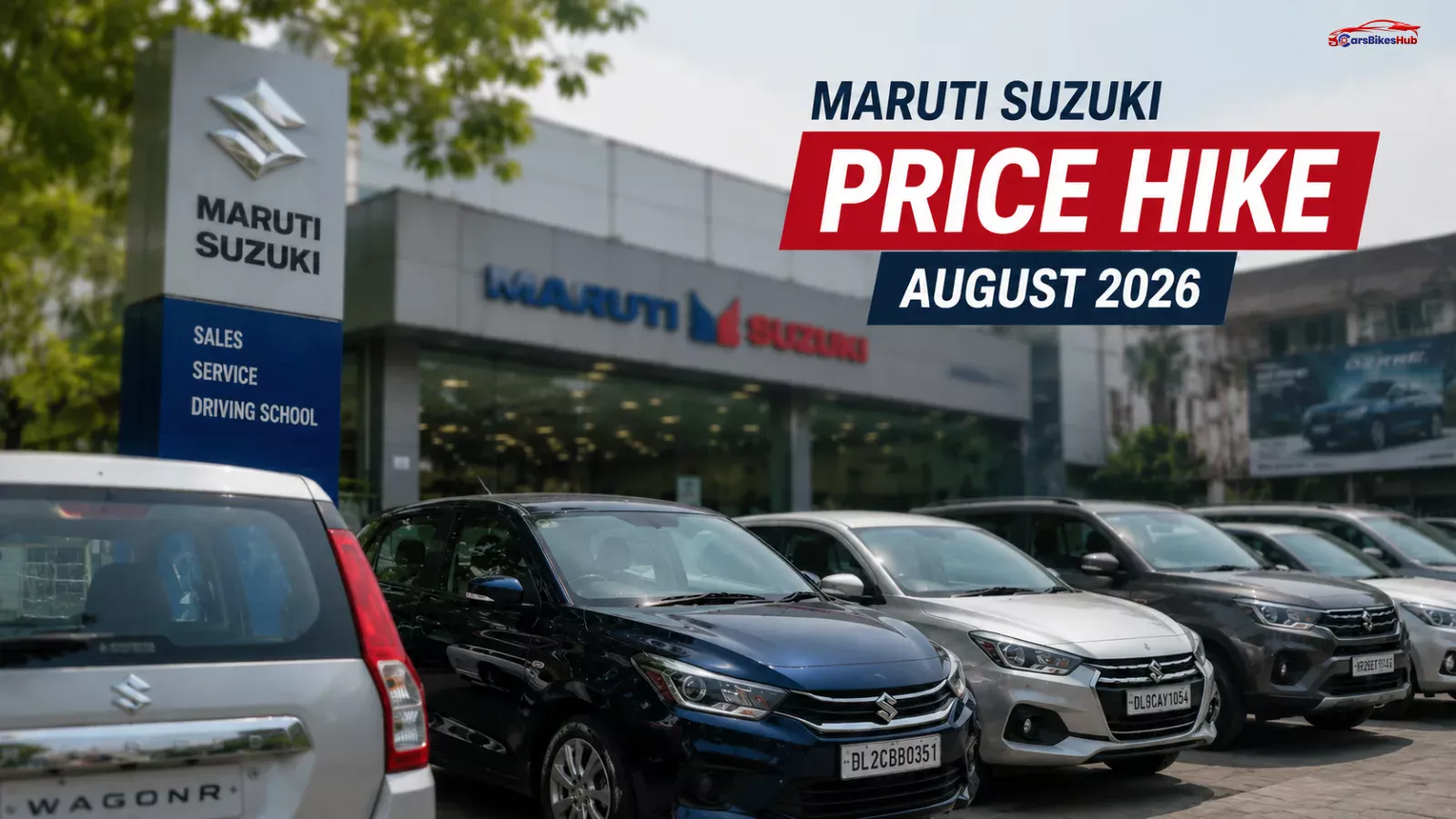
If you’re planning to buy a Maruti Suzuki this month, your decision could save you up to ₹30,000. The country’s largest carmaker has confirmed another round of price revisions from August 2026, affecting almost its entire passenger vehicle lineup. Whether you’re planning to buy your first Maruti Suzuki or upgrade to a new model, here’s what the Maruti Suzuki August 2026 price hike means, and whether booking now actually makes financial sense.
The size of the hike isn’t dramatic, and it isn’t uniform either. Some models and variants will see a bigger jump than others, and Maruti hasn’t broken down the exact number for each one. This guide walks you through why the hike is happening, which cars are likely to be affected, what it actually means for your wallet, and, most importantly, whether you should rush to book before August or it’s fine to wait.
Key Highlights
- Price hike effective from August 2026
- Increase of up to ₹30,000, varying by model and variant
- Portfolio-wide revision, not limited to a few models
- Second price hike from Maruti Suzuki in 2026, after a similar one in June
- Buyers with a finalized model and approved financing may benefit from booking early
Maruti Suzuki August 2026 Price Hike: Why Are Prices Increasing?
Maruti Suzuki informed stock exchanges that the decision comes down to persistent commodity inflation and rising input costs that have kept pressure on the company’s margins. In its filing, the automaker said it had first tried to absorb these costs internally through efficiency measures and cost-cutting, but the pressure on operating margins eventually made it necessary to pass on part of the burden to customers.
This isn’t a one-off. It’s worth noting that this is the second such increase in quick succession, following a similar hike of up to ₹30,000 that was introduced in June 2026. Two hikes within a couple of months signal that input-cost pressure, driven by rising raw material prices, logistics costs, and broader inflation across the auto component supply chain, has been more persistent than usual this year.
To be clear, this is a routine, industry-wide pattern rather than something specific to Maruti’s business. Almost every carmaker revises prices periodically to offset rising steel, aluminium, semiconductor, and freight costs, along with regulatory and compliance-related expenses. Maruti has done this multiple times in past years too; the difference this time is the short gap between two consecutive hikes.
Which Maruti Suzuki Cars Will Be Affected?
According to the company’s own statement, the price hike will apply across its portfolio, not just to a handful of models. That means buyers across every segment- hatchbacks, sedans, SUVs, and MPVs- should expect revised ex-showroom prices once the new price list comes into effect.
| Segment | Popular Models |
| Hatchbacks | Alto K10, S-Presso, Celerio, WagonR, Swift, Baleno, Ignis |
| Sedans | Dzire |
| SUVs & Crossovers | Fronx, Brezza, Grand Vitara, Jimny |
| MPVs | Ertiga, XL6, Invicto |
Here’s the important caveat: Maruti has confirmed that the increase will differ by model and variant, but it hasn’t published a model-wise or variant-wise breakup yet. Any number you see floating around for a specific trim before Maruti’s official price list is out should be treated as an estimate, not a confirmed figure. The safest approach is to check with your nearest Maruti dealership or the brand’s official website closer to August for the exact revised price of the model and variant you want.
How Much Will Prices Increase?
Maruti has stated the hike will go up to ₹30,000, but this is a ceiling, not a flat number applied to every car. Entry-level variants of small cars may see a smaller absolute increase, while higher trims and larger vehicles could be closer to the upper end.
| Price Increase | Applies To |
| Up to ₹30,000 | Selected models across Maruti Suzuki’s portfolio |
| Exact variant-wise figures | To be confirmed by Maruti Suzuki closer to August 2026 |
Until the official price list is released, it’s best to treat ₹30,000 as the maximum, not the guaranteed amount, for any particular car you’re considering.
Which Buyers Will Feel the Biggest Impact?
Not every buyer experiences a price hike the same way. Here’s how it typically breaks down:
- First-time buyers: often more affected, since every rupee matters more on a tighter, carefully planned budget.
- Premium car buyers: the increase is small relative to the overall vehicle price, so it barely moves the needle on models like the Grand Vitara or Invicto.
- Loan buyers: the effect on monthly EMIs is generally modest, usually just a few hundred rupees when spread across a multi-year tenure.
- Fleet buyers: a per-car increase can add up significantly when multiplied across several vehicles in a single purchase.
What Does This Mean for Buyers?
If you’re buying this month:
Booking before the hike takes effect locks in the current price, provided your paperwork and delivery timeline align before the cutoff. This mainly benefits buyers who’ve already zeroed in on a model.
If you’re planning to wait:
A wait of a few weeks to a couple of months for a better variant, colour option, or festive scheme may still make financial sense even after a ₹15,000–₹30,000 increase, especially if it means avoiding a rushed decision.
Financing impact:
On a car loan, a ₹20,000–₹30,000 hike in on-road price translates into a relatively small increase in EMI when spread across a 5–7 year tenure, often just a few hundred rupees a month. It’s worth factoring in, but it’s rarely a deal-breaker on its own.
Insurance impact:
Since motor insurance premiums (especially the mandatory third-party component and the IDV-linked own-damage cover) are calculated as a percentage of the vehicle’s ex-showroom price, a price hike nudges your insurance cost up slightly as well.
On-road price impact:
This is where the increase compounds. Road tax, RTO charges, and insurance are all calculated as a percentage of the ex-showroom price, so a ₹15,000–₹30,000 hike in the base price can add up to a somewhat larger jump in your final on-road price than the headline number suggests.
Should You Buy Before August 2026?
Who should consider buying now?
- Buyers with an already-approved loan, since re-processing financing later adds delay and paperwork.
- Buyers who’ve finalized their model and variant, if you know exactly what you want, locking in the current price avoids paying more for the same decision.
- Fleet or bulk buyers, where even a small per-unit saving adds up significantly across multiple vehicles.
Who can comfortably wait
- Buyers waiting on updated variants or features: a ₹20,000 saving rarely justifies settling for a car that doesn’t fully meet your needs.
- Buyers eyeing festive-season offers, discounts and schemes around Navratri, Diwali, and year-end sales have historically offset a meaningful part of similar price hikes.
- Buyers with flexible delivery timelines: if there’s no urgency, it’s worth comparing offers across dealerships even after the hike takes effect.
The broader point: a ₹15,000–₹30,000 difference is worth knowing about, but it shouldn’t be the sole reason to rush into a purchase you’re not fully ready for.
Booking Before August vs After August
| Booking Before August | Booking After August |
| Lower ex-showroom price | Revised, higher ex-showroom price |
| Potential savings of up to ₹30,000 | Possible festive-season discounts |
| Locked-in current financing terms | Updated on-road costs (tax + insurance) |
Will Discounts Continue After the Price Hike?
Yes, in almost all cases. While a hike in the ex-showroom price does not necessarily imply that dealer discounts, exchange benefits, and company discounts vanish. These vary by:
- Location: discounts differ across cities and even between dealerships in the same city.
- Inventory: The availability of stocks and less-favored variants always have more discounts despite any hike in base prices.
- Season: offers tend to improve meaningfully around major festivals and financial year-end (March), somewhat independent of when a price hike lands.
It’s worth negotiating with multiple dealers rather than assuming the “new price” is fixed and non-negotiable.
Models That Still Offer Good Value
Even after the revision, a few Maruti models continue to make a strong case on a cost-per-feature basis:
- WagonR: low maintenance costs and strong fuel efficiency keep running expenses down for city buyers.
- Swift: excellent resale value and a wide, easily accessible service network across India.
- Brezza: comprehensive safety features and practical SUV appeal at a relatively accessible price point.
- Fronx: turbo-petrol option with distinctive crossover styling that stands apart from typical hatchbacks.
- Grand Vitara: the strong-hybrid variant helps lower long-term fuel costs, offsetting its higher upfront price over time.
The takeaway: a modest price increase rarely changes the fundamental value proposition of a car that was already well-priced for what it offers.
Will Used Car Prices Be Affected?
While the announcement directly affects new-car prices, a higher new-car price can indirectly influence resale values over time; a costlier new Swift, for instance, can make a well-kept used one look more attractive by comparison. That said, this effect is usually gradual rather than immediate, and it depends heavily on demand for the specific model, its condition, and overall market supply. Don’t expect used-car prices to jump the moment the new price list is out; any shift tends to play out over months, not days.
Note: Maruti Suzuki has announced that prices will increase by up to ₹30,000 from August 2026. Exact model-wise and variant-wise revisions will be updated here once the company releases the official price list.
Final Verdict
A price increase of up to ₹30,000 sounds significant in isolation, but in the context of a car purchase, where financing, insurance, accessories, and running costs all factor into the total cost of ownership, it’s a relatively modest shift. What matters more than the headline number is your own readiness: whether your paperwork, budget, and model choice are already sorted, or whether you’re still comparing options.
Buyers who’ve already finalized their decision and have financing in place have a genuine reason to book before August. Everyone else would be better off not hurrying just because of an impending rise in prices; comparing dealer quotes, waiting for the holiday scheme, or looking for the right model should have far more importance in your financial considerations than a few thousand rupees on the price tag. Like all Maruti Suzuki price revisions from time to time, it makes sense to make your decision based on your own requirements and budget rather than creating panic.





FAQs
Why is Maruti Suzuki increasing prices in August 2026?
The company has cited sustained increases in input costs and ongoing inflationary pressure as the reason, stating it could no longer fully absorb these costs internally.
When exactly does the August 2026 price hike take effect?
Maruti Suzuki has confirmed the revised prices will apply from August 2026, though it hasn't published an exact date for every model.
Which Maruti Suzuki cars are affected by the hike?
The hike applies across Maruti's portfolio, so models like the Alto K10, WagonR, Swift, Dzire, Baleno, Brezza, Fronx, Ertiga, Grand Vitara, and others are all expected to see some increase.
How much more will I have to pay?
Maruti has said the increase will go up to ₹30,000, but the exact amount depends on the specific model and variant.
Will the price hike affect my on-road price too?
Yes. Since road tax and insurance are calculated as a percentage of the ex-showroom price, the on-road price increase can be somewhat larger than the headline ex-showroom hike.