

























If you’ve been following auto news this month, you’ve probably noticed everyone suddenly talking about 100% ethanol cars in India. It’s not just another policy announcement that will sit in a file for years. On 13 June 2026, Union Minister Nitin Gadkari signed off on the legal framework allowing vehicles to run entirely on ethanol, and within hours, the conversation shifted from “someday” to “soon.”
With so much discussion around ethanol-powered vehicles, many people are wondering what this change actually means. Let’s take a closer look at how 100% ethanol cars in India work, their benefits, potential drawbacks, and whether they could become a practical option for buyers in the coming years.
What Exactly Are 100% Ethanol Cars in India?
In simple terms, 100% ethanol cars in India are vehicles built to run on E100 fuel, a blend made up of roughly 93-95% ethanol along with a small amount of petrol and solvents.
These aren’t regular petrol cars with a small tweak; they’re engineered with different fuel injectors, larger fuel pumps, ethanol-resistant rubber seals, reworked fuel lines, and an ethanol sensor that tells the engine’s computer how much ethanol is in the tank so it can adjust fuelling and ignition timing in real time.
This matters because ethanol behaves very differently from petrol inside an engine. It absorbs moisture, is more corrosive to certain metals and rubber, and carries less energy per litre. So while 100% ethanol cars in India might sound like a simple fuel swap, it’s a fairly deep mechanical change under the hood, not something you can retrofit at a local garage.
The Policy Push Behind E100 Fuel
India’s journey toward E100 didn’t happen overnight. It builds on the 2018 National Biofuels Policy and a 2020 Automotive Industry Standard that set safety norms for ethanol-compatible vehicles. The country hit its E20 target (20% ethanol in regular petrol) by April 2025, ahead of the original 2030 deadline, and that blend is now the default at petrol pumps nationwide.
The next leap came in April 2026, when the Ministry of Road Transport and Highways proposed amendments to the Central Motor Vehicles Rules to formally recognise E85 and E100 as legitimate automotive fuels. Then, in June 2026, Gadkari signed the final rules, clearing the legal path for 100% ethanol cars in India to hit the road. The government’s main motivation is India’s fuel import bill, which sits at around ₹22 lakh crore a year, and cutting even a slice of that through homegrown ethanol, mostly produced from sugarcane molasses, is the core idea.
There’s a rural angle too: the broader ethanol blending programme has already saved around ₹1.84 lakh crore in forex since 2014 and supports farm incomes. On emissions, higher ethanol blends can cut CO2 and carbon monoxide by up to 35% versus older petrol, and ethanol’s high octane rating (100-110 RON) allows more aggressive engine tuning for a bit more power. So E100 fuel checks several boxes at once: energy security, rural income, and lower emissions.
Which Cars and Bikes Can You Actually Look At?
This is where you should keep expectations realistic, but there’s more on the ground than most people realise.
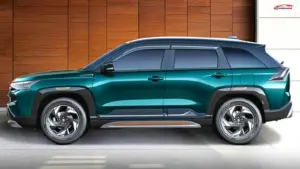
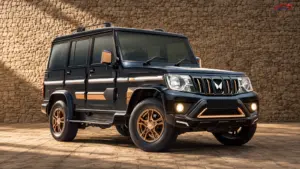
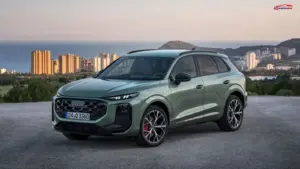
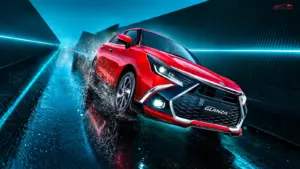
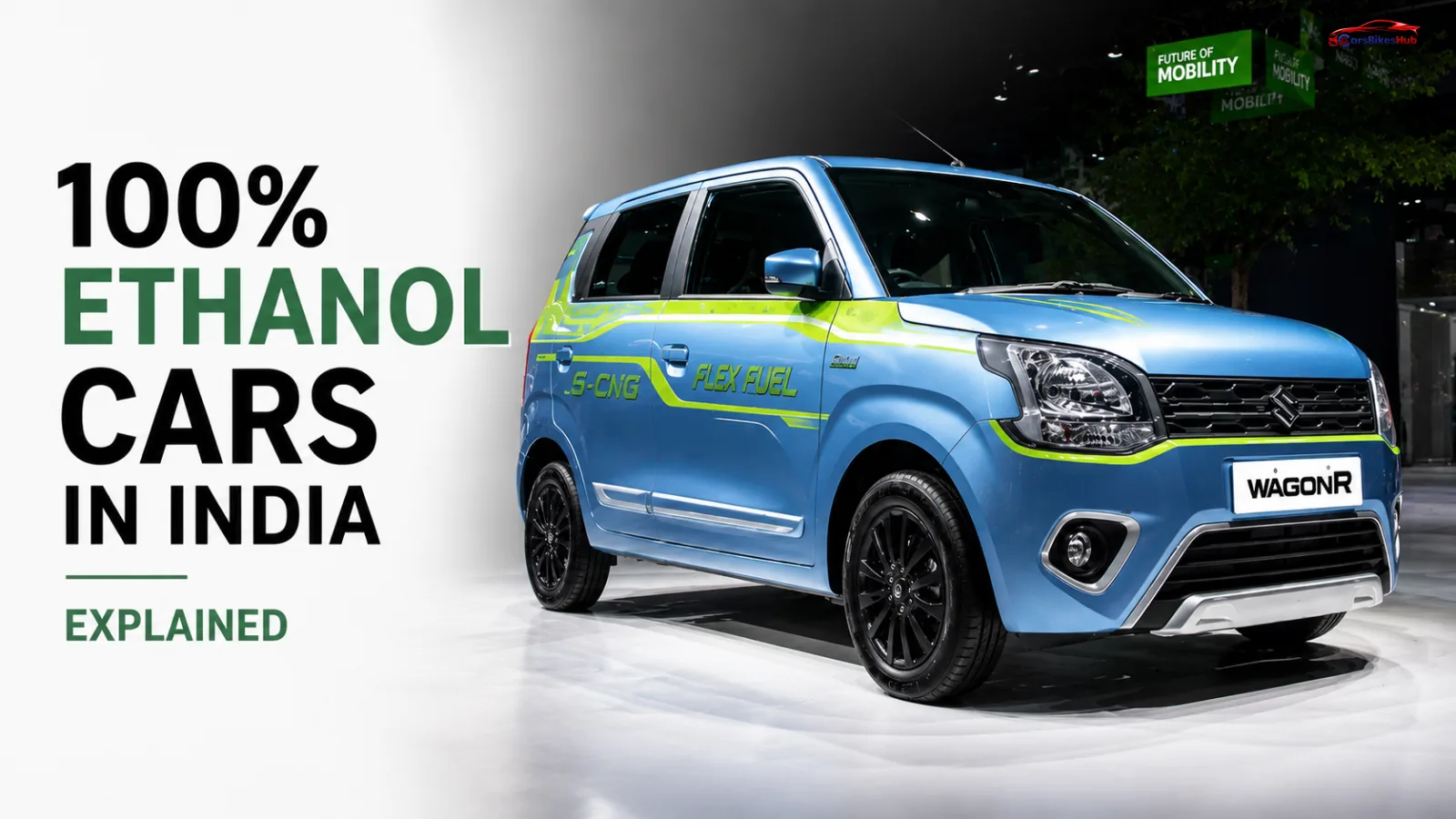
Maruti Suzuki became the first manufacturer to begin production of a flex-fuel Wagon R, though it’s homologated for E85 and limited to the commercial sector. Toyota’s Corolla hybrid, shown in October 2022, runs on a flex-fuel strong-hybrid setup capable of handling E100. Models like the Brezza, Hycross, Creta, Punch, and XUV3XO have also been showcased with flex-fuel powertrains for 85-100% ethanol blends.
Gadkari has said Toyota, Suzuki, and Hyundai will launch fully ethanol-running vehicles within a couple of months, and Hero MotoCorp has already rolled out flex-fuel two-wheelers. So while 100% ethanol cars in India aren’t in showrooms in large numbers yet, the manufacturing intent across nearly every major brand is clearly there.
If you’re wondering how to spot one, flex-fuel vehicles usually carry a badge or sticker near the rear or fuel cap, with the same details in the owner’s manual and registration documents. It’s worth checking before assuming any petrol car can take E85 or E100.
The Mileage Question Nobody Can Avoid
Here’s the part that surprises people the most. Ethanol simply doesn’t carry as much energy per litre as petrol. With E100 fuel, expect a mileage drop of around 27-30% compared to a petrol-only setup. So if your car currently gives you 20 km per litre on petrol, the same car running on this fuel would likely give you somewhere around 14-15 km per litre.
That’s a meaningful difference, and it’s the single biggest factor anyone considering 100% ethanol cars in India needs to understand before getting excited about lower fuel prices. At Delhi’s first E85 station, fuel was priced at around ₹82.12 per litre, roughly ₹20 cheaper than petrol, and E100 is expected at around ₹82-87 per litre, about 80-85% of the petrol price. Do the math, though: if fuel is 20% cheaper but mileage drops nearly 30%, your actual running cost might barely improve, and could even work out higher.
What It Costs, and What You Get Back in Tax
Turning a regular petrol car into something that can handle E85 or E100 isn’t cheap from a manufacturing standpoint. Making a car E20-ready adds roughly ₹4,000-6,000 to production costs, which is minor. But a full flex-fuel platform for E85 or E100 is a different story, potentially adding ₹50,000 to ₹1 lakh to a car’s price tag depending on the segment.
One challenge for buyers is that flex-fuel vehicles do not currently receive the tax benefits. Unlike electric vehicles, which enjoy a concessional 5% GST, flex-fuel vehicles are taxed at the standard 28% GST rate, and the GST Council has so far declined requests to lower it.
Gadkari has asked state finance ministers to consider cutting GST on flex-fuel vehicles to around 12% and reducing road tax at the state level, but as of mid-2026, this remains a request, not a rule. So early buyers of 100% ethanol cars in India should budget for the full on-road price, with any tax relief being a future bonus, not a guarantee.
The Challenges That Still Need Sorting Out
It would be misleading to present 100% ethanol cars in India as a problem-free transition, because it isn’t, at least not yet. The biggest hurdle is infrastructure. As of mid-2026, dedicated E85 and E100 dispensing stations are still extremely limited, with Delhi’s Pusa Road station being one of the first of its kind. Without wider availability, owning a car that runs primarily on E100 becomes impractical outside a handful of cities, so most buyers will want to wait until pumps appear near them.
There’s also the compatibility issue. Millions of vehicles on Indian roads were built for E10 or E20 at most, and pouring E85 or E100 into a regular petrol car can damage fuel lines, seals, and injectors over time, while also potentially affecting the manufacturer’s warranty since the car was never certified for that fuel. This isn’t something existing owners can opt into; it genuinely requires a new, purpose-built flex-fuel vehicle.
And for context, Brazil’s flex-fuel vehicles made up nearly 74.4% of new registrations in 2025, but Brazilians switch to ethanol only when it’s priced below 70% of petrol’s cost. India’s proposed E100 fuel pricing, at 80-85% of petrol, hasn’t reached that point yet, so the financial case for 100% ethanol cars in India isn’t as compelling for private buyers right now as it looks on paper.
Should You Consider Buying One Right Now?
If you like being ahead of the curve and live in a city where E85 or E100 pumps are appearing, a flex-fuel vehicle could be worth exploring, especially if your driving doesn’t involve long highway stretches where mileage differences add up.
But if you’re in a smaller town or rely on long-distance travel, it makes sense to wait. The rollout of 100% ethanol cars in India is still in its early phase, and prices for vehicles and fuel should turn more favourable as adoption grows and states decide on road tax relief.
My honest take: the direction is promising, and the policy intent is serious, but the on-ground experience for an average buyer in 2026 is still a few steps behind the announcements. Give it another year or two, and 100% ethanol cars in India could look far more practical for everyday use than they do right now.
FAQs
Can I run E85 or E100 fuel in my current petrol car?
No. Regular petrol cars, including E20-compatible ones, aren't built for it and can suffer damage to fuel lines, seals, and injectors, plus possible warranty issues. You need a dedicated flex-fuel vehicle.
How much does mileage drop with 100% ethanol cars in India?
Expect a drop of roughly 27-30% compared to petrol. A car giving 20 km/litre on petrol may give around 14-15 km/litre on E100 fuel.
Which cars and bikes are available or coming soon in India?
Maruti's flex-fuel Wagon R, Toyota's Corolla hybrid, and showcased models like the Hycross, Creta, Punch, and XUV3XO lead the four-wheeler side, while Hero MotoCorp already sells flex-fuel two-wheelers.
Is E100 fuel actually cheaper than petrol to run?
E100 is expected to cost about 80-85% of petrol's price, but the lower mileage often eats into those savings, so real-world running costs may not drop much.
Do flex-fuel vehicles get any tax benefit like EVs?
Not yet. They're taxed at the standard 28% GST, unlike the 5% rate for EVs, though there are ongoing requests to lower GST and road tax for flex-fuel vehicles.