
























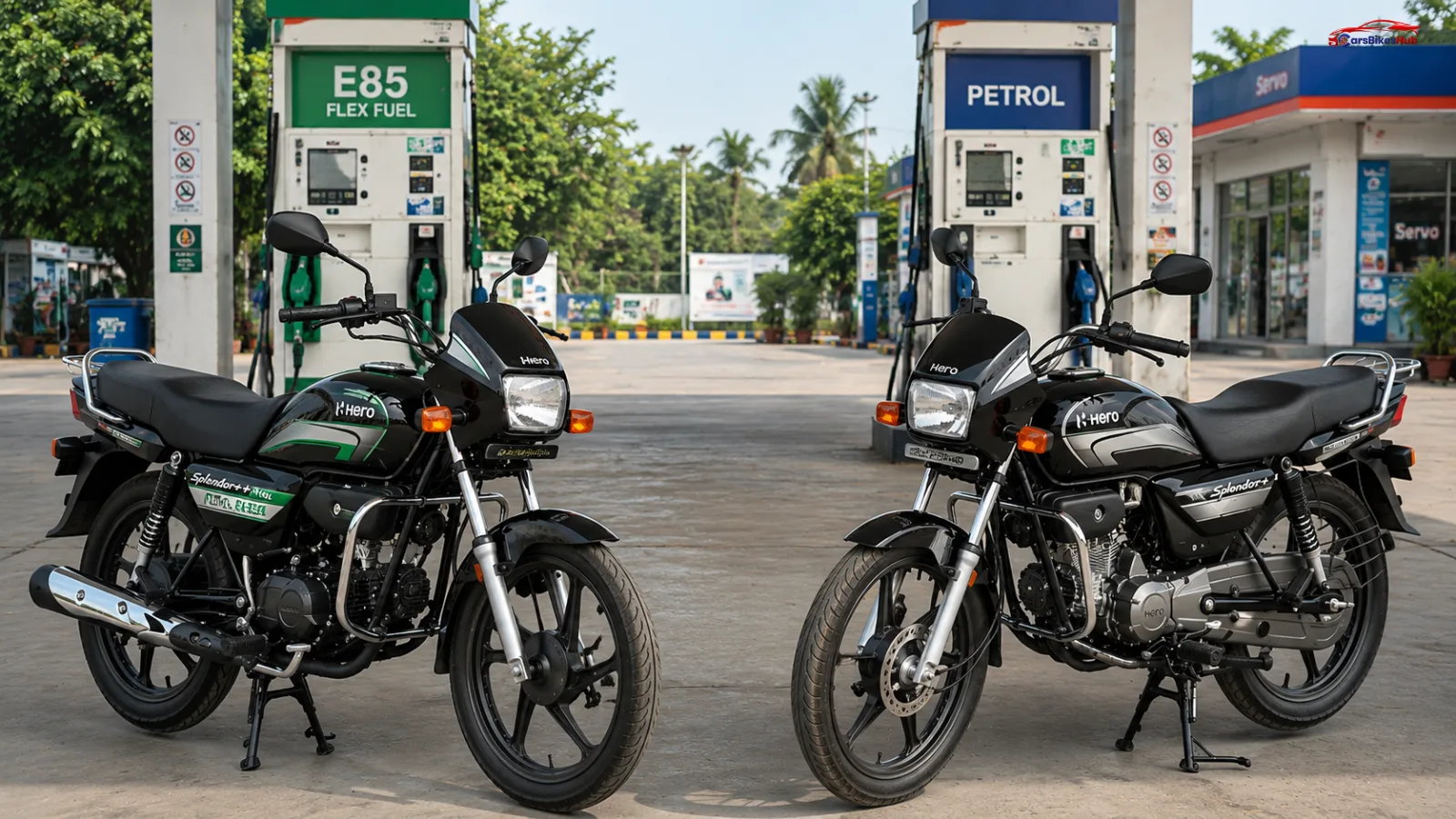
Flex fuel bike vs petrol bike is a comparison many Indian riders are making in 2026. Since Hero MotoCorp launched the Splendor+ Flex Fuel and HF Deluxe Flex Fuel, interest in ethanol-powered motorcycles has grown significantly. If you’re planning to buy a new commuter bike, you may be wondering whether a regular petrol bike is still the better choice or if it’s worth switching to a motorcycle that can run on E85 ethanol-blended fuel.
This isn’t just a technical question. It’s a money question. And in India, running costs matter as much as the purchase price. So let’s break it down properly.
What Is a Flex Fuel Bike?
A flex fuel bike is a motorcycle that can run on a range of ethanol-petrol blends, from the standard E20 fuel (20% ethanol) all the way up to E85 (85% ethanol). Unlike a regular petrol bike, which is calibrated only for E20 or pure petrol, a flex fuel bike has a modified engine, upgraded fuel system components, and a recalibrated ECU that allow it to handle high ethanol concentrations without any damage.
In India right now, the Hero HF Deluxe Flex Fuel (₹72,792 ex-showroom Delhi) and the Hero Splendor+ Flex Fuel (₹82,810 ex-showroom Delhi) are the two bikes you can actually buy in this segment. Both can run on anything from E20 to E85.
A standard petrol bike, like the regular Splendor+ or HF Deluxe, runs on E20 petrol only, which is the fuel currently available at all pumps across India.
Quick Comparison: Flex Fuel Bike vs Petrol Bike
| Factor | Flex Fuel Bike | Petrol Bike |
| Purchase Price | Higher | Lower |
| Fuel Availability | Limited (48 outlets as of June 2026) | Available everywhere |
| Mileage | Lower on E85 | Better |
| Running Cost | Similar currently | Similar currently |
| Future Potential | High | Moderate |
| Best For | Early adopters, metro riders | Most buyers in 2026 |
Price Comparison
| Bike | Ex-Showroom (Delhi) |
| Hero HF Deluxe (Standard) | ~₹59,477 |
| Hero HF Deluxe Flex Fuel | ₹72,792 |
| Hero Splendor+ (Standard) | ~₹77,557 |
| Hero Splendor+ Flex Fuel | ₹82,810 |
The flex fuel variant of the HF Deluxe costs roughly ₹13,000 more than the standard model. For the Splendor+, the gap is around ₹5,000. These are meaningful differences for a buyer in the commuter segment. Whether that premium pays off depends entirely on your running costs over time.
Fuel Cost Comparison: Does a Flex Fuel Bike Actually Save Money?
For most buyers, fuel cost is the biggest factor when choosing between a flex fuel bike and a petrol bike. While E85 fuel is cheaper than petrol, a flex fuel bike also delivers lower mileage.
E85 fuel was officially launched in Delhi in June 2026, priced at ₹82.12 per litre, roughly ₹20 cheaper than E20 petrol in the city. That’s a significant price difference at the pump.
However, ethanol has a lower energy density than petrol. This means your engine burns more E85 to cover the same distance. Real-world data from owners of the HF Deluxe Flex Fuel shows mileage of around 59 kmpl on E20. On E85, mileage is expected to drop by about 25-30%, bringing real-world figures down to somewhere around 42-46 kmpl.
Let’s see the numbers:
E20 petrol scenario (standard petrol bike, Splendor+):
- Fuel price: ~₹102/litre (approximate Delhi price)
- Mileage: 60 kmpl
- Cost per km: ~₹1.70
E85 scenario (Splendor+ Flex Fuel):
- Fuel price: ₹82.12/litre
- Mileage: ~44 kmpl (estimated, accounting for ~27% drop)
- Cost per km: ~₹1.87
At today’s prices, the per-kilometre cost of E85 and E20 petrol is nearly identical. You are not saving money right now. Petrol prices in India have been rising over time. E85 is produced domestically and priced to stay below petrol. Riders who make the switch now will feel the benefit when the gap eventually widens.
Mileage Comparison
| Bike | ARAI/Claimed Mileage | Real-World (Approx.) |
| Hero HF Deluxe (Petrol) | 83 kmpl | 60-65 kmpl |
| Hero HF Deluxe Flex Fuel (E20) | 72 kmpl | 59-65 kmpl |
| Hero HF Deluxe Flex Fuel (E85) | Not specified | ~42-46 kmpl (estimated) |
| Hero Splendor+ (Petrol) | 70 kmpl | 55-62 kmpl |
| Hero Splendor+ Flex Fuel (E20) | Similar to standard | 55-62 kmpl |
On E20, you will not feel any difference compared to a regular petrol bike. The mileage is similar. On E85, it drops. Whether that drop is worth it depends on how much cheaper E85 is near you, and right now, for most Indian riders, it roughly balances out.
Fuel Availability: The Biggest Limitation of Flex Fuel Bikes
E85 is currently available at only 48 outlets in India, concentrated in Delhi and a few other cities. The government plans to expand this to around 500 pumps by the end of 2026 and 5,000 by the end of 2027.
If you live in Delhi-NCR or the Mumbai-Pune-Nagpur corridor and mostly commute within city limits, you may have reasonable access to E85 in the near future. But if you’re in a smaller city, a semi-urban area, or anywhere outside the major metros, E85 is practically unavailable to you right now.
The good news: flex fuel bikes can run perfectly well on regular E20 petrol too. You won’t be stranded. But if you can’t access E85, the cost advantage disappears, and you’re paying a premium price for a feature you’re not using.
Will Flex Fuel Bikes Become Cheaper to Run in the Future?
Right now, the running-cost advantage of a flex fuel bike is limited because E85 availability is low and the mileage drop offsets much of the fuel-price savings. However, the situation could change over the next few years. The government plans to expand E85 fuel stations significantly, while ethanol production continues to increase.
If E85 remains cheaper than petrol and becomes widely available, flex fuel bikes could become more economical to run in the future. Buyers considering a long ownership period may therefore see greater benefits than riders looking only at short-term savings.
Maintenance Cost Comparison
For routine servicing like oil changes, filter cleaning, chain adjustment flex fuel bikes and petrol bikes cost roughly the same. Hero’s service network handles both, and parts pricing is similar.
Where there’s a potential difference is long-term engine wear. Ethanol is slightly more corrosive than petrol. Flex fuel bikes are built with materials and coatings to handle this, but it’s still something to keep an eye on over extended ownership. Standard petrol bikes have a longer track record in Indian conditions.
On the positive side, ethanol burns cleaner, meaning potentially less carbon deposit buildup in the engine over time. Long-term, this could mean lower maintenance requirements, but that’s still too early to confirm for the Indian market.
What About Resale Value?
Resale value remains one of the biggest unknowns for flex fuel bikes in India. Since the technology is still new, there is not enough used-bike market data to predict long-term demand. Conventional petrol bikes currently enjoy a larger resale market and stronger buyer familiarity.
However, if ethanol infrastructure expands and flex fuel adoption increases, resale values could improve over the next few years. Buyers planning to keep their motorcycle for a longer period may be less affected by this uncertainty.
Feature and Specification Comparison
Both the Splendor+ Flex Fuel and HF Deluxe Flex Fuel are mechanically similar to their standard counterparts. The engine displacements, power outputs, suspension setups, braking systems, and overall body dimensions are the same.
What’s different:
- Upgraded fuel system components (corrosion-resistant)
- Recalibrated ECU to handle multiple ethanol blends
- Flex Fuel-specific badging and graphics
- New instrument console with ethanol blend indicator (on some variants)
You’re not getting a more powerful or more feature-rich bike. You’re getting the same commuter in a future-ready package.
The Environmental Benefits of Flex Fuel Bikes
E85 can reduce greenhouse gas emissions by up to 61% compared to petrol, according to government estimates. Ethanol is produced domestically from raw materials such as sugarcane, maize, and other agricultural feedstocks, hence making the country less reliant on foreign crude oil imports.
For buyers who care about their carbon footprint, a flex fuel bike using E85 fuel is significantly cleaner in terms of carbon footprint compared to a regular petrol bike. This isn’t a small claim, 61% lower emissions is significant. And as India’s ethanol blending programme matures, the environmental case for flex fuel will only get stronger.
Who Should Buy a Flex Fuel Bike?
Buy a flex fuel bike if:
- You live in Delhi-NCR, Mumbai, Pune, or another major city with E85 access
- You plan to keep the bike for 4-5 years or more, betting on E85 expansion
- Reducing your fuel emissions is a genuine priority for you
- You want future-proof technology at a modest price premium
- You’re buying the Splendor+ Flex Fuel, where the premium is only ~₹5,000
Avoid a flex fuel bike (for now) if:
- You’re in a city or town without E85 pumps nearby
- You’re on a tight budget, and the ₹13,000 premium matters (HF Deluxe)
- You plan to sell the bike within 1-2 years before E85 spreads widely
- Most of your riding involves long highway trips where fuel stops matter
Who Should Stick with a Petrol Bike?
Standard petrol bikes, the Splendor+, HF Deluxe, Honda Shine 100, and Bajaj Platina remain excellent choices for daily commuting. They’re cheaper upfront, widely serviced, and run on fuel available at every pump in the country. Their mileage figures are well-established and proven in Indian conditions.
If you’re outside a major metro or if you’re not particularly concerned about ethanol technology right now, a regular petrol bike gives you better value for the money in 2026.
What Are the Disadvantages of a Flex Fuel Bike?
While flex fuel technology offers long-term potential, buyers should also be aware of a few practical drawbacks in 2026:
- E85 fuel is still available at a limited number of outlets in India.
- Mileage drops noticeably when running on E85 compared to E20 petrol.
- Flex fuel bikes cost more than equivalent petrol models.
- Long-term resale value is still uncertain because the technology is new.
- Most buyers will not fully benefit from flex fuel technology until E85 availability expands.
Final Verdict: Flex Fuel Bike vs Petrol Bike
In 2026, the petrol bike is still the safer and more practical choice for most Indian buyers. The flex fuel bike is a smart long-term bet, but only if you have access to E85 pumps, which most of India doesn’t yet.
The economics of E85 vs E20 are currently close to break-even. The real advantage will come once E85 prices stabilise, availability expands, and petrol prices keep moving upward. If you live in Delhi or plan to hold onto your bike through 2027–2028 when E85 is expected to be far more widely available, the Splendor+ Flex Fuel at a ~₹5,000 premium over the standard variant is genuinely reasonable.
For most others in 2026, the standard petrol bike is the better buy today. The flex fuel technology is here, it’s real, and it will matter more next year than it does right now.

FAQs
Can I run a flex fuel bike on regular E20 petrol if E85 is not available near me?
Yes. Both the Hero Splendor+ Flex Fuel and HF Deluxe Flex Fuel can run on any ethanol blend from E20 to E85. If E85 is not available, you simply fill up with standard E20 petrol and the bike runs normally. You're not locked into E85.
Will my mileage drop significantly on E85?
Yes. Ethanol has lower energy content than petrol, so fuel consumption increases. On E85, real-world mileage is expected to drop by roughly 25–30% compared to E20. However, since E85 is priced about ₹20 per litre cheaper, the per-kilometre cost remains close to that of petrol. The exact savings will depend on the ongoing price gap between E85 and E20.
Is the flex fuel bike more expensive to service than a petrol bike?
No, routine service costs are the same. Flex fuel bikes use corrosion-resistant fuel system components, but spare parts and service procedures are similar to standard petrol bikes. Hero's nationwide service network handles both.
Where can I find E85 fuel in India right now?
As of June 2026, E85 is available at 48 outlets, primarily in Delhi. The government plans to expand this to 500 outlets by December 2026 and around 5,000 outlets by 2027. Availability is currently limited to major cities.
Is a flex fuel bike better for the environment than a petrol bike?
Yes. E85 fuel can reduce greenhouse gas emissions by up to 61% compared to conventional petrol, according to government data. Ethanol is also produced domestically from agricultural feedstocks, which reduces India's dependence on imported crude oil.