


























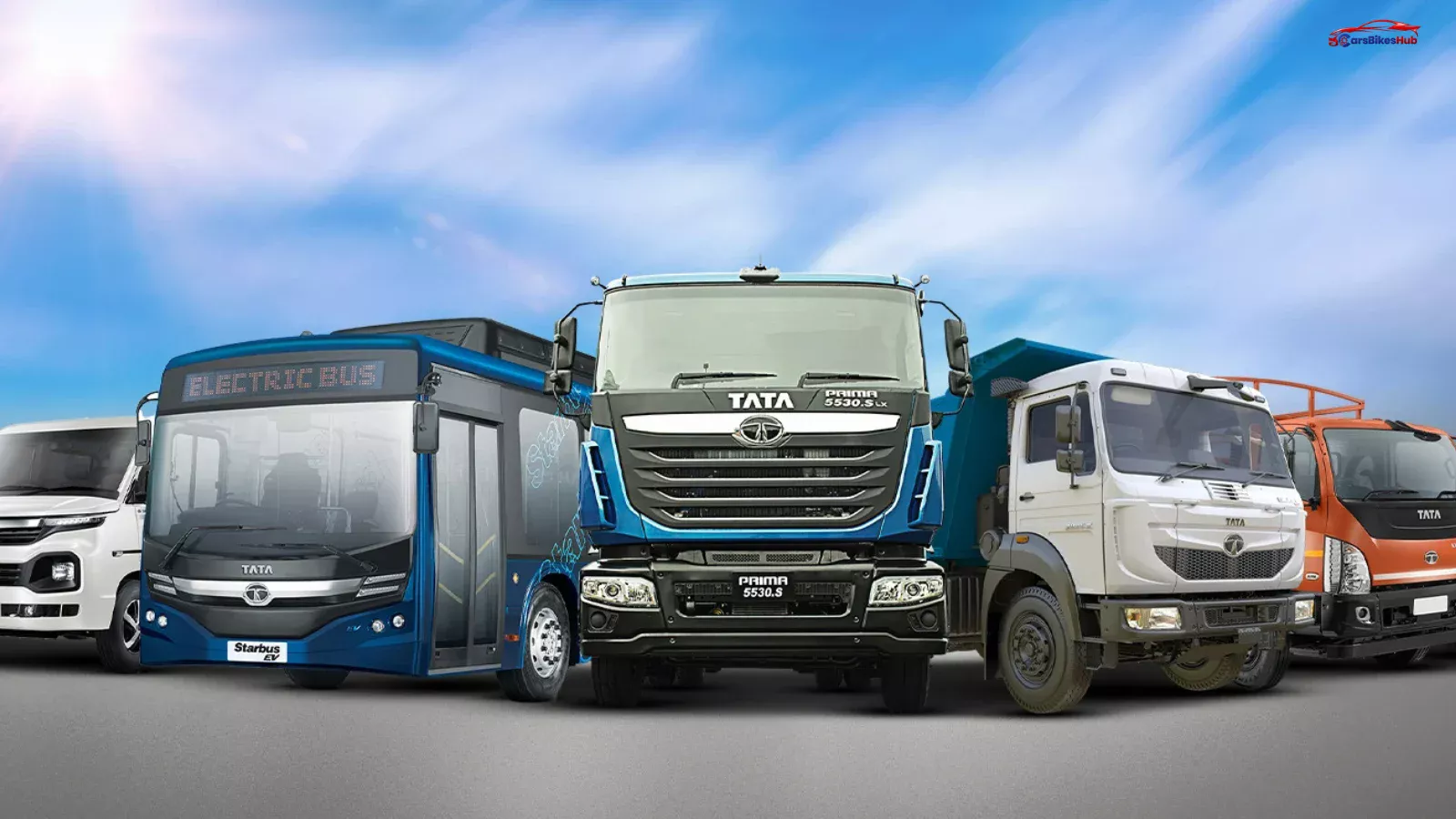
Tata Motors has secured over 3,400 electric commercial vehicle orders across trucks, buses and small commercial vehicles, marking one of the company’s biggest electric mobility milestones to date.
The announcement, made over the weekend, spans freight, logistics and passenger mobility segments and pulls in customers from e-commerce, mining, cement, FMCG distribution and urban transit.
For India’s commercial vehicle industry, the number matters less for its size than for what it represents. Electric trucks, vans and buses have spent the last few years largely confined to pilot fleets and demonstration projects. This Tata Motors electric commercial vehicle order book, spread across such varied industries, suggests commercial buyers are now treating electric vehicles as a default procurement option rather than an experiment.
This article looks at what’s behind the 3,400 orders, which Tata electric commercial vehicle models are driving demand, the economic and policy forces shaping India’s commercial EV segment, and what the milestone means for the company and the wider market.
Tata Motors 3400 EV Orders: Key Highlights
- Over 3,400 electric commercial vehicle orders secured
- Around 2,000 small commercial vehicles (SCVs) and pick-ups
- Around 900 electric trucks
- Around 500 electric buses
- Orders from e-commerce, logistics, FMCG/FMCD, mining, cement, steel and passenger mobility sectors
- Existing base: 17,000+ electric SCVs and 3,800+ electric buses already running on Indian roads
- Highlights growing commercial EV adoption and a shift from pilots to scaled fleet deployment
Tata Motors Secures 3400 EV Orders
Tata Motors announced on June 21, 2026, that it had secured orders for over 3,400 electric commercial vehicles (eCV) across freight, logistics and passenger mobility segments. The breakup of the order book is specific: around 2,000 small commercial vehicles and pick-ups, 900 trucks, and 500 buses.
The customer base is unusually broad for a single order disclosure. The vehicles will go toward e-commerce, logistics, FMCG and FMCD distribution, and intra-city mobility, as well as demanding sectors like cement, steel, mining, and tarmac operations, alongside inter- and intra-city passenger transport.
Tata Motors framed the order book as evidence of a structural shift rather than a one-off win. The wide-ranging deployment reflects growing customer confidence in electric mobility solutions in real-world conditions and signals a decisive shift from pilot programmes to full-scale fleet adoption.
The company also pointed to the data it has accumulated to support that claim. According to Tata Motors, more than 3,800 electric buses are currently in service across India and have collectively travelled over 55 crore kilometres, while over 17,000 Tata electric small commercial vehicles are actively operating on Indian roads. That existing base of operational data is part of what is now convincing larger fleet operators to commit to volume orders rather than small trial batches.
Markets responded positively to the news. Tata Motors shares were trading at ₹406.75, up ₹4.65 or 1.16% in early trading on the day of the announcement, with investors reading the 3,400-unit order book as another sign of traction in the company’s electric commercial vehicle business.
Which Tata Electric Commercial Vehicles Are Driving Demand?
The order spread maps closely onto Tata Motors’ expanded eCV lineup, which the company has built out methodically over the past 12-18 months rather than launching as a single push.
Small commercial vehicles and pick-ups account for the largest single chunk of the order book at roughly 2,000 units. This segment is served by the Ace Pro EV, Intra EV, and the Ace EV. These vehicles are aimed squarely at last-mile delivery, the kind of short-radius, high-frequency runs that e-commerce and FMCG distributors rely on. Their appeal lies in low running costs per kilometre and easier route planning around urban charging points, since daily distances are predictable and well within battery range.
Trucks, accounting for around 900 of the orders, are served by Tata’s heavier eCV range. The company has pushed into intermediate and heavy commercial vehicle segments through its Ultra EV range, along with the Prima EV 55T tractor and Prima EV 28T tipper, which are built for demanding freight, mining, cement and steel-sector operations applications that traditionally required diesel power and high payload tolerance. The fact that mining and tarmac operators are now ordering electric tippers and tractors signals that battery and payload trade-offs in this segment have narrowed enough to be commercially workable.
Buses, the remaining roughly 500 units, fall under the Starbus EV and Ultra EV range, covering both intra-city and inter-city passenger routes. Electric buses have generally had an easier adoption path in India because state transport undertakings and municipal corporations have access to dedicated subsidy schemes and tend to operate on fixed, well-understood routes, ideal conditions for planning charging infrastructure.
Across all three categories, the common thread is route predictability: last-mile delivery vans, mining-site tippers running fixed loops, and buses on scheduled routes are all use cases where total distance and charging windows are known in advance, reducing the range anxiety that still affects long-haul and unpredictable-route applications. This is precisely why Tata’s order book skews toward these segments rather than long-haul line-haul trucking, where electric range still trails diesel.
What Is Fueling Growth in India’s Commercial EV Segment?
Several forces are converging to push fleet operators toward electrification, and none of them is new in isolation; what’s changed is how they’re now reinforcing each other.
Operating economics, not environmental sentiment, are the primary driver. Unlike passenger EVs, where buying decisions are often shaped by brand preference or environmental conviction, commercial buyers evaluate vehicles almost entirely on cost per kilometre, uptime and resale value. Diesel prices remain elevated and volatile, while electricity costs for fleet charging are comparatively stable and, in most cases, cheaper per kilometre travelled, particularly for high-utilisation vehicles doing 100-plus kilometres a day.
Government incentive schemes continue to underwrite the gap. The PM E-DRIVE scheme, with a total allocation of INR 10,900 crore, provides demand-side incentives, particularly for electric trucks, with subsidies of up to INR 9.6 lakh per vehicle, and separately earmarks INR 500 crore for high-emission sectors such as logistics, mining, infrastructure, and manufacturing, precisely the sectors showing up in Tata’s order book.
Notably, the scheme’s purchase-incentive window for electric trucks and buses has been extended rather than allowed to lapse, with support running until March 2028 for electric trucks, buses, charging infrastructure, and testing agency upgrades, giving fleet buyers more confidence to commit to multi-year vehicle replacement cycles.
Corporate sustainability commitments are adding a second layer of demand, especially among large e-commerce and FMCG players who report emissions across their logistics networks and face internal or investor pressure to decarbonise last-mile delivery.
E-commerce and organised logistics growth are expanding the addressable base. As parcel volumes and quick-commerce delivery networks scale, the sheer number of last-mile vehicles needed is growing, and a meaningful share of that incremental demand is going electric by default rather than being converted from existing diesel fleets.
Charging infrastructure, while still uneven, has improved enough to de-risk commitments. India’s public charging network has expanded meaningfully, and dedicated commercial/depot charging, which matters more to fleet operators than public charging, has scaled alongside it.
The numbers back up the trend at a market level. India’s electric commercial vehicle segment recorded a CAGR exceeding 35% between FY2021 and FY2025 and is expected to more than double by FY2030, even as the overall commercial vehicle market remains comparatively stable, with sales easing slightly from 9.69 lakh units in FY2024 to 9.57 lakh units in FY2025. In other words, electrification is growing several times faster than the commercial vehicle market itself, and Tata’s 3,400-order win is a direct expression of that gap.
What This Means for Tata Motors
The order book reinforces, rather than creates, Tata Motors’ position as India’s largest commercial vehicle manufacturer and one of the country’s most established electric mobility players. The company has spent the past year systematically filling out its eCV portfolio, from sub-tonne pick-ups to 55-tonne tractors, rather than concentrating on a single segment, which is part of why this order book spans such varied industries.
That breadth is also a hedge. A company dependent on bus tenders alone is exposed to state transport budgets and procurement cycles; one dependent only on last-mile vans is exposed to e-commerce capex swings. Tata’s spread across SCVs, trucks and buses reduces that single-segment risk, and the 3,400-unit order confirms demand is holding up across all three at once rather than in just one category.
The company has also been building the supporting ecosystem that fleet buyers care about as much as the vehicle itself: charging partnerships, dedicated EV financing structures, fleet management software and uptime-guarantee programmes. For large fleet operators evaluating the total cost of ownership, this ecosystem layer, not just the vehicle spec sheet, is often the deciding factor in committing to volume orders rather than smaller trial batches.
That said, the picture isn’t uniformly favourable across every sub-segment. In electric buses specifically, Tata’s order momentum at the registration level has weakened even as its broader eCV business grows. Tata Motors, which led electric bus sales in FY25, saw its sales drop 84% year-on-year to a mere 153 units in FY26. The 500-bus component of this new order book will be an important signal of whether Tata can recover ground in that specific segment, even as it continues to scale more broadly across SCVs and trucks.
For revenue, a 3,400-unit order, even spread over a typical fulfilment window of several quarters, represents meaningful incremental volume in a segment carrying higher average selling prices than equivalent diesel vehicles, and importantly, it converts pilot-stage interest into firm, billable demand across Tata’s entire eCV range.
Impact on India’s Electric Mobility Ecosystem
This order book is also a useful proxy for where India’s broader commercial EV adoption curve stands. Fleet electrification has historically progressed unevenly; buses and three-wheelers moved first, helped by direct subsidies and predictable routes, while trucks and heavy-duty applications lagged due to range and payload constraints. The presence of 900 truck orders, including for mining and tarmac operations, suggests that lag is narrowing.
The field of manufacturers competing for this demand has also grown more capable, which is itself a sign of a maturing market. India’s eCV market is entering a transformative growth phase, and multiple commercial vehicle makers, not just Tata, are now reporting four-figure order books in parallel.
That kind of simultaneous scale-up across manufacturers tends to accelerate supplier investment, component localisation and charging infrastructure build-out, all of which lower costs for the next wave of fleet buyers.
For fleet operators evaluating electrification today, Tata’s order book is one more data point suggesting the technology has moved past the proof-of-concept stage for last-mile delivery, fixed-route buses and several categories of heavy-duty freight.
Conclusion
Tata Motors securing more than 3,400 electric commercial vehicle orders is significantly less for its raw size and more for what it confirms: commercial fleet operators across freight, logistics, heavy industry and passenger transport are now placing volume orders for electric vehicles rather than running limited trials. The spread across small commercial vehicles, trucks and buses, and across industries as varied as e-commerce and mining, points to demand that is broad-based rather than concentrated.
For Tata Motors, this order book reinforces its position as a leading force in India’s electric commercial vehicle business, even with ground still to recover in the bus sub-segment. For India’s commercial EV market more broadly, it adds to a growing body of evidence, rising order volumes, extended policy support through 2028, and a fast-expanding charging network that fleet electrification is moving from the margins of India’s transport sector toward its mainstream.





FAQs
How many electric commercial vehicle orders has Tata Motors received?
Tata Motors has secured more than 3,400 electric commercial vehicle orders, comprising around 2,000 small commercial vehicles and pick-ups, 900 trucks, and 500 buses, across freight, logistics and passenger mobility segments.
Which Tata electric commercial vehicle models are included in this order book?
The orders cover Tata's full eCV range, including the Ace Pro EV, Ace EV and Intra EV for last-mile delivery, the Ultra EV range along with the Prima EV 55T tractor and Prima EV 28T tipper for heavy-duty freight, and the Starbus EV and Ultra EV bus range for passenger transport.
Which industries are driving demand for Tata's electric commercial vehicles?
Demand is coming from a wide mix of sectors, including e-commerce, logistics, FMCG and FMCD distribution, mining, cement, steel, tarmac operations, and inter- and intra-city passenger transport, indicating broad-based adoption rather than demand from a single industry.
Why is commercial EV adoption growing in India?
Growth is being driven by lower per-kilometre operating costs compared to diesel, government incentives under schemes like PM E-DRIVE (extended to March 2028 for trucks and buses), rising corporate sustainability commitments, expanding e-commerce and logistics volumes, and improving charging infrastructure.
What does this order milestone mean for Tata Motors and India's EV market?
It signals that commercial fleet operators are moving from pilot-stage EV trials to large-scale deployment, reinforcing Tata Motors' position in India's electric commercial vehicle market and reflecting the broader trend of India's eCV segment growing faster than the overall commercial vehicle market.