
























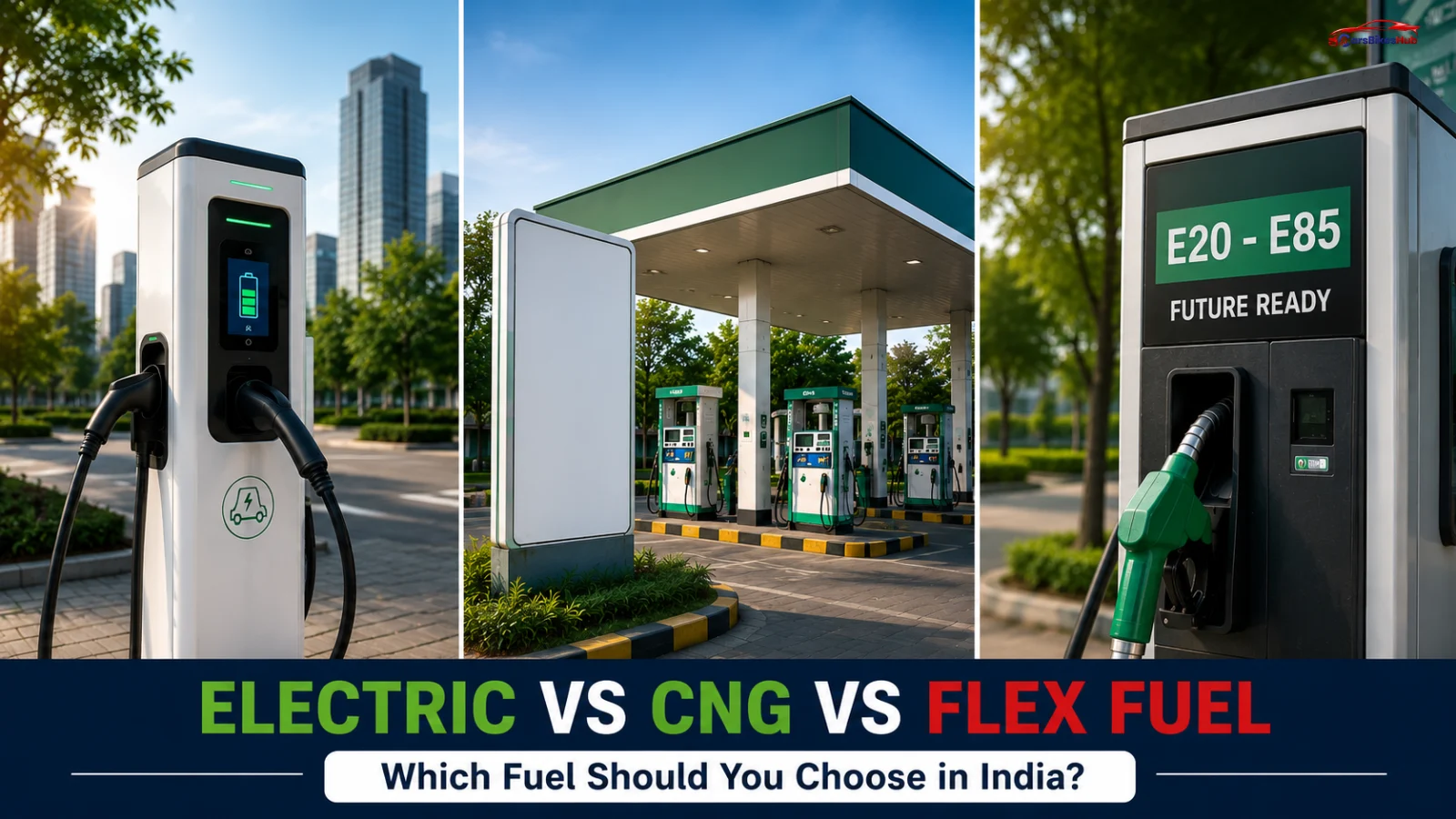
Buying a car in India today isn’t just about choosing a brand or a body type anymore. You’re also choosing a fuel ecosystem, one that decides how you refuel, how much you spend every month, and how convenient your ownership experience will be for the next several years.
Petrol prices have stayed stubbornly high, ethanol blending has quietly changed what comes out of the pump at your regular fuel station, EV adoption is growing in every metro, and CNG has expanded well beyond Delhi-NCR and Mumbai into smaller towns. Three technologies Electric, CNG, and Flex Fuel are now genuinely competing for the same buyer.
This guide isn’t about which technology is technically superior. It’s about which one actually fits your driving habits, your budget, and the infrastructure available where you live. One quick note before we begin: true Flex Fuel Vehicles (capable of running on high ethanol blends like E85) are still rare in Indian showrooms, so where this guide talks about “Flex Fuel,” it’s largely addressing the E20-compatible petrol cars most buyers can actually purchase today; we’ll draw that distinction clearly as we go. By the end, you should know exactly which fuel makes sense for you, not for the “average Indian buyer,” but for your specific situation.
At a Glance: Electric vs CNG vs Flex Fuel
| Factor | Electric | CNG | Flex Fuel |
| Upfront Cost | Highest (₹8-15+ lakh typical) | Moderate (+₹80,000-1.2 lakh over petrol) | Lowest (same as regular petrol car) |
| Running Cost | Lowest with home charging | Low, rising with CNG price hikes | Moderate, close to petrol |
| Maintenance | Lowest long-term | Slightly higher (cylinder retesting, engine wear) | Same as petrol |
| Infrastructure | Improving but patchy outside metros | Strong in NCR, Mumbai, Pune, Gujarat; growing elsewhere | Universal — same as petrol pumps |
| Refuelling / Charging | Slowest (30 min–8+ hrs depending on charger) | Fast (similar to petrol) | Fastest (identical to petrol) |
| Long-distance Travel | Needs planning around charging stops | Practical with CNG-petrol dual tank | No compromise at all |
| Environmental Impact | Zero tailpipe emissions | Lower than petrol/diesel | Marginally lower than pure petrol |
| Best For | City-based daily commuters with home charging | High-mileage drivers in CNG-strong cities | Buyers wanting zero change in routine |
What Is an Electric Vehicle, and Why Are Buyers Choosing It?
Most EV buyers aren’t choosing electric because they care deeply about emissions; they’re choosing it because the math works out in their favour if they drive mostly within the city and can charge at home or at work.
Biggest advantages: Near-silent driving, instant torque that makes city driving feel effortless, and running costs that can drop to a fraction of petrol if you charge overnight on a home connection.
Biggest disadvantages: Charging infrastructure outside major metros remains inconsistent, public fast charging isn’t as cheap as home charging, and highway trips require actual route planning around charging stops rather than the “just fill up and go” habit most Indian drivers are used to.
Who should buy one: Buyers with access to a dedicated home or office charging point, whose daily driving stays within 80–100 km, and who value low running costs over long-distance flexibility.
Who should avoid one: Frequent long-distance drivers, buyers in apartment complexes without charging access, and anyone who can’t tolerate planning trips around charger availability.
What Is a CNG Vehicle, and Where Does It Still Make Sense?
CNG cars run on compressed natural gas stored in a cylinder, with a petrol tank kept as backup, so you’re never fully stranded even if you run out of gas mid-drive.
Running cost benefits: CNG has historically delivered 40–50% lower running costs than petrol, though prices have crept up in recent years in several states, narrowing that gap slightly.
Infrastructure availability: CNG stations are dense in Delhi-NCR, Mumbai-Pune, and parts of Gujarat, but far less predictable in smaller towns or hilly regions; always check local station density before buying.
Practical compromises: The cylinder eats into boot space (typically 60-90 litres), and factory-fitted kits, while safer than aftermarket ones, add real upfront cost.
Best use cases: Cab drivers, delivery fleet operators, and daily commuters doing 60+ km a day in cities with strong CNG networks.
Limitations: Reduced boot space, mandatory cylinder retesting every three years, and a driving experience slightly less refined than petrol due to how the engine is tuned for gas.
What Is a Flex Fuel Vehicle, and Should You Wait for One?
This is where most Indian buyers get genuinely confused, so it’s worth being precise.
E20 vs true Flex Fuel: E20 petrol, a 20% ethanol blend, is already the default fuel at most Indian pumps, and nearly every modern petrol car sold in India is E20-compatible. True “Flex Fuel Vehicles” (FFVs), by contrast, are engineered to run on much higher ethanol blends, up to E85, and require specific fuel system components. These are not the same thing.
Current status in India: The government has approved pilot FFV programmes and a few manufacturers have showcased E85-capable models, but as of now, dedicated E85 flex fuel vehicles are still not widely available for retail purchase in Indian showrooms.
Government push: India’s ethanol blending programme has been one of the fastest-moving fuel policies in the country, with the E20 target achieved well ahead of original timelines — signalling strong long-term commitment to ethanol as a fuel strategy.
Benefits: Lower dependency on imported crude oil, marginally lower emissions, and, once E85 vehicles arrive, potentially significant running cost savings since ethanol is typically cheaper than petrol.
Limitations: True flex fuel vehicles aren’t meaningfully available yet, so for most buyers today, “choosing flex fuel” really just means buying a standard E20-compatible petrol car.
Should you wait? Only if you have no urgent need to buy. For most buyers who need a car now, waiting for E85 FFVs makes little practical sense; you’re better off deciding between Electric and CNG for genuine running-cost savings today.
Current Reality Check: An E20-compatible petrol car is not the same thing as a Flex Fuel Vehicle. Since dedicated E85 FFVs aren’t yet widely sold in India, most buyers considering the “flex fuel route” today are effectively choosing a modern E20-compatible petrol car, a distinction worth keeping straight before you shop.
Running Cost Comparison
| Fuel | Cost per km | Approx. Monthly (1,500 km) | Approx. Annual |
| Electric (home charging) | ₹1-1.5 | ₹1,500-2,250 | ₹18,000-27,000 |
| Electric (public fast charging) | ₹2.5-3.5 | ₹3,750-5,250 | ₹45,000-63,000 |
| CNG | ₹2-2.5 | ₹3,000-3,750 | ₹36,000-45,000 |
| Flex Fuel route (E20-compatible petrol) | ₹5.5-6.5 | ₹8,250-9,750 | ₹99,000-1,17,000 |
If you can charge at home, nothing beats an EV on pure running cost. If you rely mostly on public charging, CNG often works out just as cheap, sometimes cheaper without the charging-time inconvenience. Buyers on the flex fuel route pay the standard petrol price for the convenience of zero change in routine, since today’s “flex fuel” cars are, in practice, E20-compatible petrol cars.
Infrastructure Comparison
EV charging infrastructure is expanding fast in metro cities but remains genuinely patchy in tier-2/3 towns and along many highway stretches; always check charger density on your specific commute and travel routes before committing.
CNG station availability is strong and well-established in western and northern India but sparse in the east, north-east, and much of the south.
Ethanol-blended (E20) fuel, on the other hand, is available at essentially every fuel pump in the country already, making it the only truly infrastructure-agnostic option among the three.
For rural and highway-heavy driving, flex fuel (i.e., a regular E20 petrol car) remains the most practical choice by a wide margin. For city-bound driving, both EV and CNG can work well; the deciding factor is usually which infrastructure is stronger in your specific city.
Maintenance & Ownership Costs
EVs generally cost the least to maintain over five years: no engine oil changes, no clutch wear, far fewer components to service, though buyers should budget for potential battery-related costs outside the warranty period (typically 8 years/1,60,000 km on most current models).
CNG vehicles need mandatory cylinder retesting every three years and tend to see marginally higher long-term engine wear due to drier combustion, though factory-fitted setups have improved significantly on this front.
Flex fuel/E20 petrol cars carry standard petrol maintenance costs, with no meaningful additional expense.
Performance & Driving Experience
City driving favours EVs by a clear margin; instant torque and silence make stop-start traffic genuinely less tiring. CNG cars feel closest to petrol in daily driving but lose a bit of punch when running purely on gas, especially with the AC on. Flex fuel/E20 cars drive exactly like any standard petrol car, since that’s essentially what they are today.
Electric: Instant torque delivers immediate, linear acceleration from a standstill; this is the single biggest reason EV owners describe city driving as “effortless” rather than just “efficient.”
CNG: Expect a noticeable, if modest, performance drop under load; overtaking on the highway or climbing gradients with a full load feels less punchy on gas than on petrol.
Flex Fuel (E20 petrol): Performance is nearly identical to a standard petrol car, since that’s exactly what today’s E20-compatible vehicles are no adjustment period, no compromise.
On the highway, it flips: petrol/flex fuel offers the most stress-free long-distance experience, CNG is a close second thanks to its dual-tank backup, and EVs require the most planning due to charging stop dependency.
Environmental Impact
EVs produce zero tailpipe emissions, though their overall carbon footprint still depends on how the electricity used to charge them is generated; coal-heavy grids reduce the net environmental benefit somewhat.
CNG burns cleaner than petrol or diesel, producing meaningfully lower particulate emissions. E20 petrol offers a modest emissions improvement over pure petrol, in line with India’s broader ethanol blending and sustainability goals.
Future Readiness
India’s EV roadmap continues to expand with state-level subsidies and growing charging investment, though the pace varies significantly by state. The ethanol blending programme has consistently outperformed its own timelines, suggesting flex fuel technology has strong government backing even if retail FFV availability is still catching up. CNG infrastructure continues to grow steadily, particularly in states investing in city gas distribution networks.
It’s worth being clear here: EV and ethanol blending both have strong long-term policy momentum, but that’s a statement about future direction, not a guarantee about how quickly infrastructure or vehicle availability will catch up in your specific city.
Base your decision on the infrastructure available where you live right now, not on expected future developments. Government roadmaps for EV charging, CNG expansion, and true flex-fuel vehicle availability are all encouraging, but the pace of rollout still varies significantly by state and city; buy for the car you’ll own for the next 5-7 years, not the ecosystem that might exist by then.
Choose Electric if:
- You have reliable access to home or workplace charging
- Your daily driving is mostly within 80-100 km inside the city
- You want the lowest possible running and maintenance cost
- You’re comfortable planning for occasional long trips
Choose CNG if:
- You drive high daily distances, 60 km or more
- You live in a city with strong CNG station density (NCR, Mumbai-Pune, Gujarat)
- You want low running costs without changing your refuelling routine much
- You need the flexibility of a backup petrol tank
Choose E20-Compatible Petrol (the “Flex Fuel” Route, for Now):
- You travel frequently between cities or through areas with uneven CNG/charging infrastructure
- You want zero compromise on refuelling speed or routine
- You prioritise resale value and want the most “normal” ownership experience
- You’re not planning to wait for true E85 vehicles, which remain largely unavailable
Final Verdict
There isn’t a single best option here because each fuel type excels in different situations. The right choice depends on how, where, and how much you drive. If you can charge at home and drive mostly within the city, an EV will save you the most money and offer the smoothest daily experience.
If you drive long distances regularly in a city with solid CNG infrastructure, CNG remains one of the most balanced, low-risk choices available today. And if you simply want a car that behaves exactly like every car you’ve owned before- no new habits, no infrastructure dependency a standard E20-compatible petrol car is already doing its part for lower emissions without asking anything extra of you.
The right choice depends less on which technology is “better” and more on your driving pattern, your budget, and what’s actually available where you live and travel.


FAQs
Is an EV cheaper than CNG in India?
On a pure cost-per-km basis, EVs are usually cheaper if you charge at home. If you rely mainly on public charging, CNG often works out just as economical, sometimes more so.
Are Flex Fuel cars available in India?
E20-compatible petrol cars are already the default; nearly every current petrol car qualifies. True E85-capable Flex Fuel Vehicles, however, are still not widely available for retail purchase.
Is E20 petrol the same as Flex Fuel?
No. E20 is a 20% ethanol blend used in regular petrol cars today. Flex Fuel Vehicles are purpose-built to run on much higher ethanol blends, up to E85, and aren't yet mainstream in India.
Which fuel has the lowest running cost?
Electric, if you have consistent access to home charging. CNG is the closest competitor and often the more practical choice for high-mileage drivers without home charging.
Which fuel is best for long-distance travel?
Flex fuel (i.e., a standard E20 petrol car) offers the most stress-free long-distance experience, with CNG a close second thanks to its dual-tank backup. EVs require the most trip planning.