























Hyundai has filed a design patent in India for a production-spec version of its rugged Boulder concept, and it’s already got automotive enthusiasts speculating about a potential Mahindra Thar rival. But here’s the catch worth knowing upfront: a patent filing isn’t a launch confirmation. It’s an early legal safeguard, not a promise, and plenty of patented designs never make it to Indian roads at all. Before you get too excited, though, it’s worth pausing on one important fact: a patent filing is not a launch confirmation. It’s an early, procedural step, and plenty of patented vehicles never make it to Indian showrooms at all.
That’s exactly why this patent has generated so much interest; it arrives against the backdrop of Hyundai’s previously announced plans to expand its SUV portfolio in India. This particular filing is more interesting than most, because Hyundai has already told investors it plans to bring a genuinely off-road-focused SUV to India before FY2030. So the real question isn’t just “what is the Boulder,” but whether this patent is the first tangible sign of that promise taking shape. Let’s walk through what’s actually known, what’s speculation, and what it could mean if you’re in the market for a rugged SUV over the next few years.
What Is the Hyundai Boulder?
The Boulder started life as a concept vehicle, unveiled at the 2026 New York International Auto Show. It marked a genuine departure for Hyundai, previewing the brand’s first body-on-frame architecture, a ladder-frame underpinning typically reserved for serious off-roaders and pickup trucks rather than the monocoque crossovers Hyundai is best known for.
Design-wise, the Boulder concept leaned hard into rugged, utilitarian styling: a boxy silhouette, muscular bonnet, vertically stacked LED headlamps, flared wheel arches, and suicide-style doors. It rode on 18-inch wheels wrapped in all-terrain tyres, sat on generous ground clearance, and carried a full-size spare wheel mounted on a tailgate that opens from both sides.
A roof rack with integrated LED lighting rounded off the exterior. Inside, the concept’s cabin was equally purposeful, built around a bank of four rotary knobs for adjusting drive and off-road modes, an inclinometer, a strip of four rectangular displays, and a full-width head-up display, with exposed gear-lever linkages adding to the mechanical, functional feel.
Hyundai has been clear that the concept’s body-on-frame platform primarily previews a pickup truck for the US market, expected around 2030. The company has not confirmed that the concept itself would be sold as-is anywhere, including in the US.
Why Has Hyundai Boulder Patented in India?
Automakers routinely file design patents in markets long before (and sometimes without ever) launching a product there. A design patent protects the visual identity of a vehicle, its proportions, surfacing, lighting signatures, and overall silhouette, from being copied by rivals or knock-off manufacturers. Filing early is a low-cost way for a company to lock down those design rights while it still has the option to launch later.
This is precisely why a patent filing shouldn’t be read as a guarantee. Manufacturers patent facelifts, global models with no India business case, and even design studies that get shelved. For a brand as large as Hyundai, which sells dozens of body styles and variants across regions, patent filings in India happen fairly often and don’t always translate into a car you can walk into a dealership and book.
What makes this filing worth paying attention to, though, is the broader context. During its 2025 Investor Day, Hyundai confirmed it would add an off-road-capable SUV to its India lineup by FY2030, as part of a wider plan that includes several new nameplates. A patent for a Boulder-like design landing in the same window as that promise is a meaningful data point, even if it isn’t proof on its own.
Does the Patent Mean the Hyundai Boulder Will Launch in India?
Simply put, a patent filing does not equal a confirmed launch. This is one of the most common misunderstandings readers have when these stories break, so it’s worth spelling out the usual sequence of events.
After a design is patented, a manufacturer typically has years of runway to decide whether, when, and in what form to bring it to market. Some patented designs go on to become the exact car you see on roads. Others get significantly reworked before launch. And a fair number are simply insurance policies filed by legal and IP teams that never turn into a sales program at all.
Indian buyers have seen this pattern before, where design or technical patents for global Hyundai, Kia, and other group models surfaced years ahead of any official word, and in several cases, no India launch followed at all.
For now, the honest answer is: this patent tells us Hyundai is protecting a specific design in India, and that design closely tracks a concept the company has separately said will inform a future body-on-frame product line.
It does not tell us a launch date, a variant lineup, or even a firm commitment that this specific styling will reach Indian roads unchanged. Buyers should treat this as an early signal worth watching, not a green light to start planning a purchase around.
What Does the Patent Reveal?
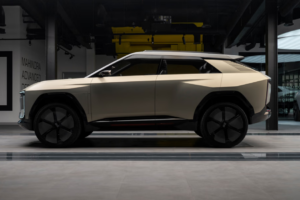
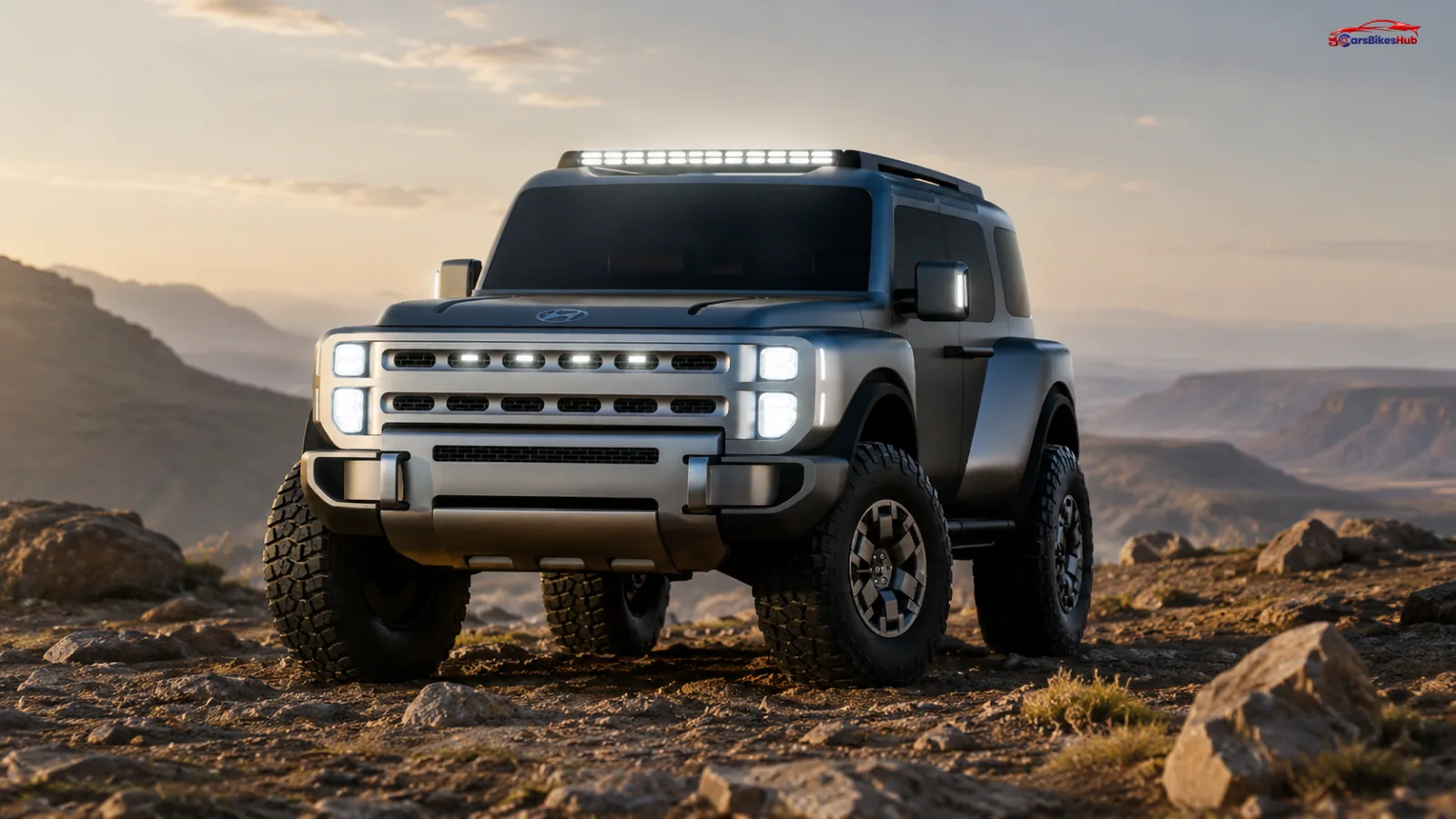
This is where things get genuinely interesting, because the patented design isn’t a carbon copy of the New York show car. It shares the concept’s boxy, rugged proportions, chunky off-road tyres, muscular wheel-arch cladding, and distinctive L-shaped C-pillars, but several details have clearly been reworked for a production-oriented design.
Up front, the concept’s large dual-headlamp clusters have been swapped for a pair of smaller, square lights flanked by vertical LED strips. The slotted grille cover seen on the concept is gone too, replaced by a cleaner, more closed-off grille in the patent image. The bumper design also differs, featuring a more defined skid plate finished with a pattern of small rectangular slats, a detail suggesting genuine underbody protection rather than a styling flourish.
Along the sides, the previously rounded wheel-arch cladding has been squared off, and the wheel design itself is different from the concept. Instead of the concept’s roof-mounted light bar, the patented design shows a substantial roof rack with cable-style risers running toward the front fenders, a functional feature intended to deflect branches and overgrowth away from the windshield when driving off-road. The window graphics are also less curved than on the concept, and the small glass inserts above the doors have been dropped entirely.
The patent does not include the rear of the vehicle or any interior views, so anything about the tailgate, boot design, or cabin layout on the production version remains unconfirmed. For reference, the concept’s rear featured a large bootlid-mounted spare wheel and twin tail-lamp clusters, but whether that carries over is currently unknown.
Expected Powertrain
What Hyundai Has Confirmed
Hyundai has confirmed only that a body-on-frame platform underpins the Boulder concept, and that this platform will be used for a pickup truck designed, developed, and built specifically for the US market by 2030. Separately, and on a different track, Hyundai has confirmed it will bring a “muscular” off-road-capable SUV to India by FY2030, without specifying whether it will share the Boulder’s body-on-frame construction or use a monocoque platform instead.
What Is Being Speculated
Everything about engines, transmissions, 4WD hardware, and drivetrain layout for an India-bound Boulder-based SUV is currently speculation, and no credible powertrain details have been reported. Given Hyundai’s India strategy has generally favoured monocoque platforms for cost and localisation reasons, it’s plausible the India-spec model could differ mechanically from the US pickup, but this is not something Hyundai has stated, and readers should treat any specific horsepower or engine claims circulating online with scepticism until Hyundai confirms them.
Could the Hyundai Boulder Rival the Mahindra Thar?
If a Boulder-based SUV does arrive in India, it would enter a segment that currently isn’t crowded, but is fiercely loved: rugged, image-led SUVs built around genuine off-road capability rather than just SUV styling cues.
On paper, the Hyundai Boulder appears to fit into India’s growing lifestyle off-road SUV segment, which is currently dominated by just a handful of models.
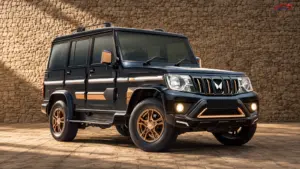
The Mahindra Thar remains the default choice here, prized for its go-anywhere credibility, ladder-frame construction (in some variants), and strong after-sales ecosystem built specifically around off-road use. The Force Gurkha leans even further into hardcore capability, with a focus on serious trail use over daily comfort. The Maruti Jimny sits at the more compact, lifestyle-oriented end of the spectrum, popular with buyers who want off-road looks and light-duty capability in a smaller, easier-to-live-with package.
A Hyundai entrant would likely position itself somewhere in this mix, competing on brand trust, dealership reach, and Hyundai’s typically feature-rich cabins, an area where rivals in this segment have historically been more spartan. Whether it can match the low-range gearing, wading depth, and modification culture that has made the Thar an off-road icon in India is an open question that depends entirely on the final specification Hyundai chooses, none of which is confirmed yet. It’s too early to say whether a Boulder-based SUV would be better or worse than these rivals; that verdict can only come once Hyundai reveals actual specifications and pricing.
Expected Price in India
There is no official pricing information from Hyundai for a Boulder-based SUV, and given a launch isn’t even confirmed, treating any number as reliable right now would be misleading. Some automotive listing sites have floated broad estimate ranges for a future “Hyundai Boulder” in India, but these figures are generic placeholders rather than reports based on confirmed specifications, and should be read with that context in mind.
Hyundai has not officially announced pricing for this model. Until Hyundai issues an official statement or unveils a production-ready concept, any price figure you see online is, at best, an educated guess.
Expected Launch Timeline
Officially, Hyundai has only committed to launching an off-road-capable SUV in India sometime before FY2030, as part of a broader seven-nameplate expansion plan announced at its 2025 Investor Day. There is no confirmed launch date, no confirmed name (it may or may not be sold as “Boulder” in India), and no confirmed connection between this specific patented design and the eventual production model.
Realistically, based on how Hyundai has sequenced past product reveals, buyers should expect a multi-year gap between a patent filing like this one and an actual showroom launch, likely including a formal concept reveal or teaser campaign closer to the on-sale date. Treat FY2030 as the outer boundary of Hyundai’s own stated commitment, not a firm booking date.
Should Buyers Get Excited?
There’s genuine reason for cautious optimism here. Hyundai rarely files detailed design patents without some underlying product intent, and the timing lines up neatly with the company’s own public commitment to an off-road SUV for India. If it does arrive close to what’s shown in the patent, it would be a distinctive, purpose-built off-roader from a mainstream brand with strong service infrastructure across the country, something the segment doesn’t currently have much of outside Mahindra and Force.
Potential concerns: the production model could still be diluted for cost, emissions, or localisation reasons by the time it reaches India; the segment is niche, so Hyundai’s dealer network and service staff may need real specialisation to support this kind of vehicle; and given the multi-year runway involved, plans can and do change.
Who might wait: enthusiasts specifically shopping for a rugged, off-road-first SUV who don’t need a vehicle in the next year or two, and who are curious how Hyundai’s take on this format compares to the Thar, have reason to keep an eye on this story as it develops.
Who should not delay: anyone who needs a vehicle now, or whose primary use case is daily driving and light SUV duty rather than serious off-roading, shouldn’t factor an unconfirmed, undated product into their current buying decision. The Thar, Gurkha, and Jimny all exist today, with known pricing, specifications, and ownership experiences to evaluate.
Final Verdict
Right now, this is simply a design patent, nothing more, nothing less. It’s a legally protective filing that happens to closely track a concept Hyundai has already shown publicly, filed in a market where the company has separately promised an off-road SUV within a defined timeframe. That combination makes it a meaningful signal, but not a confirmed product.
Could it become one of Hyundai’s most exciting SUVs for India? Potentially, yes, if the production version retains even a fraction of the concept’s rugged design language and Hyundai backs it with genuine off-road hardware rather than just styling. But buyers should realistically expect a long wait, no confirmed specifications for at least a while yet, and the possibility that the final product looks and performs differently from what’s pictured in this patent.
For now, the Hyundai Boulder patent should be viewed as an encouraging early signal rather than a confirmed launch plan. If Hyundai eventually brings a production version to India, it could offer buyers an exciting new alternative in the lifestyle off-road SUV segment. Until then, it’s best to treat the design filing as an interesting glimpse into Hyundai’s future rather than a reason to postpone your current SUV purchase.





FAQs
Does the Hyundai Boulder patent confirm it will launch in India?
No. A design patent only protects the visual design of a vehicle from being copied; it doesn't confirm a launch, timeline, or specification. Many patented designs never reach Indian showrooms at all.
What is the Hyundai Boulder?
The Boulder is a rugged SUV concept Hyundai unveiled at the 2026 New York International Auto Show. It previews the brand's first body-on-frame platform, primarily built to underpin a pickup truck for the US market by 2030.
Will the Hyundai Boulder rival the Mahindra Thar in India?
It's too early to say for certain, but if a production version does arrive, it would likely compete in the same lifestyle off-road SUV space as the Thar, Force Gurkha, and Maruti Jimny. Hyundai hasn't confirmed specifications, so a direct comparison isn't possible yet.
What is the expected price of the Hyundai Boulder in India?
Hyundai has not announced official pricing. Any figures circulating online are estimates from third-party sources, not confirmed by the company, and should be treated with caution.
When will the Hyundai Boulder launch in India?
Hyundai has only confirmed it will bring an off-road-capable SUV to India before FY2030, as part of a broader lineup expansion. No exact launch date or model name has been announced yet.