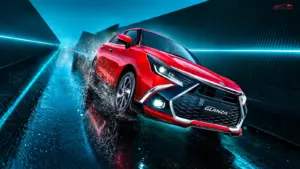













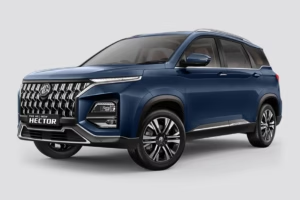
















MG has just launched the MG Hector Tomahawk EV in India, with two very different ways to pay for it. Outright purchase starts at ₹19.49 lakh. But there’s a second number floating around too: ₹13.99 lakh, under MG’s Battery-as-a-Service (BaaS) programme.
That’s ₹5.5 lakh less to pay upfront, but the battery rental means the real ownership-cost difference isn’t anywhere near that simple. Naturally, the BaaS price is the one getting shared around. But before you get excited about “saving” ₹5.5 lakh, here’s the question that actually matters: does paying less upfront make the Tomahawk EV cheaper to own, or does the battery rental simply move the cost somewhere else?
In this article, we will walk you through what the Tomahawk EV actually is: a 69.2kWh, three-row electric SUV with a claimed 517km MIDC range, seating for five or seven, and V2H (vehicle-to-home) tech that MG claims is a first for a passenger car in India, but the BaaS question comes first.
MG Tomahawk EV Price and Variants in India
The MG Tomahawk EV is available in three trims: Excite, Exclusive and Essence. There are four configurations in total because the top-spec Essence can be had with either five or seven seats.
| Variant | Seating | Ex-showroom price |
| Excite | 7-seater | ₹19.49 lakh |
| Exclusive | 7-seater | ₹21.99 lakh |
| Essence | 5-seater | ₹22.99 lakh |
| Essence | 7-seater | ₹23.49 lakh |
The Excite is the entry point at ₹19.49 lakh, while the Essence 7-seater is the most expensive version at ₹23.49 lakh. If you specifically want the five-seat layout, that is currently available only with the top Essence trim.
What about the ₹13.99 lakh BaaS price?
This is where the Tomahawk EV’s pricing gets more interesting. MG is offering the Excite 7-seater under its Battery-as-a-Service (BaaS) programme at ₹13.99 lakh, with a separate battery rental of ₹4.90 per kilometre.
It’s important not to treat BaaS as another variant, though. Excite, Exclusive and Essence are the actual trims; BaaS is an alternative ownership model.
The ₹13.99 lakh figure therefore isn’t the full price of the EV. You pay that amount upfront for the vehicle and then pay the applicable battery rental based on how much you drive.
For now, MG has announced the BaaS starting price for the Excite but has not disclosed detailed BaaS pricing for the Exclusive and Essence trims. So if you’re interested in a higher-spec Tomahawk EV, you’ll need to check the latest terms with MG before assuming the same BaaS structure applies.
Outright purchase
You pay the full amount upfront, and the battery is included in the vehicle purchase, no separate rental, no per-kilometre charge. This is the more straightforward ownership route: a fixed cost from day one, with no running battery bill to track.
BaaS
Under BaaS, MG splits the vehicle and the battery into two separate costs. You pay ₹13.99 lakh upfront for the vehicle (currently only on the base Excite trim), and then a battery rental of ₹4.90 per kilometre on top of that, for the duration of the BaaS arrangement. MG hasn’t disclosed BaaS pricing for the Exclusive or Essence variants yet, so if you want a higher trim under this scheme, you’ll need to wait for that detail or check with your dealer.
The one thing worth repeating clearly: ₹13.99 lakh is the upfront vehicle price, not the total cost of owning the car. It’s a lower entry point, not a discount. Everything you drive after that comes with a running bill attached to the battery.
What is BaaS and how does it actually work?
If you haven’t come across Battery-as-a-Service before, here’s the simplest way to think about it. In a normal EV purchase, the price you pay covers the car and the battery pack together. The battery is usually the single most expensive component in an EV, often close to 40-50% of the vehicle’s cost.
BaaS unbundles that. MG sells you the vehicle at a lower price because the battery isn’t included in it. Instead, you pay for battery use separately, in this case at ₹4.90 for every kilometre you drive. So your total ownership cost isn’t fixed the way it is with an outright purchase; it grows with how much you drive and how long you keep the car.
This also means two Tomahawk EV owners under BaaS, buying the same variant on the same day, can end up with very different total costs a year later, purely based on their driving habits. That’s the trade-off you’re signing up for: a smaller number today in exchange for a variable number tomorrow.
Is BaaS actually cheaper?
This is genuinely the question that matters, and the honest answer is: it depends, and MG hasn’t given us enough information yet to run a reliable five-year cost comparison.
To understand how quickly the rental can add up, here’s a simple illustration using the current ₹4.90/km rate. Treat this as an illustration, not an official MG ownership-cost projection:
- Driving 1,000km a month adds roughly ₹4,900 a month, or about ₹58,800 a year, in battery rental.
- Driving 2,000km a month roughly doubles that to about ₹9,800 a month, or close to ₹1.18 lakh a year.
Over five years, the 1,000km/month owner would pay close to ₹2.94 lakh in rental, and the 2,000km/month owner close to ₹5.88 lakh, on top of the ₹13.99 lakh upfront price. Add those figures up, and you can see the gap with the ₹19.49 lakh outright price narrowing, and in the higher-mileage case, potentially disappearing or reversing.
We’re deliberately not turning this into a precise “BaaS saves you X” or “outright wins by Y” table, because several pieces MG hasn’t confirmed would change the answer meaningfully:
- Whether the ₹4.90/km rate is fixed for the ownership period or can be revised
- What happens to the rental structure if you don’t opt for outright purchase later
- How resale value differs between an owned-battery car and a rented-battery one
- What the assured buyback programme (mentioned separately by MG) means for BaaS buyers specifically
- Financing costs on either path, since a lower upfront price also usually means a smaller loan
Until MG spells these out, treat any five-year total-cost claim you see online, including the illustration above, as an approximation, not a verdict. The one thing that is clear: at the current ₹4.90/km rate, the more you drive, the faster the upfront BaaS advantage gets eroded.
Who should choose BaaS?
BaaS could make sense if you:
- Want to keep more cash upfront, for a down payment, savings, or other priorities
- Drive a modest, predictable distance each month and are comfortable calculating what that costs you in rental
- Understand you’re taking on an ongoing cost rather than getting a cheaper car
Outright purchase could make sense if you:
- Plan to keep the car for the long haul and want a fixed, predictable ownership cost from day one
- Drive high monthly distances, where the per-km rental adds up quickly
- Would rather not track a running battery bill on top of fuel-equivalent charging costs
- Want to avoid uncertainty around resale value and buyback terms tied to a rented battery
Neither option is the “smart” one by default. It genuinely comes down to how much you drive and how you’d rather structure the cost.
MG Tomahawk EV battery and range
The Tomahawk EV runs a 69.2kWh LFP (lithium iron phosphate) battery pack paired with a single front-mounted electric motor. MG claims a range of up to 517km on the MIDC test cycle.
It’s worth being clear about what that number means: MIDC is a standardised lab test, not a real-world guarantee. Actual range will depend on your speed, traffic conditions, weather, air-conditioning use, how loaded the car is, and your driving style, especially with three rows of seats potentially in use. Since the Tomahawk EV has only just launched, independent real-world range tests from Indian roads aren’t available yet, so treat 517km as a reference figure for now, not a number you should plan a road trip around without a buffer.
Performance
On paper, the Tomahawk EV’s motor produces 201bhp and 310Nm of torque, with MG claiming a 0-100kmph time of 8.2 seconds.
For a three-row family SUV, that’s a reasonably brisk number, and the instant torque delivery typical of EVs should make it well suited to stop-start city driving, where you don’t need to wait for a petrol or diesel engine to build revs before overtaking or merging. On the highway, that torque should also help with quick overtakes without needing to floor the accelerator. How it behaves fully loaded with seven occupants and luggage is something only a proper road test can tell you; MG’s figures are almost certainly measured with fewer passengers on board.
Charging
The Tomahawk EV uses a CCS2 charging port and supports:
- DC fast charging at up to 90kW, with MG claiming a 30-80% charge in around 35 minutes
- AC charging at 7.4kW, with a 10-100% charge taking roughly 12.5 hours
- A portable charger that works off a standard 15A household socket, for emergency top-ups
In practical terms, the 90kW DC figure is useful for highway stops; a 35-minute charge is roughly the length of a meal break. The 7.4kW AC option is really meant for overnight home charging, where a 12.5-hour full charge simply happens while you’re asleep and isn’t something you need to actively manage. If you don’t have access to a dedicated home charger, you’re leaning on the portable 15A charger or public charging infrastructure, and both will take considerably longer than the headline DC number suggests.
The Tomahawk EV’s V2L, V2V and V2H features
V2L (Vehicle-to-Load)
This lets the Tomahawk EV’s battery power external devices, like camping equipment, power tools, or a projector on a road trip, the same way a portable power bank works, just at a much larger scale.
V2V (Vehicle-to-Vehicle)
This allows the Tomahawk EV to transfer charge to another electric vehicle. Useful in a genuine emergency,y say another EV owner runs out of charge nearby, though it’s a niche-use feature rather than something you’ll reach for often.
V2H (Vehicle-to-Home)
This is the headline tech feature. MG claims it is India’s first passenger car to offer V2H functionality. In simple terms, the Tomahawk EV’s battery can supply power back to a compatible home setup, effectively working as a large backup battery during a power cut.
The honest caveat here: V2H requires compatible home wiring and equipment to actually use, which MG hasn’t detailed pricing or availability for. Until that ecosystem is in place at the dealer or installer level, most buyers should think of V2H as a genuinely useful future-proofing feature rather than something they’ll be using from day one.
Features that actually matter
- 15.6-inch touchscreen infotainment: running wireless Apple CarPlay and Android Auto, so you’re not fumbling with cables.
- 8.8-inch digital instrument cluster: clear, configurable, and paired with a head-up display on higher trims.
- Level 2 ADAS (11 functions): includes adaptive cruise control, lane-keep assist, lane-departure warning, forward-collision warning, and automatic emergency braking. These are meant to reduce fatigue and add a safety net on highway drives, not to make the car self-driving.
- 360-degree camera with transparent chassis view: genuinely useful for a car this size, especially in tight parking situations or when you can’t see what’s under the front wheels off-road.
- Six airbags as standard: a welcome baseline across the entire range, not locked behind the top trim.
- Panoramic sunroof, ventilated front seats, 10-speaker Infinity sound system: comfort features that matter on long family drives, particularly in Indian summers.
- 80+ connected car features and 30+ Hinglish voice commands: practical if you use voice control regularly rather than just as a novelty.
Practicality as a family SUV
This is where the five-seat versus seven-seat decision really comes into play, and it comes with a genuine trade-off.
The five-seat Essence gets a 610-litre boot, which is generous and genuinely useful for family luggage. Fold the second row, and that expands to 1,053 litres.
The seven-seat versions are a different story with all three rows up: just 192 litres, which is tight, enough for a few soft bags, not a family’s full luggage for a long trip. Fold the third row down, and it opens up to 528 litres, which is far more usable. In other words, the seven-seat Tomahawk EV works well as a five-seater with an occasional-use third row, but if you’re regularly carrying seven people and their luggage, you’ll be stretched for boot space.
With a 2,810mm wheelbase and 230mm ground clearance, second-row space should be reasonably generous, and the elevated stance should help with rough roads and speed breakers. Whether the third row is genuinely adult-friendly or better suited to children is something we’d want to confirm with an actual seat-time review rather than guess from dimensions alone.
MG Tomahawk EV vs its rivals
| Feature | MG Tomahawk EV | Mahindra XEV 9S | Kia Carens Clavis EV |
| Price (ex-showroom) | ₹19.49 lakh–₹23.49 lakh (outright); BaaS from ₹13.99 lakh | ₹19.95 lakh–₹30.90 lakh | ₹17.99 lakh–₹24.99 lakh |
| Seating | 5 or 7 | 6 or 7 | 6 or 7 |
| Battery | 69.2kWh LFP | 59kWh / 70kWh / 79kWh | 42kWh / 51.4kWh |
| Claimed Range | 517km (MIDC) | 521- 679 km (ARAI) | 404- 490 km (ARAI) |
| Power | 201bhp | Up to 286hp (top variants) | 99kW-126kW |
| Torque | 310Nm | Varies by variant | 255Nm |
| Charging | 90kW DC | DC fast charging (varies by trim) | 100kW DC (10-80% in ~39 min) |
| Key Advantage | BaaS option, V2H, 15.6-inch touchscreen | Widest range and power spread, more battery options | Lowest entry price, own BaaS programme too |
Range figures are claimed/certified figures as stated by the respective manufacturers; test cycles (MIDC for the Tomahawk EV, ARAI for its rivals) and variants differ, so these aren’t a perfectly like-for-like comparison.
A few honest takeaways from this table:
- On claimed range, the Mahindra XEV 9S has an advantage at the top end, with its 79kWh pack claiming up to 679km, well ahead of the Tomahawk EV’s 517km. If range anxiety is your biggest worry, that’s worth weighing.
- On price, the Kia Carens Clavis EV undercuts both rivals at the bottom of its range, and it also offers its own BaaS programme, so if the lower-upfront-cost idea appeals to you, it’s worth cross-shopping the two BaaS structures rather than assuming MG’s is the only one available.
- On technology, the Tomahawk EV pulls ahead with its V2H feature and its large touchscreen, though whether that justifies choosing it over the XEV 9S’s longer range or the Clavis EV’s lower price depends entirely on what you value.
- For seven-seat family use specifically, all three offer a genuine third row, but boot space with all rows up is tight across the board; this is a segment-wide limitation, not just a Tomahawk EV issue.
- On ownership model simplicity, outright purchase is simpler across all three; BaaS, wherever you find it, adds a variable running cost that needs active tracking.
Who should buy the MG Tomahawk EV?
Buy or consider the Tomahawk EV if:
- You need a practical three-row family EV and value flexible five- or seven-seat configurations
- A claimed 517km range comfortably covers your typical usage with room to spare
- You’re drawn to newer EV technology like V2H, and see genuine use for it
- You want the option of a lower upfront cost through BaaS and are comfortable tracking a running battery bill
- You can charge conveniently at home or work
Think twice if:
- You can’t charge easily at home or at work, since that undercuts the practicality of both charging options offered
- You drive high monthly distances and are considering BaaS, the per-km rental adds up faster than it looks
- You want maximum range today; the Mahindra XEV 9S’s 79kWh option currently beats it comfortably
- You’d rather not deal with the uncertainty of BaaS pricing on higher trims, which MG hasn’t disclosed yet
- Third-row boot space with all seats in use is a dealbreaker for your family’s typical trips
Final verdict
The MG Tomahawk EV makes a strong case as a practical family EV, with a 69.2kWh battery, claimed 517km range, five- and seven-seat options, and a good mix of features. It may not match the Mahindra XEV 9S on outright range, but its technology and flexible ownership options make it worth considering.
The BaaS option is more complicated. The ₹13.99 lakh starting price lowers the upfront cost, but the ₹4.90/km battery rental means it can become less attractive as your monthly driving increases. For lower-mileage buyers who want to spend less upfront, it could make sense; for high-mileage users, outright purchase may be the simpler option.
Ultimately, the Tomahawk EV is worth considering, but the better ownership option depends on how much you drive and how long you plan to keep it.





FAQs
What is the price of the MG Tomahawk EV in India?
The Tomahawk EV starts at ₹19.49 lakh (ex-showroom) for outright purchase, going up to ₹23.49 lakh for the top seven-seat variant.
What is the MG Tomahawk EV BaaS price?
Under Battery-as-a-Service, the Tomahawk EV starts at ₹13.99 lakh, plus a battery rental of ₹4.90 per kilometre. This is currently available on the base Excite trim only, for a limited number of units.
How does MG Tomahawk EV BaaS work?
MG separates the vehicle price from the battery cost. You pay a lower upfront price for the car, then pay for battery use separately based on how many kilometres you drive.
What is the range of the MG Tomahawk EV?
MG claims a range of up to 517km on the MIDC test cycle. Real-world range will vary based on driving conditions and usage.
How many people can the MG Tomahawk EV seat?
It's available in both five-seat and seven-seat configurations, with the five-seat layout offered only on the top Essence trim.