








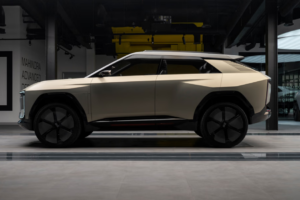













Range Rover has gone electric for the first time in its history. On September 2, 2026, JLR unveiled the production-spec Range Rover Electric globally, and on the very same day, bookings opened in India. This marks a major shift for a nameplate that has relied on combustion and hybrid power for more than five decades.
Buyers in India can now reserve a Range Rover Electric with a token amount of Rs 10 lakh. What they cannot do yet is find out the India price, because JLR has not officially announced it. This article walks through what is confirmed, what applies specifically to India, what has been reported, and what remains unconfirmed for now.
Range Rover Electric Price in India
JLR has not announced an official India price for the Range Rover Electric. What is confirmed is the booking amount: Rs 10 lakh, refundable, to reserve a unit ahead of the India launch.
The car will come to India as a CBU (completely built unit), imported directly from JLR’s Solihull plant in the UK, the same facility that builds the petrol, mild-hybrid and plug-in hybrid Range Rover. As a CBU import, the Range Rover Electric is expected to command a substantial price in India, although JLR has not announced the final figure yet.
Some Indian publications have estimated a starting price in the region of Rs 3.5 crore ex-showroom based on how JLR typically prices its CBU flagships in India, but this is a media estimate, not an official figure. Overseas pricing gives a sense of positioning rather than an Indian number: the Range Rover Electric starts at around $138,000 in the US and has been estimated at around £170,000 in the UK for early configurations. None of these should be read as the India price.
Range Rover Electric India Booking and Availability
Bookings opened in India on September 2, 2026, the same day as the global unveiling. The amount required to book is Rs 10 lakh.
Buyers can currently book the Range Rover Electric in the following configurations:
- Standard-wheelbase Autobiography
- Standard-wheelbase First Edition, available in Belgravia Green, Santorini Black and Varesine Blue exterior finishes
- Long-wheelbase SV
- Long-wheelbase SV Ultra
- Long-wheelbase SV Black
JLR has said that final pricing and delivery timelines for India will be announced closer to the car’s actual market launch. In other words, opening bookings is not the same as the car being on sale yet; deliveries and confirmed pricing are still to come, and JLR has not confirmed a delivery timeline for India at this stage.
Battery and Range
The Range Rover Electric is built around a 118.5 kWh usable battery pack, arranged in a double-stack layout using 344 prismatic cells. The whole system runs on an 800-volt electrical architecture, which is a step up from the 400V systems used in many rival luxury EVs and is what allows for faster charging.
JLR’s claimed WLTP range for the Range Rover Electric is up to 600 km. Some reports citing JLR also mention a real-world estimate closer to 535 km. It’s worth understanding what that gap means: WLTP is a standardised lab test-cycle figure, useful for comparing cars against each other, but it isn’t a promise of what you’ll see on your odometer.
Actual range will depend on speed, traffic conditions, cabin temperature and air conditioning use, the load in the car, terrain, and how the car is driven. JLR has not published an India-specific real-world range figure, and until the car is tested locally, any number beyond the claimed WLTP figure should be treated as an estimate rather than a guarantee.
Power comes from two permanent-magnet electric motors, one on each axle, giving all-wheel drive as standard. Combined output is rated at around 543 bhp (550 PS) and 850 Nm of torque.
Performance
JLR quotes a 0-100 kmph time of around 4.5 seconds for the Range Rover Electric, which puts it ahead of the equivalent V8 petrol Range Rover and comfortably ahead of the diesel version. In practical terms, that means effortless overtaking and a car that never feels like it’s working hard to get up to speed, which matters more day-to-day than the outright number.
The 850 Nm of torque is also available almost instantly, since electric motors don’t need to build revs the way an engine does. JLR’s Integrated Traction Management system can adjust motor speed roughly every 50 milliseconds, letting it manage wheel slip far quicker than a combustion-engined Range Rover can.
Can the Range Rover Electric Still Go Off-Road?
This is the question that matters most for a nameplate built on all-terrain credibility, and JLR seems to have treated it as the priority rather than an afterthought.
The Range Rover Electric also gets a new single-pedal off-road driving mode, which allows the driver to control low-speed movement more precisely using the accelerator alone, bringing the car to a smooth halt on loose or uneven ground without touching the brake. JLR says this mode allows the car to pull away on a 33-degree slope and, once rolling, manage descents or climbs of up to 45 degrees.
Wading depth is rated at 900mm, in line with what Range Rover buyers have come to expect from the combustion models. The car retains air suspension, and independent driving impressions from JLR’s own off-road test tracks describe the throttle calibration in off-road modes as notably forgiving, smoothing out inconsistent driver inputs on rock crawls and inclines.
JLR says the electric model has been engineered to match the all-terrain capability expected of a Range Rover. However, independent testing across different terrains and conditions will be needed to establish how it compares with the combustion models in real-world use.
Charging
The Range Rover Electric’s 800V architecture supports DC fast charging at up to 350 kW. JLR claims a 10-80% charge can be done in around 22 minutes on a suitable charger, and that a short 10-minute charging stop can add roughly 220 km of WLTP range.
These figures depend on access to a suitable high-power DC charger, so charging times will vary considerably depending on the charger available. On a typical 50-60 kW DC charger, charging times will be meaningfully longer than JLR’s headline figures suggest. AC home charging details for the Indian market have not been confirmed yet.
Design: How Different Is It From a Standard Range Rover?
Very little has changed on the outside, and that appears to be a deliberate choice. JLR has described the car internally as “Range Rover first, EV second,” and the exterior largely carries over the familiar proportions, grille treatment and lighting signature of the standard Range Rover. There’s no dramatically different EV-specific design language of the kind some rivals have adopted.
This isn’t unusual for JLR’s approach with this platform; the Range Rover Electric shares its underlying MLA-Flex architecture with the mild-hybrid, plug-in hybrid and petrol Range Rover models, all built on the same Solihull production line, so a shared exterior identity follows from a shared platform.
Interior and Features
Cabin details specific to the electric model are still limited in what JLR has officially detailed for the India market, but the First Edition is confirmed to get Light Cloud Ultrafabrics upholstery and Kvadrat textile trim as standard, alongside the usual Range Rover expectations of a quiet, well-isolated cabin. JLR has also confirmed towing range prediction technology, a feature that estimates how range will be affected when towing a trailer, and a towing capacity of up to roughly 2,500 kg.
Beyond this, expect the electric model to carry over the current Range Rover’s infotainment, display, and driver-assistance suite, since it shares its interior architecture with the ICE version. JLR has not detailed any electric-specific infotainment changes for India.
Range Rover Electric vs Petrol Range Rover
The two versions are built to serve different needs rather than one simply replacing the other.
The electric model offers near-silent running, instant torque delivery, and a 0-100 kmph time that’s quicker than the petrol V8. Refuelling becomes charging, which means planning around charger availability rather than pulling into a fuel station, but it also means the possibility of home charging overnight. JLR’s off-road engineering suggests the EV may actually offer finer low-speed control off-road, thanks to how precisely electric motors can be modulated.
The petrol Range Rover remains the simpler choice for buyers who do long-distance highway driving regularly, since refuelling takes minutes anywhere in the country, without depending on charging infrastructure. Running costs, servicing needs and long-term ownership costs for the EV in India haven’t been confirmed yet, so this shouldn’t be assumed to be cheaper or more expensive to run than the petrol model until real ownership data is available.
Range Rover Electric vs Luxury EV Rivals
Within the luxury electric SUV space in India, the Range Rover Electric will compete against cars like the Mercedes-Maybach EQS SUV and the BMW iX.
The Maybach EQS SUV, currently sold in India from around Rs 2.40-2.65 crore ex-showroom, uses a 122 kWh battery with a claimed range of 611 km and puts out 649 bhp and 955 Nm, with a 0-100 kmph time of 4.4 seconds.
The BMW iX, priced from around Rs 1.40 crore in India, uses a 111.5 kWh battery for a claimed WLTP range of up to 635 km, with 516-523 bhp and 765 Nm on offer, and DC fast charging capped at 195 kW.
On paper, the Range Rover Electric’s claimed WLTP range of 600 km sits between these two, and its 350 kW DC charging capability is higher than the maximum charging rates quoted for these two rivals. That doesn’t automatically translate to faster real-world charging, since actual speeds also depend on the charger used, the battery’s state of charge, and its charging curve.
Where the Range Rover is likely to differentiate itself most is off-road capability, an area where neither the Maybach EQS SUV nor the BMW iX is positioned to compete seriously. Final judgement on how these cars actually compare will depend on the Range Rover Electric’s confirmed India price, which isn’t available yet.
What Does the Range Rover Electric Mean for Indian Buyers?
For now, Indian buyers can book the car but can’t yet know what it will cost them. That’s an unusual position for a segment where buyers are used to knowing pricing before committing even a token amount, but it isn’t unheard of for CBU flagship launches.
The bigger practical question for Indian ownership is charging. The claimed 22-minute 10-80% charging time depends on access to a 350 kW-capable charger, which is still rare outside a small number of locations in major cities and on select highways. Buyers considering this car will need to think about home charging setup and realistic charging speeds on the routes they actually drive, rather than assuming JLR’s headline figures will apply everywhere.
The retained off-road hardware and claimed all-terrain capability will matter to the segment of Range Rover buyers who genuinely use these vehicles off-road, not just as a badge. For buyers who see the Range Rover mainly as a city and highway luxury SUV, the electric model’s quiet running and quick acceleration will likely be the bigger draw.
Who Is the Range Rover Electric For?
The Range Rover Electric is likely to appeal to buyers who want the Range Rover name and cabin experience, combined with an electric powertrain that offers quick acceleration, near-silent refinement, and genuine off-road hardware rather than a badge-only EV.
It’s less suited to buyers who cover long highway distances regularly and want the certainty of refuelling anywhere in minutes, or those who aren’t ready to plan their driving around charger availability. For that kind of use case, the petrol or plug-in hybrid Range Rover remains the more straightforward choice for now.
Final Verdict
The Range Rover Electric is a significant vehicle for JLR: it’s the brand’s first fully electric model after more than five decades of combustion and hybrid power, and it has been engineered to retain the off-road capability associated with the Range Rover name, rather than simply chasing range and charging numbers. The 800V architecture, 118.5 kWh battery, and retained air suspension and wading capability all point to a car built to be a Range Rover first and an EV second.
For Indian buyers, what’s known right now is that bookings are open at Rs 10 lakh, the car will arrive as a CBU import, and several variants across both wheelbases can already be reserved. What remains unknown is the India price, the delivery timeline, and how the claimed range and charging figures will actually hold up on Indian roads and at Indian charging infrastructure. Real-world range, long-term ownership experience, and independent testing in Indian conditions will tell us far more than the launch specifications alone, and until JLR confirms India pricing, that’s the one number every prospective buyer is still waiting on.


FAQs
Has the Range Rover Electric launched in India?
No. JLR unveiled the Range Rover Electric globally on September 2, 2026, and opened bookings in India the same day. This is not the same as a market launch; customer deliveries and official India pricing have not been announced yet.
What is the Range Rover Electric price in India?
JLR has not announced an official India price. Some Indian publications have estimated a starting price of around Rs 3.5 crore ex-showroom, but this is a media estimate, not a confirmed figure.
How much does it cost to book a Range Rover Electric in India?
Bookings are open for a token amount of Rs 10 lakh. Buyers can currently reserve the standard-wheelbase Autobiography and First Edition, and the long-wheelbase SV, SV Ultra and SV Black.
What is the claimed range of the Range Rover Electric?
JLR's claimed WLTP range is up to 600 km, from a 118.5 kWh battery pack. Actual range on Indian roads will depend on speed, traffic, temperature, load, and driving style, and hasn't been independently tested locally yet.
Can the Range Rover Electric go off-road like the petrol version?
JLR says the electric model has been engineered to match the all-terrain capability expected of a Range Rover, retaining all-wheel drive, a 900mm wading depth and a new single-pedal off-road driving mode. Independent testing across varied terrain and conditions will be needed to confirm how it compares with the combustion models in real-world use.