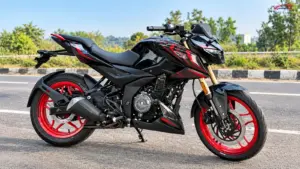














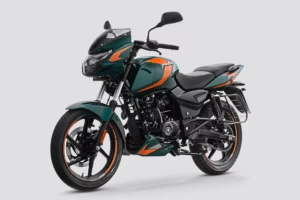




Bajaj has just expanded the Pulsar N160 lineup with two new motorcycles, the Pulsar N160 S and the Pulsar N160 SS. Both bikes get a new 4-valve engine, electronic throttle, and additional riding aids that aren’t available on the existing Pulsar N160. The launch comes as Bajaj marks 25 years of the Pulsar brand, with the older 2-valve N160 continuing alongside the new 4-valve variants.
Here’s the thing, though, since both the S and the SS share the same new 4-valve engine, the obvious question on most buyers’ minds is: what do you actually get for paying extra for the SS? Is it just a fancier screen, or is there more to it?
This article goes through the price, engine, features, electronics, and design of both variants so you can decide which one is the right fit for you, and whether the SS is genuinely worth the extra money.
Bajaj Pulsar N160 S vs N160 SS: Price
| Variant | Price (ex-showroom, Delhi) |
| Pulsar N160 S | ₹1,33,511 |
| Pulsar N160 SS | ₹1,42,585 |
The N160 SS costs about ₹9,000 more than the N160 S. That’s not a huge gap in absolute terms, but it’s enough to matter if you’re buying on a tight budget. For that extra money, you mainly get a bigger, more advanced display, Wi-Fi connectivity on top of Bluetooth, traction control, dual-channel ABS instead of single-channel, adjustable levers, and a few cosmetic touches like coloured alloy wheels. Whether that’s worth it depends on how much you actually care about those specific features, which we’ll get into below.
For context, both new variants sit above the existing 2-valve Pulsar N160, which continues to be sold at a lower starting price.
Engine & Performance
There is no difference between the two variants here: both use the same new 4-valve engine.
Both bikes use a new 164.5cc, single-cylinder, 4-valve, oil-cooled engine, replacing the older 2-valve motor. Bajaj has also reworked the internals: the bore has gone up to 63.5mm from 58mm, while the stroke has come down from 63mm to 52mm, making this a shorter-stroke, more free-revving engine than before.
Power stands at 18.5 PS at 9,500 rpm and 14.4 Nm of torque at 8,000 rpm, which is about 2.5 PS more than the outgoing 2-valve N160, though torque is marginally lower. The engine is paired with a 5-speed gearbox, and Bajaj claims a 0-60 kmph time of 4.5 seconds.
The biggest mechanical change isn’t the extra valves, though; it’s the switch to an electronic throttle body (ride-by-wire) in place of a mechanical cable. This is what makes the next set of features possible.
The N160 S and N160 SS use the same engine, output, and gearbox. There is no performance difference between the two variants. If straight-line performance is all you care about, the cheaper S gives you everything the SS does.
N160 S vs N160 SS: Feature Differences
This is the section that actually answers the buyer’s question, so here’s a clean breakdown.
| Feature | Pulsar N160 S | Pulsar N160 SS |
| Instrument console | LCD | 5-inch TFT |
| Navigation | Turn-by-turn navigation | Full Google Maps mirroring |
| Connectivity | Bluetooth | Bluetooth + Wi-Fi |
| Ride modes | Road, Rain, Sport, Off-road | Road, Rain, Sport, Off-road |
| Traction control | Not available | Available |
| ABS | Single-channel | Dual-channel |
| Levers | Fixed | Adjustable |
| Front brake disc | 300mm | 300mm |
The most meaningful differences are the display, traction control, and ABS. The LCD on the S still gives you Bluetooth connectivity, turn-by-turn navigation, and call/SMS alerts, so it’s not a bare-bones unit by any means. But the SS’s TFT is a bigger step up, with full Google Maps mirroring on the dash itself, not just directional prompts, plus Wi-Fi on top of Bluetooth.
The ABS difference is worth noting. The S gets single-channel ABS, while the SS gets dual-channel ABS, providing anti-lock protection to both wheels. The SS also adds traction control, giving it more electronic rider assistance in low-grip conditions.
Display & Connectivity
If you’re trying to decide whether the SS’s screen is actually useful or just a premium badge, here’s how the two compare.
The N160 S’s LCD console covers the basics well: Bluetooth pairing, turn-by-turn navigation prompts, and alerts for calls and messages. For a rider who mainly wants trip info and basic phone notifications, this is enough.
The N160 SS’s 5-inch TFT does more than just look bigger. It mirrors Google Maps directly on the dash, so you’re looking at the actual map rather than arrows and distance markers. It also adds Wi-Fi connectivity alongside Bluetooth.
So is it worth the upgrade? If you regularly navigate unfamiliar roads and want the map in front of you rather than glancing at your phone, yes, the TFT genuinely adds convenience. If you mostly ride familiar routes and just want basic info, the S’s LCD does the job without you missing much.
Safety & Electronics
Both bikes get ride-by-wire throttle response, four ride modes (Road, Rain, Sport, Off-road), and Bajaj’s Crawl Technology, which helps the bike creep along in traffic without you having to constantly work the clutch. These are shared across both variants.
Where they differ is in rider aids tied to safety. The N160 SS gets traction control, which the S does not. The SS also steps up to dual-channel ABS, versus single-channel on the S. In other words, the SS has additional electronic safety equipment for low-traction situations, including traction control and dual-channel ABS. If you ride mostly on dry, well-maintained roads in fair weather, this difference will matter less day-to-day. If you ride in the rain often or want that extra safety margin, it’s a genuine reason to consider the SS.
Design & Hardware
Both the N160 S and N160 SS carry the familiar Pulsar N-series design, a projector LED headlamp, LED DRLs, a muscular fuel tank, split seats, and a sharp tail section with split grab handles. Mechanically, they share the same chassis, suspension, 300mm front disc, and 230mm rear disc.
The SS gets a few extra visual and ergonomic touches: additional styling elements, distinct graphics, coloured alloy wheels, a revised handlebar position, and adjustable brake and clutch levers. Both bikes are offered in the same three colours: Atlantic Blue, Pearl Metallic White, and Brooklyn Black, just with different graphic treatments and rim colours depending on variant.
So the two aren’t different-looking motorcycles in any dramatic sense. You’re largely buying the same design and hardware, with the SS getting sportier detailing and the ergonomic tweak of adjustable levers.
What Both N160 S and N160 SS Get
Before assuming the S is a stripped-down version, here’s what carries over to both bikes:
- The new 164.5cc, 4-valve, oil-cooled engine with identical power and torque
- Ride-by-wire throttle with four ride modes
- Crawl Technology for low-speed riding
- 5-speed gearbox
- 300mm front disc and 230mm rear disc brakes
- 17-inch wheels
- LED headlamp and LED DRLs
- Digital instrument console with Bluetooth connectivity
- Same kerb weight (151 kg), seat height (795mm), and ground clearance (165mm)
- Same three colour options
The S isn’t a bare-bones motorcycle by any stretch; it gets the full engine and platform upgrade, just with a simpler console and fewer electronic aids.
N160 S vs N160 SS: What’s Actually Different?
| Difference | N160 S | N160 SS |
| Engine | Same | Same |
| Display | LCD | 5-inch TFT |
| Connectivity | Bluetooth | Bluetooth + Wi-Fi |
| Safety electronics | Single-channel ABS | Dual-channel ABS + traction control |
| Extra hardware | Fixed levers | Adjustable levers, coloured alloys |
| Price | ₹1,33,511 | ₹1,42,585 |
N160 S vs N160 SS: Which One Should You Buy?
There’s no single right answer here; it depends on what you actually value.
Choose the N160 S if:
- You want the new 4V engine and ride-by-wire experience
- You’d rather keep the on-road price lower
- You don’t specifically need traction control or dual-channel ABS
- You’re more focused on the riding experience than the tech on the dash
Choose the N160 SS if:
- You want the bigger TFT display with Google Maps mirroring
- You ride in varied conditions and want the extra reassurance of traction control and dual-channel ABS
- You like the sportier styling touches and adjustable levers
- The extra ₹9,000 doesn’t change your buying decision
Is the SS worth the extra money?
For roughly ₹9,000 more, you’re getting a genuinely useful safety upgrade (dual-channel ABS and traction control) along with a display that’s meaningfully better, not just cosmetically different. That’s a reasonable trade for riders who can stretch the budget. But if you’re buying primarily for the new engine and ride-by-wire feel, which is the biggest change over the older N160, the S delivers that at a lower price, and you’re not missing out on performance.
What About the Existing Pulsar N160?
If you’ve been researching the Pulsar N160 and are now seeing “N160 S” and “N160 SS” pop up, here’s how they fit together. The existing Pulsar N160 uses the older 2-valve engine and continues to be sold at a lower price.
The new N160 S and N160 SS are separate, higher-positioned variants built around the new 4-valve engine, electronic throttle, and ride modes, features the standard 2V N160 doesn’t have. If you’re specifically looking for the new 4-valve Pulsar N160, you’re looking for the S or the SS, not the standard N160.
Final Verdict
The Pulsar N160 S and N160 SS are built around the same new 4-valve engine, so neither one shortchanges you on performance. The S makes sense if you want that new engine and ride-by-wire experience at a lower price, and you’re comfortable without traction control or the bigger screen. The SS makes sense if you want the added safety net of dual-channel ABS and traction control, plus a display that actually adds convenience on the move, and you don’t mind paying roughly ₹9,000 more for it.
For riders who can stretch the budget, the SS makes a stronger case for the extra ₹9,000 if you value traction control, dual-channel ABS, and the more advanced display. But if keeping the purchase price down matters more, the S gives you the same 4V engine and performance without compromising on the core riding experience.


FAQs
What is the difference between the Pulsar N160 S and N160 SS?
The SS gets a 5-inch TFT display with Google Maps mirroring, Wi-Fi connectivity, traction control, dual-channel ABS, and adjustable levers. The S gets an LCD console, Bluetooth connectivity, and single-channel ABS. Both share the same engine, power, and torque.
Do the N160 S and N160 SS use the same 4V engine?
Yes. Both use the same 164.5cc, 4-valve, oil-cooled engine producing 18.5 PS and 14.4 Nm, paired with a 5-speed gearbox. There is no performance difference between the two.
Which N160 variant has the TFT display?
The Pulsar N160 SS gets the 5-inch TFT display with Google Maps mirroring. The N160 S uses an LCD console instead.
Does the Pulsar N160 SS get traction control?
Yes, traction control is exclusive to the N160 SS. The N160 S does not get it.
What is the price difference between the N160 S and N160 SS?
The N160 SS costs about ₹9,000 more than the N160 S (₹1,42,585 vs ₹1,33,511, ex-showroom, Delhi).