













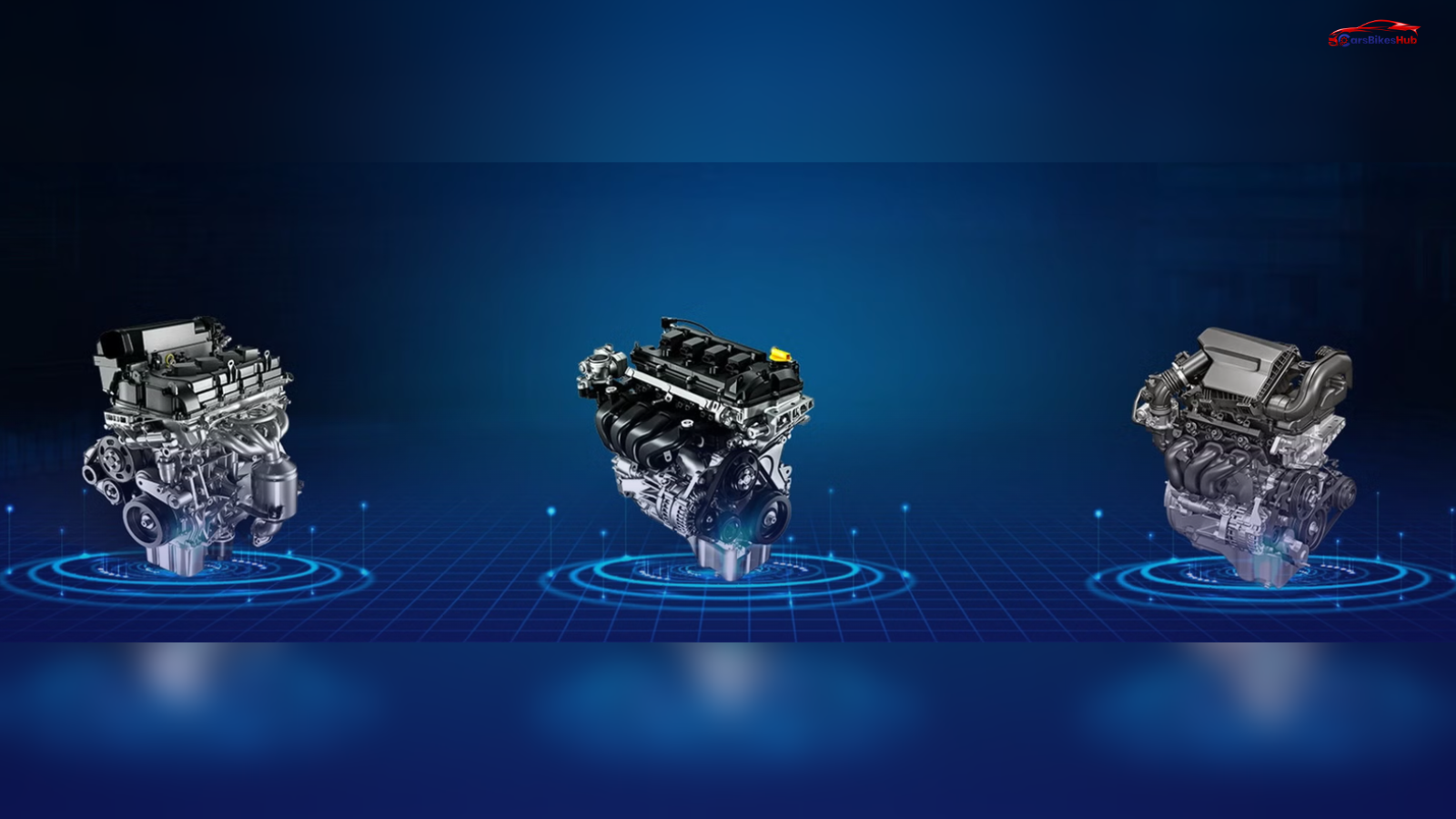
Suzuki’s new 1.5L turbo petrol engine has started attracting attention in India after the company outlined its next-generation engine strategy, including a new family of direct-injection turbo engines. Reports from Suzuki’s technology briefing have since revealed details of a 1.5-litre, four-cylinder turbo engine with a reported output of around 160 PS and 280 Nm.
The numbers are significant because they point to a much stronger petrol powertrain than Maruti Suzuki’s current 1.5L naturally aspirated engine. But there is an important catch: this is still a development engine. Suzuki has not announced a production model, India launch date, or final production specifications yet.
It matters for India because Maruti Suzuki’s largest petrol engine in its mainstream SUVs and MPVs is still a naturally aspirated 1.5-litre unit making around 103 PS. If the engine reaches production with similar specifications, it would give Maruti Suzuki a substantially stronger petrol powertrain option in this segment. Suzuki has also said it will strengthen India as a manufacturing and export hub, targeting annual production capacity of around 4 million units in fiscal 2030 and beyond. Efficiency and alternative-fuel compatibility are also part of this roadmap, and both directly support India’s ethanol and CNG/CBG push.
Suzuki 1.5L Turbo Petrol Engine: What Has Been Confirmed?
Suzuki’s official announcement is broad. It names direct-injection turbo engines as one of several technologies alongside series hybrids, a new hybrid system called Super Ene Charge, and lightweight structures. It does not publish a spec sheet. The 1.5-litre displacement and the 160 PS / 280 Nm figures come from the briefing materials as reported.
| Detail | Status |
| Suzuki is developing new direct-injection turbo engines | Confirmed (Suzuki press release) |
| India is a target growth market for the DITC engine programme | Reported |
| 1.5-litre displacement, four cylinders | Reported |
| Up to 160 PS (118 kW / ~158 bhp) | Reported (development target) |
| 280 Nm | Reported |
| Designed for E100, CNG and CBG compatibility | Reported |
| Transverse, front-wheel-drive layout | Reported |
| Thermal efficiency above 40% (2030 milestone), above 50% (around 2035) | Reported as programme-wide targets |
| Production model, launch date, transmission | Not announced |
Two cautions apply. The thermal-efficiency targets were presented for Suzuki’s engine programme as a whole, so they should not be read as a rating for this specific 1.5L engine. And the 160 PS / 280 Nm figures are development targets, not homologated production ratings.
160 PS and 280 Nm: What Do These Numbers Mean?
Peak power tells you how much an engine can deliver at high revs. Torque tells you how strongly it pulls in the ordinary driving range. For many everyday driving situations, torque can be more noticeable than peak power.
A turbocharger forces extra air into the cylinders, so the engine can make more torque without a larger displacement. A naturally aspirated engine typically has to be revved harder to reach its best output, while a turbo engine generally delivers strong pull earlier. Suzuki has not published the rpm at which 280 Nm arrives, so we cannot say how flat the torque curve is.
Where this could be noticeable (analysis):
- Highway overtaking: More mid-range torque typically means less downshifting to pass a truck.
- Passengers and luggage: With a full load on board, extra torque can make acceleration and hill climbs feel less demanding, particularly at lower and mid-range speeds.
- Ghat roads: Climbing gradients at lower revs is generally easier with more torque available.
- Versus a naturally aspirated engine: Turbo engines usually feel stronger from lower revs. How linear the response feels depends on tuning, gearbox, and turbo design, none of which Suzuki has disclosed.
We have no tested or officially claimed acceleration, mileage, or top-speed figures for this engine, so none are quoted here.
How Does It Compare With Maruti Suzuki’s Current 1.5L Petrol Engine?
Maruti’s current 1.5-litre unit is the K15C, a naturally aspirated four-cylinder with mild-hybrid assistance in many applications. It powers models such as the Brezza, Ertiga, XL6, Grand Vitara and Victoris. The table uses Maruti’s published Victoris figures for the petrol Smart Hybrid.
| Maruti K15C (current) | Suzuki 1.5L turbo (reported) | |
| Engine type | Petrol, mild-hybrid assisted | Direct-injection turbo petrol |
| Displacement | 1,462 cc | 1.5 litre (exact cc not disclosed) |
| Cylinders | 4 | 4 |
| Aspiration | Naturally aspirated | Turbocharged |
| Power | 103 PS @ 6,000 rpm | Up to 160 PS (118 kW) |
| Torque | 139 Nm @ 4,300 rpm | 280 Nm (rpm not disclosed) |
| Fuel system | Multipoint injection (Dualjet) | Direct injection |
| Fuel options | Petrol; CNG version available | Designed for E100, CNG, CBG |
| Transmission | 5-speed manual; 6-speed automatic | Not disclosed |
| Status | In production | In development |
Estimated difference: On paper, that is roughly 55% more peak power and about double the torque (calculated from the figures above).
What it could mean for a buyer, and the trade-offs:
- A turbo engine could feel notably stronger in the mid-range. That does not automatically mean better real-world fuel economy.
- Turbocharged direct-injection engines are more complex than naturally aspirated ones, which can influence cost, servicing,g and long-term maintenance. Those depend on Suzuki’s production design, which is unknown.
- The naturally aspirated K15C is well understood and widely serviced, and its simplicity is a real advantage for many buyers.
- Suzuki targets efficiency gains through combustion technology, but efficiency targets and real-world mileage are different things.
The new engine is not “better” in every respect. It is a different set of trade-offs.
Why This Engine Could Matter for India
A stronger option for larger vehicles. Maruti’s mid-size SUV and three-row lineup relies heavily on the ~103 PS K15C, plus a Toyota-sourced strong-hybrid setup on the Grand Vitara and Victoris. Reports compare the new engine’s output with turbo petrols from Hyundai, Kia, Renault, Tata and Mahindra. If it reaches production with anything close to the reported output, Maruti could compete on performance in segments where it currently leans on efficiency and network strength.
Efficiency still matters. Suzuki’s stated direction is to reduce energy consumption, not just add power. The reported targets, above 40% thermal efficiency by 2030 and above 50% around 2035, apply to the wider engine programme. Suzuki says its current Z12E engine already reaches roughly 40%.
Fuel flexibility. The reported E100, CNG and CBG compatibility is particularly relevant to India, where ethanol, CNG and compressed biogas are already part of the country’s broader alternative-fuel strategy. However, Suzuki has not confirmed that the 1.5L turbo will be offered in India with any of these fuels.
Could the 1.5L Turbo Engine Come to Grand Vitara or Victoris?
| Model | What is known | What is only speculation |
| Grand Vitara | On sale in India with the 1.5L K15C NA petrol (~103 PS) and a strong-hybrid option. No official statement links it to the new turbo. | Rushlane cites the Grand Vitara’s size class as an example of where the engine “could” suit. This is the publication’s inference, not a Suzuki announcement. |
| Victoris | Shares its powertrain options with the Grand Vitara. No official statement links it to the new turbo. | I found no credible report specifically connecting the Victoris to this engine. Any such claim should be treated as speculation. |
Technically, both are front-wheel-drive, transverse-engine SUVs, which matches the layout Suzuki’s new engines are reportedly designed for. That is a compatibility observation, not evidence of plans. We are not predicting a launch.
What About XL6, Ertiga or Other Maruti Models?
No credible reports are linking the 1.5L turbo to the XL6 or Ertiga.
Some older reports have linked the Brezza, Ertiga, XL6 and Grand Vitara with a possible 1.2-litre three-cylinder turbo engine based on Suzuki’s Z12 series. However, that was a separate powertrain under development and was never officially confirmed. Those reports should not be confused with the newly reported 1.5L turbo engine discussed here.
Autocar India also notes that all the engines Suzuki showcased are designed for transverse, front-wheel-drive vehicles. Suzuki has not shown powertrains for rear-wheel-drive models such as the Jimny.
Technology Behind the Engine
Turbocharging. It forces more air into the engine to make more torque from a compact displacement. For buyers, that generally means stronger pull at lower and mid-range revs. Reports on Suzuki’s new turbo-engine programme say the engines use variable-geometry turbocharging, which is intended to improve response across the rev range.
Direct injection. Fuel is sprayed directly into the cylinder rather than into the intake port. It allows more precise fuel control and, combined with turbocharging, can improve both output and efficiency.
Thermal efficiency. This is the share of fuel energy converted into useful work. Higher efficiency generally means less fuel burned for the same work. Reported techniques include the Miller cycle, high compression, faster combustion, and low-pressure exhaust gas recirculation. For 2035, Suzuki mentions lean combustion, pre-chamber ignition and waste-heat recovery.
Fuel flexibility. E100 (100% ethanol), CNG and CBG are the reported target fuels. For an Indian buyer, this could mean more fuel choices in the future, subject to Suzuki’s actual product plans.
Hybrid compatibility. Suzuki showed a series-hybrid system built around the 1.2L Z12E engine. It also said it is considering combining that system with the new 1.2L turbo in a plug-in hybrid, with a reported combined output of up to about 177 hp. No hybrid application has been stated for the 1.5L turbo.
What Suzuki’s India Strategy Means for This Engine
Suzuki’s press release says India will be “further strengthened as a manufacturing and export hub” with a target of around 4 million units of annual capacity in fiscal 2030 and beyond. It also says product and production development will be optimised for each market using technologies developed in Japan.
That is strategic context. It is not confirmation that this specific engine will be built in India, used in Maruti products, or exported. Suzuki has not said where the engine will be produced. India is named as a target market for the DITC programme in reports, but the 1.5L engine has no confirmed India application.
When Could the Suzuki 1.5L Turbo Engine Arrive in India?
There is no confirmed launch timeline. Suzuki has not announced a production date, a model, or an India-specific plan for this engine.
What has been announced is a set of technology-development milestones: efficiency targets around 2030 and 2035, and a company goal of halving new-vehicle development lead time by 2030. These are engineering and process targets, not vehicle launch dates. Anyone quoting a specific year for a Maruti with this engine is guessing.
Confirmed vs Reported vs Unknown
| Category | Details |
| Confirmed (Suzuki) | New direct-injection turbo engines under development; broader roadmap (series hybrids, Super Ene Charge, lightweight tech); India as a manufacturing and export hub |
| Reported | 1.5L, four-cylinder configuration; ~160 PS / 280 Nm; E100/CNG/CBG compatibility; transverse FWD layout; efficiency targets above 40% and 50% by 2030/2035 |
| Still unknown | Production model; India launch date; transmission; final production specs; price; model-wise application; production location |
What This Could Mean for Future Maruti Suzuki Buyers
- Performance: If production figures resemble the reported ones, larger Maruti vehicles could offer noticeably stronger performance than today’s 1.5L.
- Highway use: Higher torque generally helps with relaxed cruising and overtaking, especially with a full load.
- Efficiency: Suzuki’s targets point towards better efficiency, but real-world mileage depends on the final tune, gearbox,x and vehicle weight.
- Complexity and cost: Turbocharged direct-injection engines are more complex than naturally aspirated ones. Pricing, servicing costs, ts and long-term ownership are unknowns.
- Wait for production specs: Reported prototype figures can change, and the engine may never appear in a given model. Please do not delay a purchase based on this announcement alone.
Final Verdict
The 160 PS figure will get the headlines, but it is not the most important part of this story. The more meaningful signal is that Suzuki is developing a stronger turbo petrol alongside efficiency targets, alternative-fuel compatibility,ity and hybrid systems. Suzuki is not betting on one technology. It is preparing a range of options for different markets.
Today, the Suzuki 1.5L turbo petrol engine is a development programme with reported specifications. No Maruti model, launch date, or India production plan has been announced. What to watch next: an official production application, a stated transmission, homologated power and torque, and any India-specific confirmation.









FAQs
What is Suzuki's new 1.5L turbo petrol engine?
It is a reported 1.5-litre, four-cylinder direct-injection turbo petrol engine in development, revealed as part of Suzuki's Technology Strategy 2026 briefing. It has not been launched in any vehicle.
How much power does Suzuki's 1.5L turbo engine produce?
Reports say up to 160 PS (118 kW). This is a development target from briefing material and not a confirmed production rating.
How much torque does the Suzuki 1.5L turbo engine produce?
Reports list 280 Nm. The rpm at which peak torque arrives has not been disclosed.
Is Suzuki's 1.5L turbo engine coming to India?
Suzuki has not confirmed it. India is described as a target market for its DITC engine programme, but the specific 1.5L engine has no announced India application or timeline.
Which Maruti Suzuki cars could get the new 1.5L turbo engine?
None has been announced. Some reports have cited the Grand Vitara's size class as an example of a possible fit, but that is the publication's inference.