
























BMW has launched the i5 Long Wheelbase in India at an introductory ex-showroom price of ₹79.60 lakh. It is the company’s first locally produced electric sedan, built at the BMW Group Plant Chennai, and it arrives in a single eDrive35L M Sport specification. What makes this launch worth a closer look isn’t the electric badge by itself. It’s the price bracket it lands in.
For roughly ₹3 lakh more than the petrol BMW 5 Series LWB, the i5 now gives buyers an electric long-wheelbase executive sedan from the same showroom. That puts a real decision in front of anyone who was already planning to spend around ₹80 lakh on a BMW LWB sedan: stick with the familiar petrol car, or move to the electric one built specifically for this market. This article looks at what the i5 LWB actually offers at this price, and how it stacks up against the 5 Series LWB it’s positioned alongside.
BMW i5 LWB Price in India
The BMW i5 LWB is priced at ₹79.60 lakh (ex-showroom) for the eDrive35L M Sport variant. This is an introductory price, so it could change once the initial sales phase ends. BMW has also introduced a First Edition at the same ₹79.60 lakh price, with exclusive exterior, interior, and rear-seat entertainment upgrades. However, all 99 units were reportedly sold before the official launch, so that version is effectively unavailable to new buyers for now.
Ex-showroom pricing includes GST but excludes road tax, RTO charges, insurance and TCS so the on-road price will run noticeably higher depending on the state and city of registration. BMW hasn’t published a city-wise on-road figure yet, so it’s worth checking with a local dealer before budgeting.
For comparison, the petrol BMW 5 Series LWB (530Li M Sport) currently starts at ₹76.60 lakh ex-showroom. That puts roughly ₹3 lakh between the two cars at launch, not a large enough gap to be the deciding factor on its own, which means the choice really comes down to what each powertrain offers rather than what each car costs.
BMW i5 LWB: Key Specifications at a Glance
| Specification | BMW i5 LWB (eDrive35L M Sport) |
| Motor | Single electric motor, rear-wheel drive |
| Power | 268 hp |
| Torque | 410 Nm |
| Battery | 81.6 kWh |
| Claimed range (MIDC) | Up to 669 km |
| 0-100 km/h | 6.7 seconds (claimed) |
| Top speed | 195 km/h |
| DC fast charging | Up to 160 kW |
| 10-80% charging time | 33 minutes (claimed, on a suitable DC charger) |
| Home charging | 11 kW BMW Wallbox, included with installation |
| Length | 5,175 mm |
| Wheelbase | 3,105 mm |
| Seating | 5 |
What Does the BMW i5 LWB Offer?
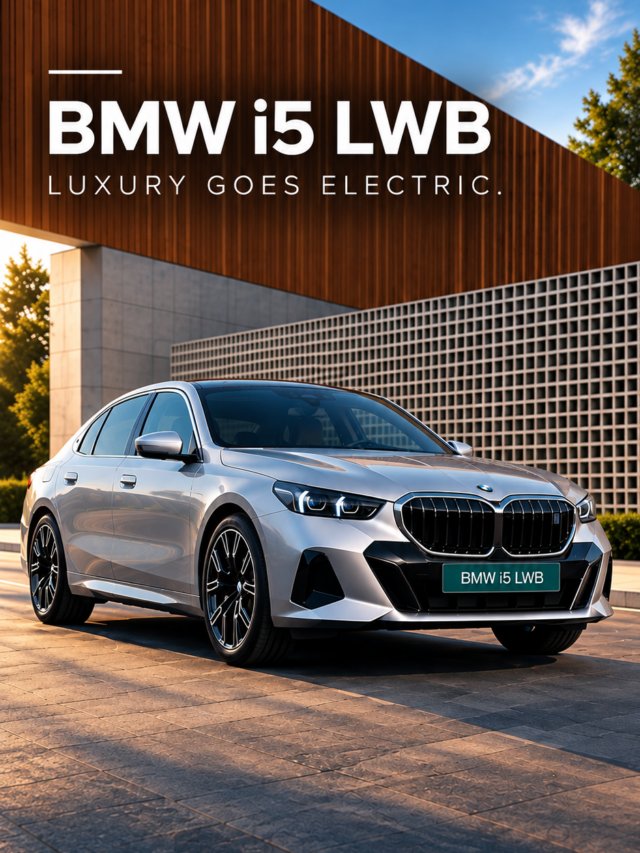
On the outside, the i5 LWB uses BMW’s illuminated kidney grille (badged Iconic Glow), adaptive LED headlights, L-shaped LED tail-lights and 20-inch M alloy wheels. The flush-fitting door handles also give the side profile a cleaner look. Buyers get four metallic paint choices: Mineral White, Phytonic Blue, Carbon Black and Oxide Grey.
Step inside and the cabin uses fully vegan Veganza upholstery, finished in Copper Brown and Atlas Grey on the standard car. This matters for buyers who specifically want to avoid animal leather. The dashboard runs BMW’s curved display setup, a 12.3-inch instrument screen paired with a 14.9-inch central touchscreen, along with the Interaction Bar and CraftedClarity crystal-effect controls for things like the gear selector and volume knob. These controls are also the primary interface for functions such as climate control, drive settings, and infotainment, so their usability matters in everyday driving.
Audio comes from a Bowers & Wilkins system with 17 speakers, which is a genuine step up from the standard fitment on most cars in this segment. A panoramic Sky Lounge glass roof is standard, and it changes the feel of the cabin noticeably, especially for rear passengers who’ll spend more time looking up than out. Front seats are ventilated and powered, and the car gets four-zone climate control so front and rear occupants can each set their own temperature.
On safety, the i5 LWB gets Level-2 ADAS, 8 airbags, ABS with EBD, electronic stability control, a 360-degree camera, tyre-pressure monitoring and ISOFIX mounts. The regular i5 (not the India-spec LWB) has been rated 5 stars by Euro NCAP, though the LWB itself hasn’t been independently crash-tested yet, so that rating should be read as an indicator rather than a direct guarantee for this exact variant.
Battery, Range and Charging: What Does It Mean in Everyday Use?
The i5 LWB uses an 81.6 kWh battery paired with a single rear-mounted motor, and BMW claims a range of up to 669 km under the MIDC test cycle. MIDC (Modified Indian Driving Cycle) is a standardised lab test, not a real-world drive. It’s useful for comparing EVs against each other on a like-for-like basis, but actual range will be lower once you factor in air-conditioning use, city traffic, highway speeds above 100 km/h, and driving style. A realistic expectation for most owners would be a meaningful margin below the claimed figure, though BMW hasn’t published India-specific real-world test data yet, so it isn’t possible to put an exact number on that gap.
Charging is one of the i5 LWB’s stronger areas on paper. It supports up to 160 kW DC fast charging, and BMW claims a 10-80% charge takes about 33 minutes on a charger capable of delivering that speed. In practice, this depends entirely on finding a charger that can actually output 150 kW-plus, which is still uncommon outside a handful of highways and major cities in India. For daily use, the more relevant number is the 11 kW BMW Wallbox that comes complimentary with installation. On a home connection that can support it, this lets you charge overnight and start most days with a full battery, which is really how an EV at this price is meant to be used.
The practical question for a buyer isn’t the battery size; it’s whether home charging is realistic. Apartment buyers need to check with their society or building management about dedicated EV charging points and adequate power sanction before assuming overnight charging will be simple. Buyers in independent houses have an easier path here. For anyone doing frequent inter-city drives where fast-charging infrastructure is inconsistent, that 33-minute charging claim is worth treating as a best-case scenario rather than a routine expectation.
Performance and Ride Comfort
The single motor makes 268 hp and 410 Nm, with BMW claiming a 0-100 km/h time of 6.7 seconds and a 195 km/h top speed. The bigger everyday difference from a petrol car isn’t the outright number; it’s how that torque arrives. Electric motors deliver peak torque instantly, so there’s no waiting for revs to build or a gearbox to shift down. This makes the i5 LWB feel quick and responsive from a standstill and in city overtaking, without needing to work the throttle hard. It’s a car built more around effortless, quiet progress than outright thrills, which suits its role as a long-wheelbase executive sedan.
The i5 LWB also gets adaptive rear-axle air suspension, which continuously adjusts damping based on road conditions and load. BMW says it has also raised ground clearance for Indian roads, though it hasn’t specified the exact figure. Combined with the air suspension, this should help the car deal with speed breakers and uneven surfaces better than most cars in this segment, which matters more in India than in most other markets the i5 is sold in.
Why the Long-Wheelbase Format Matters
The i5 LWB measures 5,175 mm long and has a 3,105 mm wheelbase, giving it the same long-wheelbase focus as the 5 Series LWB. The extra wheelbase over the standard-length 5 Series isn’t just a bigger number on a spec sheet; it goes almost entirely into the rear seat. BMW quotes a 31-degree rear-seat torso angle, additional cushioning, side support and comfort headrests, along with 4-zone auto AC controls, wireless charging in the rear armrest and USB-C ports for rear passengers. There are also mounting points for personal tablets behind the front seats.
For a chauffeur-driven buyer, this is the part of the car that actually gets used the most. More legroom means being able to stretch out on a long commute; the reclining rear seat and additional cushioning matter on trips longer than an hour. For an owner-driver, the LWB format doesn’t take anything away; the extra length sits behind the B-pillar, so it works just as well whether you’re behind the wheel or in the back seat. This dual-use flexibility is one reason LWB sedans have remained popular with Indian luxury buyers even as SUVs have taken over much of the segment.
BMW i5 LWB vs BMW 5 Series LWB
| Aspect | BMW i5 LWB | BMW 5 Series LWB |
| Price (ex-showroom) | ₹79.60 lakh | ₹76.60 lakh |
| Powertrain | Single electric motor, RWD | 2.0-litre turbo-petrol, mild-hybrid, RWD |
| Power / Torque | 268 hp / 410 Nm | 258 hp / 400 Nm |
| 0-100 km/h (claimed) | 6.7 seconds | 6.5 seconds |
| Energy source | 81.6 kWh battery | Petrol tank, 48V mild-hybrid assist |
| Range / Refuelling | Up to 669 km claimed (MIDC); recharge via DC fast charging or home Wallbox | Refuel at any petrol pump in minutes |
| Ride comfort tech | Adaptive rear-axle air suspension | Conventional suspension setup |
| Rear-seat focus | Same LWB cabin, plus rear climate/charging conveniences | Same LWB cabin, well proven in India already |
| Ownership routine | Needs planned charging, especially for long trips | Familiar petrol refuelling, no planning needed |
| Best suited for | Buyers with home charging who value quiet, instant-torque driving | Buyers who want zero change to their driving/refuelling habits |
The i5 LWB has a small edge in outright power and torque, and it will feel noticeably quieter and smoother at low speeds and in traffic, since there’s no engine to hear or feel. The 5 Series LWB is marginally quicker to 100 km/h on paper, though the difference is small enough that neither car will feel meaningfully faster than the other in real driving.
The real difference is ownership routine. With the 5 Series LWB, you drive it exactly like every other petrol car you’ve owned, fuel up in a few minutes and go. With the i5 LWB, range and charging access become things you actually plan around, at least until fast-charging infrastructure on Indian highways becomes more consistent.
The ₹3 lakh price difference isn’t large enough to be a deciding factor by itself. What should decide it is whether you have reliable charging access, particularly at home, and whether you’re comfortable with an EV’s different day-to-day rhythm in exchange for the quieter, torquier driving experience and potentially lower energy costs than petrol, depending on electricity and fuel prices and how the car is charged.
Who Should Consider the BMW i5 LWB?
The i5 LWB makes the most sense for buyers who have reliable home charging already sorted, or can set it up without difficulty. It suits people who mostly drive within a city or between nearby cities, where the claimed range comfortably covers daily use without needing a mid-journey charge. It’s also a strong option for chauffeur-driven buyers who want the quiet, smooth ride of an EV in the back seat, and for existing luxury-car owners who are ready to move to an EV without giving up BMW’s usual performance feel or the LWB’s rear-seat comfort.
Who Should Still Consider the BMW 5 Series LWB?
The 5 Series LWB remains the better fit for buyers who regularly drive long distances where charging access can’t be guaranteed, such as long highway trips between cities without reliable fast chargers, for instance. It also suits buyers who don’t have a practical way to charge at home, whether due to apartment restrictions or a lack of dedicated parking. And for anyone who simply prefers the familiarity of a petrol car- quick refuelling, no range planning, no dependence on charging infrastructure- the 5 Series LWB continues to deliver everything that has made it a popular choice in this segment, without asking the owner to change any habits.
Is the BMW i5 LWB Worth the Price?
At ₹79.60 lakh, you’re paying roughly ₹3 lakh more than the 5 Series LWB for an electric powertrain, DC fast-charging capability, a home Wallbox, and adaptive air suspension. Whether that’s worth it depends almost entirely on whether you can use the charging setup properly. If home charging is straightforward for you, the i5 LWB gives you a quieter, torquier car with genuinely useful range for city and regional driving, and potentially lower energy costs than petrol, depending on electricity and fuel prices and how the car is charged.
If home charging isn’t easy to arrange, or if long, charging-uncertain road trips are a regular part of your driving, the extra features don’t offset the added planning an EV demands, and the 5 Series LWB offers the same long-wheelbase rear-seat package without that trade-off.
The long-wheelbase format itself adds genuine value in both cars, since the extra rear-seat space is real and noticeable rather than a marketing point. It’s the powertrain choice, not the LWB badge, that should drive the decision here.
Final Verdict
The BMW i5 LWB makes a strong case for buyers who have reliable home charging and want a quieter, more effortless electric luxury sedan with the comfort of a long-wheelbase cabin. At roughly ₹3 lakh more than the petrol 5 Series LWB, the price gap is small enough that the real decision comes down to how comfortable you are with EV ownership and charging.
The i5 makes more sense for city-focused and chauffeur-driven buyers who can charge conveniently at home, while the 5 Series LWB remains the more straightforward choice for those who regularly undertake long-distance trips or prioritise quick, hassle-free refuelling. The i5 LWB is a meaningful alternative to the 5 Series, but only if your charging setup can support it.


FAQs
What is the BMW i5 LWB price in India?
The BMW i5 LWB is priced at ₹79.60 lakh ex-showroom in India for the eDrive35L M Sport. BMW has also introduced a First Edition at the same price, but all 99 First Edition units were sold before the official launch.
What is the BMW i5 LWB range?
BMW claims a range of up to 669 km under the MIDC test cycle from its 81.6 kWh battery. Actual range will vary depending on speed, traffic, air-conditioning use, weather, and driving conditions.
How long does the BMW i5 LWB take to charge?
The i5 LWB supports up to 160 kW DC fast charging, with BMW claiming a 10-80% charge in around 33 minutes under suitable charging conditions. It also comes with an 11 kW BMW Wallbox for home charging.
What is the BMW i5 LWB battery capacity?
The BMW i5 LWB gets an 81.6 kWh high-voltage battery paired with a single rear-mounted electric motor.
How powerful is the BMW i5 LWB?
The i5 LWB produces 268 hp and 410 Nm. BMW claims a 0-100 km/h acceleration time of 6.7 seconds and a top speed of 195 km/h.