








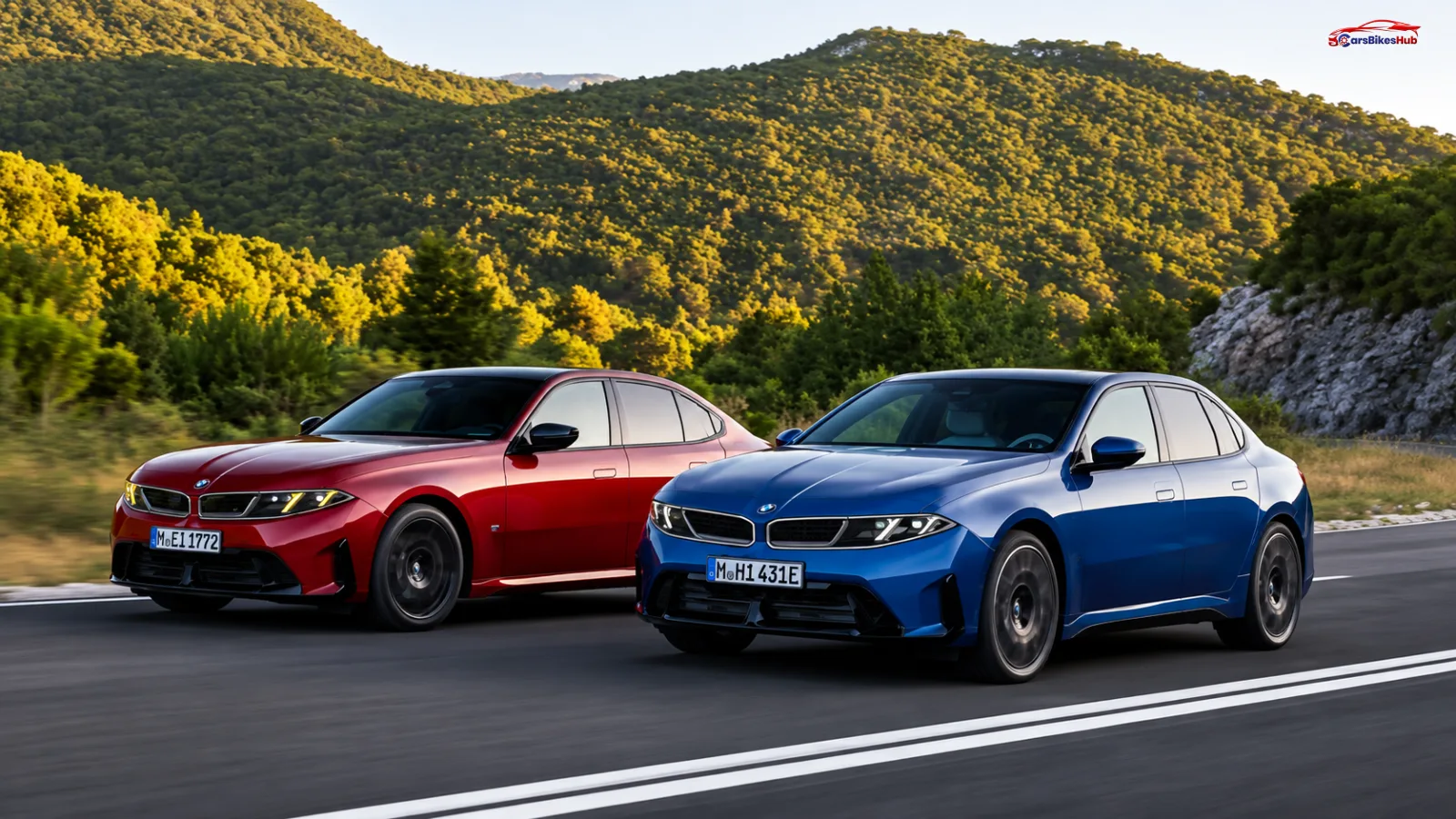
BMW has unveiled the eighth-generation 3 Series, and this is the first time the nameplate gets Neue Klasse design and technology across its range. The BMW 3 Series 2027 line-up covers three kinds of powertrain: petrol cars with 48V mild-hybrid assistance, the six-cylinder M350 xDrive at the top of the combustion range, and the fully electric BMW i3, which BMW first showed in March and now presents as part of the same family.
BMW 3 Series 2027: What Has Changed?
The biggest change is how the car is built around its software and displays. The previous 3 Series carried a conventional dashboard and a separate driver’s display. The new one uses BMW Panoramic iDrive: a display strip across the base of the windscreen, a 17.9-inch central display and an optional 3D head-up display. It runs on BMW Operating System X, which is based on the Android Open Source Project. BMW says the 3 Series now shares the Neue Klasse electronics and software architecture, which is designed to receive new functions through software updates.
The exterior follows the Neue Klasse design language first seen on the iX3 SUV. The kidney grilles and twin headlights now merge into a single lighting unit at the front, the tail-lamps run horizontally into the rear shoulders, and the door handles are flush-fitting. BMW says the electric i3 and the petrol cars differ only in details.
Under the skin, BMW says the petrol car gets a thoroughly revised body structure and chassis, with a longer wheelbase and wider tracks than before. Every petrol engine uses 48V mild-hybrid technology. A plug-in hybrid will be added over the coming year, BMW says. The i3 sits on a separate electric architecture and is built in Munich, while the petrol cars are built in Dingolfing.
Two more changes are worth noting. BMW has also changed the naming of its petrol models, with the new range using 318, 320, 330 and M350 xDrive badges. And the M350 xDrive gets a rear-wheel-drive mode called Drift Moment, which BMW has so far reserved for its full M cars.
BMW 3 Series 2027: Engine and Performance
BMW has published specifications for several markets. The 318, 320, and M350 xDrive figures below come from BMW’s global technical data, while the 330 figures are from BMW USA.
| Variant | Engine | Power | Torque | 0–100 km/h | Drive |
| BMW 318 | 2.0-litre 4-cyl turbo-petrol, 48V mild hybrid | 156 hp (115 kW) | 250 Nm | 9.5 s | Rear-wheel drive |
| BMW 320 | 2.0-litre 4-cyl turbo-petrol, 48V mild hybrid | 211 hp (155 kW) | 330 Nm | 7.4 s | Rear-wheel drive |
| BMW 330 / 330 xDrive (US) | 2.0-litre 4-cyl turbo-petrol, 48V mild hybrid | 255 hp | 295 lb-ft (about 400 Nm) | 5.9 s (0–60 mph) | RWD / xDrive |
| BMW M350 xDrive | 3.0-litre inline-six turbo-petrol, 48V mild hybrid | 443 hp (326 kW) | 580 Nm | 4.1 s | xDrive (AWD) |
The four-cylinder engines all displace 1,998 cc, and the differences between the 318, 320 and 330 are in tuning. All use an eight-speed Steptronic automatic. BMW lists top speeds of 215 km/h for the 318, 240 km/h for the 320, and an electronically limited 250 km/h for the M350 xDrive. The US release describes the 330 as limited to 155 mph with sport tyres.
The 48V mild-hybrid system differs between the two engine families. On the four-cylinder cars, it is a belt-driven starter-generator, rated at 8 kW. On the M350 xDrive, it is a crankshaft-mounted unit inside the transmission housing, rated at 13 kW. In practice, a mild hybrid does not drive the car on electric power alone. It assists the engine under acceleration, supports start-stop and recovers energy under braking. BMW also says all engines use Miller-cycle combustion and the latest Valvetronic system, with the aim of lowering fuel consumption.
The main differences between these versions are their power outputs, drivetrain configurations and intended positioning within the range. The 318 and 320 are rear-wheel-drive cars, the 330 adds xDrive as an option in the US, and the M350 xDrive comes only with xDrive. BMW has not announced any diesel version of the new generation. The plug-in hybrid has no published specifications yet.
BMW M350 xDrive: What Has Changed?
The M350 xDrive is the combustion-engine flagship of the new 3 Series range. It uses a 3.0-litre inline-six with 48V mild-hybrid assistance. Its combustion engine is rated at 313 kW (426 hp) and 540 Nm. Adding the 13 kW (18 hp) and 200 Nm electric motor gives a system output of 326 kW (443 hp) and 580 Nm. BMW quotes 0–100 km/h in 4.1 seconds and a top speed limited to 250 km/h. Power goes to all four wheels through xDrive and the eight-speed Steptronic Sport automatic.
A note on figures: BMW USA quotes the same car at 437 hp, which is the same power in a different unit. Some Indian reports have also quoted 426 hp and 540 Nm for the M350, but those are the engine’s figures without the electric motor’s contribution.
Adaptive M suspension, variable sport steering, an M Sport differential and M Sport brakes are all standard, according to BMW. Compared with the outgoing car, BMW says the front end gets new reinforcement struts for extra rigidity, and a standard rear spoiler to reduce lift. The M350 xDrive weighs 1,860 kg (DIN) in BMW’s data.
Drift Moment
This is the new feature. It is activated through the central display and sends all drive power to the rear wheels, working alongside the traction control’s off mode. BMW says it will become available during 2027 and will be added by software update to cars already delivered. It is reserved for M Performance models.
How it compares with the M340i
BMW’s US release positions the M350 xDrive as the successor to the previous performance-oriented 3 Series, with output rising from 386 hp to 437 hp, while some reported it as the replacement for the M340i. However, BMW has not confirmed that the M350 xDrive will replace the M340i in India.
For reference, the M340i currently sold in India is rated by BMW India at 374 hp, 500 Nm, and 0–100 km/h in 4.4 seconds. On paper, the M350 xDrive has roughly 70 hp and 80 Nm more and is 0.3 seconds quicker, though hp figures are quoted on different conventions in different markets, so treat the gap as approximate.
Where it sits
BMW describes the M350 xDrive as an M Performance model and “the entry point into the world of BMW M”. It is not a full M3, and BMW has not positioned it as one.
BMW i3: The Electric 3 Series
The new BMW i3 is the first fully electric 3 Series, and it is built on the Neue Klasse architecture. BMW offers it as part of the same family as the petrol cars, not as a replacement for them. It also has nothing to do with the small i3 hatchback BMW sold from 2013 to 2022.
| BMW i3 40 xDrive | BMW i3 50 xDrive | |
| Battery (net) | 82.8 kWh | 108.7 kWh |
| Power | 275 kW (374 hp) | 345 kW (469 hp) |
| Torque | 520 Nm | 645 Nm |
| 0–100 km/h | 5.4 s | 4.7 s |
| WLTP range | 566–710 km | 729–912 km |
| Max DC charging | 300 kW | 400 kW |
| 10–80% (DC, max rate) | 21 min | 21 min |
| Drive | Dual motor, AWD | Dual motor, AWD |
| Top speed | 200 km/h (limited) | 200 km/h (limited) |
A more powerful BMW i3 M60 xDrive M Performance model is scheduled for 2027. BMW lists it as a prototype and has published no performance or range figures.
The i3 matters for reasons beyond its range. It carries BMW’s sixth-generation eDrive technology, which means 800V architecture, cylindrical battery cells built into the pack without modules, and bidirectional charging. The rear motor is an electrically excited synchronous unit,t and the front one is an asynchronous motor. BMW USA says the Gen6 system delivers about 30% more range and 30% faster charging than the Gen5 technology in other models. Those are BMW’s claims, compared against its own previous hardware.
The i3 also gets its own driving-dynamics computer, called Heart of Joy, which BMW says runs ten times faster than previous systems and manages the drive, brakes and steering functions together. The petrol cars use a different, combustion-specific version of BMW’s Driving Stack. BMW says production began in Munich in August 2026. US sales of the i3 50 xDrive begin in the first quarter of 2027.
BMW i3 Range and Charging
On BMW’s WLTP test, the i3 50 xDrive is rated at up to 912 km, and BMW’s own range for that car runs from 729 km upward depending on equipment and wheels. The i3 40 xDrive is rated at 566–710 km. WLTP is a laboratory test cycle, and BMW itself says real-world range depends on load, driving style, route, weather, climate control, tyres, and battery condition.
For motorway driving, BMW lists a higher consumption: 16.7–22.0 kWh/100 km for the 50 xDrive against 13.4–18.0 kWh/100 km combined. Buyers should read 912 km as a ceiling for the best-case configuration and not as a guarantee.
On charging, the i3 50 xDrive supports up to 400 kW DC and the 40 xDrive up to 300 kW. BMW quotes 10–80% in 21 minutes for both. In ten minutes at the maximum rate, BMW says the 50 xDrive can add 320–423 km of range, calculated by the ISO 12906 method on the WLTP cycle. BMW adds that this assumes a charger that can deliver the full rate, and that results depend on battery temperature, state of charge, and the power the station provides. The car can also pre-condition the battery before a fast-charging stop to improve the initial charging rate.
For AC charging, BMW’s German specification lists 11 kW as standard and 22 kW as optional. At 11 kW, a full charge takes about 11 hours for the 50 xDrive and 8 hours 15 minutes for the 40 xDrive. BMW says the car can also use 400V DC chargers, though it has not published the speed it would reach on them. Bidirectional charging is part of the package, with vehicle-to-home and vehicle-to-grid rated at 11 kW DC, and an optional vehicle-to-load adapter at 3.7 kW.
For India, the 400 kW figure is a limit set by the car, not a promise about the charger. Actual charging speed will depend on what the station can deliver. We have not verified that India has public chargers capable of the i3’s top rate, and BMW has not announced an India specification for the i3. The AC and DC figures above are for Germany and may differ for any market that eventually gets the car.
Interior and BMW Panoramic iDrive
Most of what is new in the cabin is in how the driver sees and controls information. BMW Panoramic iDrive has four parts: BMW Panoramic Vision, an optional BMW 3D Head-Up Display, a 17.9-inch central display and a new multifunction steering wheel.
- Panoramic Vision: Projects content across the full width of the lower windscreen, and BMW says it stays visible through polarised sunglasses. There is no separate instrument cluster behind the wheel. Up to six widgets can be moved from the central display onto it.
- The central display: A free-cut 17.9-inch touchscreen angled towards the driver.
- The steering wheel: It has a central spoke at the top, and the left-side buttons for assistance and parking light up only when relevant, which BMW calls shy-tech. The M350 xDrive gets a flat-bottomed M wheel with spokes at four and eight o’clock instead.
- Physical controls: Remain for the parking brake, rear-window defogger, hazard lights, audio volume, and the transmission selector. The air vents are electrically adjustable. Most other functions, including climate settings, are on the screen.
BMW Operating System X handles all of it. It is based on Android, and BMW says it can add features through software updates. Voice control comes from the BMW Intelligent Personal Assistant, which now integrates Amazon Alexa+, a generative-AI voice system. BMW says this is for more natural dialogue, and that Alexa+ will be rolled out gradually, starting with Germany and the US. Wireless Apple CarPlay and Android Auto are standard in the US specification.
Other details include electric front seats with memory as standard, optional multifunction seats with massage in the i3 and ventilation on petrol cars, a panoramic sunroof with climate comfort glazing, and a seven-speaker hi-fi system as standard. Harman Kardon systems with Dolby Atmos are available as options, while the M350 xDrive gets Harman Kardon as standard.
Equipment varies by market, and BMW’s material is based on Germany and the US.
Safety and Driver Assistance
BMW says the new 3 Series offers SAE Level 2 driver-assistance capability, with exact equipment and availability varying by market. The following is standard in the US specification, according to BMW USA:
- Driving Assistant Plus: Active cruise control with stop-and-go, speed limit assistant, lane keeping assistant, and steering assistant. It works alongside BMW Symbiotic Drive, which lets the driver steer, brake, or accelerate without switching the system off immediately.
- Active safety: Emergency steering intervention that can steer around an object in the lane, lane change warning, side collision warning with steering intervention, crossing-traffic warning with emergency braking, and Emergency Brake Assistant with Evasion Assistant. BMW says new sensor technology improves detection of wildlife, and the exit warning can delay a door from opening when a cyclist is approaching.
- Airbags: Driver and passenger, side, an interaction airbag between the front occupants, and front and rear head airbags.
Parking Assistant Plus adds a 360-degree view, Parking Assistant Professional adds remote parking from the My BMW app, and Maneuver Assistant can record and repeat a manoeuvre. Optional Highway Assist allows hands-free driving on suitable roads.
BMW’s Motorway Assistant covers hands-free driving up to 130 km/h in 21 countries, and India is not among them. Navigation-guided assisted driving in urban areas is expected to follow from 2027.
Practicality: Dimensions, Boot and Space
BMW lists different dimensions for the petrol cars and the i3 because they use different architectures.
| Petrol 3 Series (320 / M350 xDrive) | BMW i3 | |
| Length | 4,765 mm | 4,760 mm |
| Width | 1,850 mm | 1,865 mm |
| Height | 1,455 mm | 1,480 mm |
| Wheelbase | 2,860 mm | 2,897 mm |
| Boot | 450 litres | 420 litres (plus 31 litres under the bonnet) |
| Turning circle | 11.7 m (320), 12.1 m (M350) | 12.2 m |
BMW describes the new car as slightly larger than its predecessor, with a longer wheelbase and wider tracks. It has not published rear legroom or headroom figures in the material we reviewed, so we cannot say how much rear-seat space has changed.
The standard seats include BMW’s Travel and Comfort System for rear passengers, and the rear seats can be heated as an option. BMW has not published a ground-clearance figure for these global-spec cars, and we will not guess one for India.
New BMW 3 Series vs Current BMW 3 Series in India
BMW India sells two versions of the current 3 Series: the long-wheelbase (LWB) car, which is BMW’s best-selling sedan in India according to reports, and the M340i, a performance version built on the standard wheelbase. The table compares what is sold now with what BMW has revealed globally. The new car has not launched in India.
| Factor | Current BMW 3 Series in India | New BMW 3 Series (global reveal) |
| Generation | Seventh generation (G20); LWB and M340i | Eighth generation (G50) |
| Powertrain | Petrol and diesel (LWB), petrol six-cylinder (M340i) | Petrol with 48V mild hybrid, electric i3; plug-in hybrid to follow |
| Engine | 2.0-litre petrol (330Li), 2.0-litre diesel (320Ld), 3.0-litre inline-six (M340i) | 2.0-litre four-cylinder petrol, 3.0-litre inline-six (M350 xDrive), electric i3 |
| Power | 258 hp (330Li), 190 hp (320Ld), 374 hp (M340i) | 156–255 hp (four-cylinder petrol), 443 hp (M350), 374–469 hp (i3) |
| Wheelbase | 2,961 mm (LWB) | 2,860 mm (petrol), 2,897 mm (i3) |
| Technology | BMW Curved Display with 14.9-inch touchscreen and 12.3-inch driver display (LWB, per Autocar India) | Panoramic iDrive, 17.9-inch display, BMW Operating System X, Alexa+ |
| Interior | Curved display, separate driver’s screen | Windscreen-width Panoramic Vision, no separate cluster |
| Electric version | None in the 3 Series line-up | BMW i3 |
| India status | On sale, built in Chennai | No India announcement found |
On India prices, the 3 Series LWB is priced at ₹62.70 lakh for the 330Li M Sport and ₹64.20 lakh for the 320Ld M Sport, while the M340i is priced at ₹77.10 lakh, all ex-showroom. BMW’s own launch pricing for the updated 3 Series was ₹62.60 lakh for the 330Li M Sport LWB and ₹74.90 lakh for the M340i. Prices can change over time, so buyers should check the latest figures before making a purchase.
The wheelbase row deserves attention. By our calculation from the published figures, the new global petrol car’s wheelbase is about 101 mm shorter than the LWB sold in India, and the i3’s is about 64 mm shorter. BMW has not announced a long-wheelbase version of the new petrol 3 Series. It did show a long-wheelbase i3 for China, but that is a different car from the Indian LWB.
BMW 3 Series 2027 India: Will It Come?
BMW’s global materials describe a production start for the petrol cars at Dingolfing from November 2026, and US sales of the i3 50 xDrive, 330, 330 xDrive and M350 xDrive from the first quarter of 2027. None of the BMW material we reviewed mentions India.
We found no BMW India press release or announcement about the new 3 Series, the i3,3, or the M350 xDrive.
The new 3 Series is expected to arrive in India sometime in 2027, although BMW has not announced an official launch date. A long-wheelbase version is also possible, particularly given the importance of the LWB 3 Series in India and the existence of a long-wheelbase i3 in China.
An expected price of around ₹65 lakh has been cited for the 2027 3 Series, but this is not an official BMW India price. BMW has not announced pricing for the new generation in India.
BMW has confirmed the iX3 long-wheelbase for India in 2027, but there is no confirmation yet on whether the new i3 will be offered in the country.
BMW has not said whether India will get the new 3 Series at all, or when. Nothing is confirmed on which variants would come, whether there will be a long-wheelbase body, whether the i3 will be offered, whether the M350 xDrive will come as the M340i’s successor, whether a diesel will return, or whether the cars would be assembled in Chennai.
What the New 3 Series Means for India
Why Neue Klasse in the 3 Series
BMW’s own executives describe the 3 Series as taking Neue Klasse innovations to the core of the brand for the first time. The model is BMW’s highest-volume nameplate historically, so moving the software and display architecture here makes it a test of whether buyers accept the new interface in a mainstream car and not a niche one.
Why petrol and electric together matter
BMW calls this a technology-open approach, and the i3 and petrol cars share a design and cabin. For a buyer, that means the choice of powertrain does not mean a different car. For India, it also means petrol could remain a practical option while public charging matures.
Where an i3 could fit
BMW India already has electric SUVs in its line-up, while the iX3 LWB has been reported for India in 2027. If an i3 came, it would add a sedan-based EV option. That is a possibility, not an announcement.
Why the LWB matters
BMW India introduced the long-wheelbase 3 Series in 2021 because Indian buyers prefer longer sedans, according to BMW India’s launch release. If the global petrol car keeps its 2,860 mm wheelbase, BMW India would have to decide whether to sell it as it is or develop a stretched version, as it did before. That decision has not been announced.
Charging considerations
A potential i3 buyer in India would need to look at home charging first, since BMW’s AC figures are for Germany, and then at whether public fast chargers on their regular routes can deliver anything near the car’s maximum DC rate. The fast-charging claims are only useful if the infrastructure can match them.
Final Verdict
The new 3 Series is significant because BMW is bringing its Neue Klasse technology into one of its best-known nameplates while offering petrol, performance and electric powertrains. The i3 adds a long-range electric option, while the M350 xDrive keeps a six-cylinder engine and introduces new performance technology such as Drift Moment.
For India, however, the bigger question is how BMW adapts this global generation to a market where the long-wheelbase 3 Series has been particularly important.
BMW has revealed the global model, but Indian buyers should wait for official India specifications, pricing, and launch confirmation.





FAQs
What is new in the BMW 3 Series 2027?
It is the eighth-generation 3 Series. It adopts Neue Klasse styling, BMW Panoramic iDrive with a 17.9-inch display, BMW Operating System X, and a new electronics architecture. The range includes petrol models with 48V mild hybrid, the M350 xDrive and the fully electric BMW i3. A plug-in hybrid is planned.
Is the new BMW 3 Series coming to India?
BMW has not announced it for India as far as we could find. Autocar India reports it is likely and was expected sometime in 2027, but no date, variants, or pricing are confirmed.
What is the BMW i3?
It is the fully electric 3 Series based on the Neue Klasse architecture, not the older i3 hatchback. It is available as the i3 40 xDrive and i3 50 xDrive, with an M60 xDrive due in 2027. BMW has not announced it for India.
What is the range of the BMW i3?
BMW claims up to 912 km WLTP for the i3 50 xDrive (729–912 km depending on configuration) and up to 710 km for the i3 40 xDrive (566–710 km). WLTP is a test-cycle figure, and real-world range will vary.
How powerful is the BMW i3?
The i3 50 xDrive makes 345 kW (469 hp) and 645 Nm, and does 0–100 km/h in 4.7 seconds. The i3 40 xDrive makes 275 kW (374 hp) and 520 Nm, and does 0–100 km/h in 5.4 seconds.