




















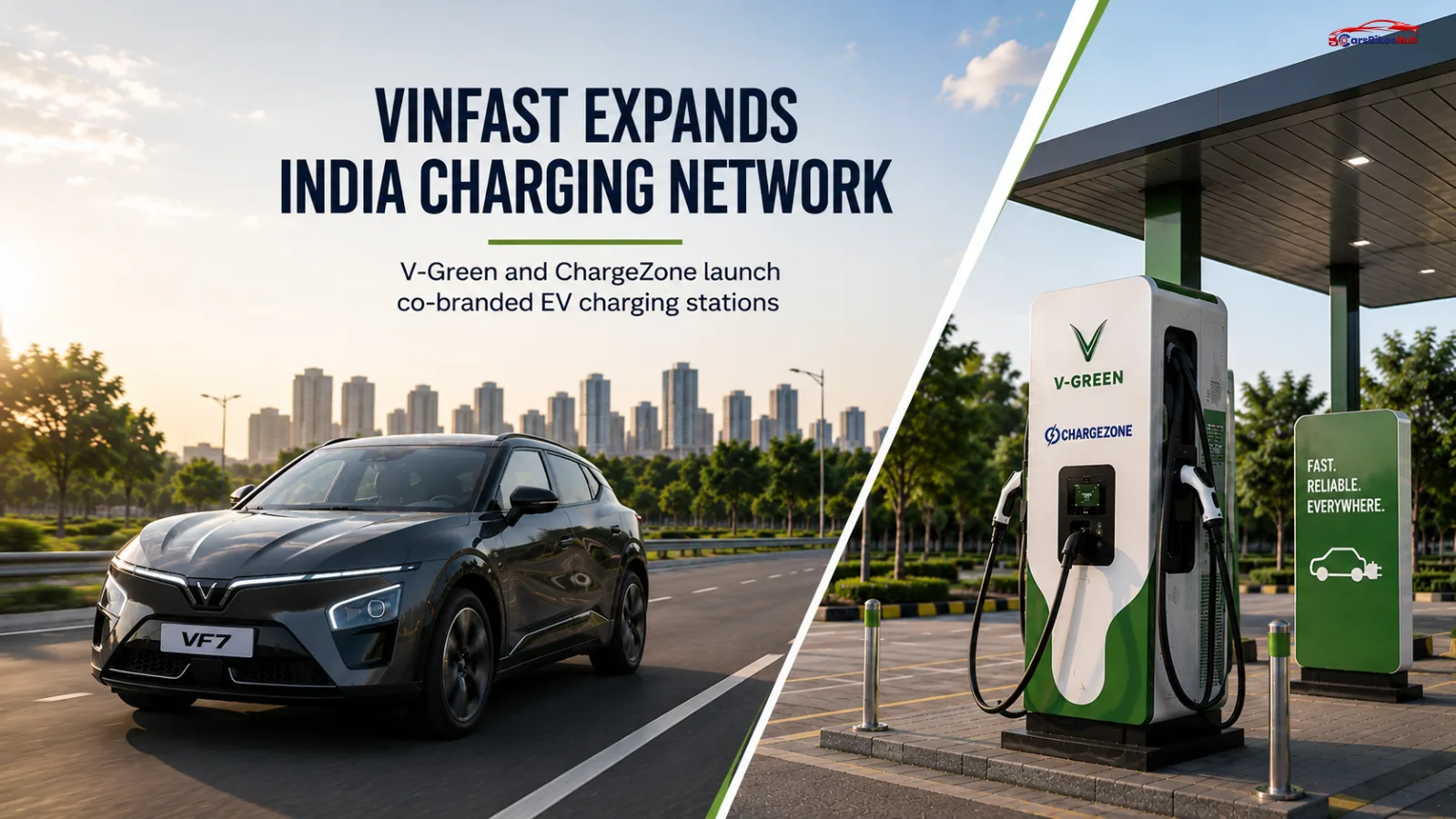
On May 28, 2026, the Vietnamese automaker’s V-Green ChargeZone partnership went live, marking VinFast’s first co-branded collaboration with a Charge Point Operator in India. And it is already generating more conversation than the cars themselves.
There’s a certain kind of confidence that comes with launching 15 charging stations and calling it a movement. That is essentially what VinFast EV charging in India has just become: a headline strategy, not just a footnote.
But the more interesting story is not the partnership itself; it is whether VinFast EV charging in India is solving a real problem or simply solving a perception problem. In this piece, we break down exactly that, what the V-Green ChargeZone partnership actually means on the ground, why the timing of this VinFast India expansion move is no accident, what Indian buyers should genuinely watch out for, and whether free EV charging in India until 2029 is a game-changer or just a clever sales hook.
What Actually Happened And What It Means
The V-Green ChargeZone partnership has been structured to strengthen EV charging infrastructure in India for VinFast customers through a nationwide rollout of co-branded fast-charging stations across key Indian mobility corridors.
The first of these VinFast charging stations in India came up in Vadodara, at the Mangla Trade Hub, placed right next to a VinFast dealership, which is a deliberate signal. This location choice reflects the partnership’s clear intent to integrate VinFast EV charging in India directly into the vehicle purchase and ownership experience.
The Vadodara site includes a 60 kW DC fast charger with dual-gun capability for simultaneous charging of two vehicles. That is not a slow AC wall box. A 60 kW DC charger can take a depleted battery to near-full in roughly 45-60 minutes for most mid-segment EVs, practically useful for highway pit stops and city dealership visits alike. For anyone tracking the growth of EV charging infrastructure in India, this spec matters.
As part of the next phase of VinFast India expansion, nearly 100 additional co-branded VinFast charging stations in India are planned for deployment over the next six months. Meanwhile, ChargeZone already operates more than 15,000 charging points across over 1,200 locations in India and the UAE. That existing backbone is what makes the V-Green ChargeZone partnership genuinely useful rather than just a press release.
Why This Partnership Is Smarter Than It Looks
Most EV brands entering India try to build their own charging networks from scratch. That is expensive, slow, and operationally complex. VinFast EV charging in India has taken a different path, co-branding with an established Indian Charge Point Operator rather than reinventing the wheel. Under the V-Green ChargeZone partnership, ChargeZone will own the end-to-end operation of all co-branded VinFast charging stations in India, ensuring a consistent and high-quality charging experience for customers nationwide.
This matters more than most people realise. Network uptime and maintenance have been persistent complaints across the EV charging infrastructure in India broadly. By placing operational responsibility with ChargeZone, a company that does this as its core business, VinFast insulates itself from the reliability problems that have hurt other brands attempting to manage their own networks.
The V-Green ChargeZone partnership reflects a growing and deeper integration between EV manufacturers and charging infrastructure providers, a model that is arguably more sustainable long-term than automakers trying to do everything in-house. Think of it less like VinFast building petrol pumps and more like a bank choosing to place its ATMs inside already-busy kirana stores. For VinFast India’s expansion goals, this approach saves both time and capital.
The Bigger Picture Nobody Is Talking About
The V-Green ChargeZone partnership does not exist in isolation. It is part of a layered strategy behind VinFast EV charging in India that the company has been building across multiple fronts since late 2025.
V-Green had already partnered with Hindustan Petroleum Corporation Limited (HPCL) to deploy VinFast charging stations in India across HPCL’s nationwide fuel station network, while also signing with multiple vendors pan-India to accelerate fast charger rollout across highways, urban centres, and Smart Cities zones. That means EV charging infrastructure in India for VinFast owners is being built on at least two parallel tracks simultaneously.
Add to this that VinFast India’s expansion comes with a compelling ownership package, free EV charging in India until March 2029, free maintenance for three years or 36,000 kilometres, and cash support for customers switching from petrol or diesel vehicles. For an Indian buyer already wary about running costs and post-purchase support of a relatively new brand, that combination is genuinely hard to ignore.
The factory angle adds yet another dimension to the VinFast India expansion story. The site in Thoothukudi, Tamil Nadu, was transformed from undeveloped land into a highly automated EV factory within just 15 months, and the company has already signed agreements to expand that facility to eventually include electric buses and motorcycles. Local production typically means lower prices and faster service parts availability over time, both critical factors that influence how seriously Indian buyers take any new brand.
What Indian Buyers Should Actually Watch
For anyone considering a VinFast vehicle, or evaluating whether VinFast EV charging in India is mature enough to justify a purchase, here is what to actually watch rather than what is being celebrated in press releases.
The 100-station target under the V-Green ChargeZone partnership over six months is a plan, not a promise. India has seen many announcements of EV charging infrastructure that have moved far more slowly than projected. The quality question matters equally: how many of these VinFast charging stations in India will be fast DC chargers like the Vadodara unit, versus slower AC chargers that are cheaper to install but far less useful on the road?
Placement strategy is equally critical for VinFast EV charging in India to mean something real. Both parties will jointly handle site identification and deployment planning. If stations cluster around showrooms and Tier-1 city centres, the network serves marketing more than mobility. If they push into national highways and Tier-2 corridors, that is when range anxiety for VinFast owners genuinely starts to drop, and when EV charging infrastructure in India begins to feel like a solved problem rather than a work-in-progress.
Then there is the open-access question around VinFast charging stations in India. The co-branded network is designed to serve the broader EV community, not just VinFast owners. If ChargeZone keeps these stations accessible to all compatible EVs, utilisation rates stay high, and the economics of running them remain viable long-term. That also strengthens the case for free EV charging in India programs like the one VinFast currently offers, because a well-used network is a well-maintained one.
The Honest Assessment
VinFast EV charging in India is doing something that many established carmakers with far bigger India budgets have been slow to do: treating charging infrastructure as a sales tool, not an afterthought. The V-Green ChargeZone partnership is strategically sound, operationally pragmatic, and notably faster to market than building proprietary stations from zero.
The challenge is that 115 VinFast charging stations in India, even if fully operational, barely scratch the surface of this country’s geography. For context, electric four-wheeler registrations in India surged 63 per cent year-on-year to 17,654 units in January 2026 alone, meaning demand is outpacing EV charging infrastructure in India industry-wide, not just for VinFast. Free EV charging in India until 2029 is a strong pull, but only if the stations are actually where buyers need them.
The brand has laid an interesting foundation through its VinFast India expansion strategy. Whether it holds depends on how aggressively and honestly the rollout follows the announcement.
FAQs
What is the VinFast and ChargeZone EV charging partnership?
The V-Green ChargeZone partnership is a strategic alliance to build co-branded VinFast charging stations in India for customers across the country. Fifteen stations are already live as of May 28, 2026, with around 100 more planned over the next six months as part of VinFast India's expansion.
Where is the first VinFast ChargeZone charging station in India?
The first VinFast charging station in India under this partnership is in Vadodara, Gujarat, at Mangla Trade Hub, adjacent to a VinFast dealership. It features a 60 kW DC fast charger that can charge two vehicles simultaneously.
Is VinFast EV charging free in India?
Yes, VinFast is currently offering free EV charging in India until March 2029 through its V-Green program, available at dedicated V-Green outlets across the country for both new and existing customers.
How does VinFast EV charging in India compare to Tata and Hyundai?
VinFast EV charging in India is growing through partnerships with established operators like ChargeZone and HPCL rather than building solo. Tata and Hyundai have more mature networks currently, but the V-Green ChargeZone partnership and EV charging infrastructure in India strategy could help VinFast close the gap faster than expected.
Who operates the VinFast co-branded charging stations in India?
Under the V-Green ChargeZone partnership, ChargeZone owns and manages end-to-end operations of all VinFast charging stations in India, covering installation, maintenance, and customer experience, while V-Green handles strategic planning and site selection.