


























For years, Audi buyers who needed genuine three-row space had to make a compromise. The Q7 offered seven seats on paper, but that third row was really built for kids, not adults on a highway run. Meanwhile, BMW and Mercedes-Benz had the full-size luxury SUV space largely to themselves with the X7 and GLS. Audi has now closed that gap. The Q9 was officially unveiled on July 28, 2026, as the brand’s largest and most expensive SUV to date, and it arrives with real numbers behind it rather than just concept-car promises.
The Audi Q9 is Audi’s new flagship full-size SUV, sitting above the Q8 and effectively taking over as the brand’s range-topping model from the outgoing A8 sedan. It was revealed on July 28, 2026, with U.S. pricing starting at $89,095 for the standard Q9 and $119,395 for the performance-oriented SQ9. It rivals the BMW X7, Mercedes-Benz GLS, and Range Rover, and it’s genuinely larger than the X7 in both length and width. U.S. deliveries begin in the fourth quarter of 2026, while Audi has stated the Q9 will reach India around Q2 2027, likely via local assembly. If you want a three-row Audi with adult-usable rear seats, this is the first one that truly delivers that.
If you’re wondering whether the Audi Q9 is worth waiting for, or whether a BMW X7, Mercedes-Benz GLS, or even Audi’s own Q7 makes more sense today, this article walks you through everything you need to know before making that decision.
This article breaks down everything confirmed at launch, pricing, engines, dimensions, interior, and safety tech, along with what we know so far about an India launch, so you can decide whether the Q9 is worth waiting for or whether an existing model already covers your needs.
Audi Q9: Specifications at a Glance
| Specification | Audi Q9 |
| Body Type | Full-size luxury SUV |
| Seating | 6 or 7 |
| Platform | Premium Platform Combustion (PPC) |
| Engine | 2.9L twin-turbo V6 / 4.0L twin-turbo V8 (market dependent) |
| Transmission | 8-speed automatic |
| Drivetrain | Quattro AWD (standard) |
| Power | Up to 591 hp (SQ9) |
| 0–60 mph | 4.9 sec (Q9) / 3.8 sec (SQ9) |
| Towing capacity | Up to 7,700 lbs |
| Starting price (US) | $89,095 (Q9) / $119,395 (SQ9) |
| India launch | Stated for Q2 2027, likely locally assembled |
| Rivals | BMW X7, Mercedes-Benz GLS, Range Rover |
Audi Q9: Where It Fits in Audi’s Lineup
The Q9 is Audi’s first full-size SUV, built specifically to compete in the segment occupied by the BMW X7, Mercedes-Benz GLS, and Range Rover, a class Audi previously had no real answer for. It sits above the Q8 in the lineup and is aimed at buyers who want three rows of usable seating, serious towing capacity, and flagship-level technology, rather than the sportier, more compact positioning of the Q7 or Q8.
Audi CEO Gernot Döllner has called it the new flagship of the brand’s portfolio, and the Q9 effectively steps into the role the A8 sedan used to hold as Audi’s most prestigious model. It shares its underlying architecture, the new Premium Platform Combustion (PPC), with the redesigned Q7, and both were developed around the same time, with the Q9 essentially a stretched, more upscale interpretation of that platform.
Why Is Everyone Talking About the Audi Q9?
A few things have converged to make this one of the most searched Audi models of the year. First, it’s a genuinely new body style for the brand; Audi hasn’t used the “9” nameplate since the early 1990s, and this is its first attempt at a true full-size SUV rather than a stretched mid-size one. Second, the timing matters: SUVs now account for a huge share of premium vehicle sales in markets like the U.S., and three-row luxury SUVs specifically have stayed in high demand even as overall premium car sales have softened. The BMW X7, for comparison, posted its best sales year yet in 2025.
Third, Audi built the Q9 with North American buyers specifically in mind, offering a V8 engine option exclusive to the U.S. market, which signals how seriously the brand is treating this launch as a way to reverse recent sales softness in that region.
Confirmed Pricing
Unlike a lot of “upcoming SUV” coverage, actual pricing is now on the table rather than a guess.
United States:
- Q9 (2.9-liter V6): starts at $89,095, including destination
- SQ9 (4.0-liter V8): starts at $119,395, including destination
International base pricing: Audi listed a European starting price around €108,400 (roughly ₹1.18 crore before local taxes and duties).
India: Not yet officially priced. Based on how Audi typically marks up flagship models after import duties, taxes, and local assembly costs, expect the India price to land somewhere in the ₹1.20–1.45 crore range once it arrives, but treat this as an estimate rather than a confirmed figure until Audi India makes an official announcement closer to launch.
Expected India Launch
Audi has stated the Q9 will come to India in the second quarter of 2027, and notably reports from the reveal event indicate it will be locally assembled rather than imported as a fully built unit, which would help keep pricing more competitive than a straight import. This would follow the same pattern Audi has used for the Q7 and Q3, both of which are already assembled locally in India. Globally, the Q9 itself is built at Audi’s Bratislava plant in Slovakia.
This timeline comes from Audi’s own communication at the global reveal, corroborated by multiple outlets covering the event, rather than dealer speculation, though as with any launch still more than a year out, some specifics (exact trims, final pricing, and confirmation of local assembly plans) could still shift before Audi India makes a formal announcement closer to launch.
What’s New Compared to the Audi Q7?
Since many readers will be cross-shopping the Q9 against Audi’s existing three-row model, here’s how the two actually differ, at a glance:
- Size: The Q9 is meaningfully longer, wider, and rides on a longer wheelbase than the Q7; this isn’t a mild refresh; it’s a genuinely larger vehicle class.
- Third-row comfort: The Q7’s rearmost seats work for kids on short trips; the Q9’s third row is built to fit adults comfortably on real journeys.
- Cabin technology: The Q9 introduces the tri-screen “Digital Stage” layout with a dedicated passenger display and 4D sound, a step above what the Q7 offers.
- Engines: The Q9 brings more powerful V6 and V8 options (in the US) and a broader spread of outputs than the Q7’s lineup.
- Road presence: With its illuminated grille, split headlights, and larger footprint, the Q9 reads as a distinctly flagship vehicle rather than a Q7 with extra badges.
- Luxury positioning: The Q9 effectively replaces the outgoing A8 sedan as Audi’s range-topping model, while the Q7 remains a more accessible, mid-size family SUV.
In short: if you’re deciding between the two, the real question isn’t “which looks nicer”; it’s whether you actually need the Q9’s extra size and third-row usability, or whether the Q7 already covers your needs at a lower price.
Exterior Design
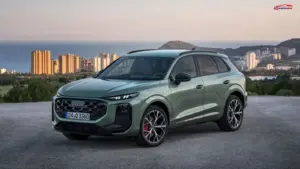
The Q9 wears Audi’s newest design language, and if you’ve seen the redesigned Q7, the Q9 will look familiar; just scaled up. Up front, it uses a split-headlight setup with slim LED daytime running lights sitting above the main headlight clusters, paired with Digital Matrix LED headlights. The grille is large, as you’d expect on a flagship model, using vertical slats on the standard Q9 and a more aggressive honeycomb pattern on the SQ9; on higher trims, the grille can illuminate.
In terms of size, the Q9 isn’t just “big for an Audi”; it’s genuinely larger than its direct rivals in some dimensions. It measures around 209 inches long and roughly 86.8 inches wide (measured mirror to mirror), which makes it slightly longer and wider than the BMW X7, with a longer wheelbase too at 123.5 inches between the axles; it actually beats a Chevrolet Tahoe’s wheelbase, even though the Tahoe is longer overall.
Around back, the Q9 gets curved digital OLED taillights, continuing the light-bar theme found across Audi’s current lineup. One genuinely new touch: the doors are electrically powered, a first for Audi, and use sensor-based protection to stop them opening into tight parking spots or oncoming traffic.
Interior & Cabin Experience
This is where Audi has clearly put a lot of effort, and it shows. The Q9’s cabin is built around a “Digital Stage” dashboard layout that spans three screens: an 11.9-inch driver display, a 14.5-inch central MMI touchscreen, and a 10.9-inch passenger display, giving front passengers their own way to interact with media and navigation without distracting the driver.
Seating comes in two configurations: a standard seven-seat layout or an optional six-seat arrangement with individual second-row captain’s chairs, which reviewers who’ve sat in the car describe as genuinely comfortable rather than a token upgrade. Third-row access is designed to be easy, and unlike the cramped rearmost seats in the current Q7, the Q9’s third row is built to actually fit adults for real trips, not just short school runs.
Practical touches back this up. The center console includes two wireless charging pads that meet the Qi2.2 standard, along with USB-C ports capable of delivering up to 100 watts, so both a phone and a laptop-class device can charge quickly at once. In the trunk, an aluminum rail system with sliding hooks and adjustable anchors lets you secure cargo in three dimensions, keeping the floor clear for larger items. A roof rack for the standard roof rails comes included with every Q9, which is a nice touch for anyone planning to carry bikes, luggage boxes, or gear.
Ambient touches include a large, illuminated panoramic sunroof with switchable transparency, and a new 4D sound system designed to turn music into a more immersive, whole-cabin experience.
Features & Technology
Beyond the screens and charging setup, the Q9 leans on the kind of tech buyers in this segment actually expect:
- Digital Matrix LED headlights with adaptive, animated lighting signatures
- 360-degree camera system for tighter parking and low-speed maneuvering in a large vehicle
- Adaptive air suspension as standard equipment on both Q9 and SQ9, allowing the ride height to adjust for comfort, performance, or light off-road use
- All-wheel steering on select trims, which should help a vehicle this size feel more manageable in tight city streets and parking structures
- Quattro all-wheel drive as standard across the range, with the SQ9 getting a rear-biased tune and a new electronically controlled locking rear differential for sportier handling.
- Adaptive cruise control, though notably without a hands-free driving mode at launch, something competitors like GM’s Super Cruise and Ford/Lincoln’s BlueCruise already offer, and an area where the Q9 currently trails rather than leads
Engine & Performance
This is one part of the story where the details genuinely differ by market, so pay attention to which region’s spec you’re reading about.
United States:
- Q9: 2.9-liter twin-turbo V6, 429 horsepower, 442 lb-ft of torque, paired with an eight-speed automatic and standard quattro AWD. 0–60 mph in 4.9 seconds.
- SQ9: 4.0-liter twin-turbo V8 (the same unit previously used in the RS Q8), 591 horsepower, 590 lb-ft of torque. 0–60 mph in 3.8 seconds, top speed of 155 mph, with six-piston front brake calipers gripping 16.5-inch rotors.
Europe: Audi is launching the Q9 in Europe exclusively with a 3.0-liter turbodiesel V6 at first, offered in two states of tune: 241 hp/369 lb-ft, or 295 hp/464 lb-ft, both using mild-hybrid assistance. Additional gasoline and possibly plug-in hybrid powertrains are expected to follow, mirroring the rollout pattern of the smaller Q7.
Towing: Both the Q9 and SQ9 are rated to tow up to 7,700 lbs, which is a genuinely useful number for anyone planning to pull a boat or a decent-sized trailer.
India: Audi hasn’t confirmed India-spec powertrains yet. Given emissions norms and past patterns with the Q7, expect the India launch to lean toward petrol V6 options, though this remains speculative until Audi India shares official details.
Ride Comfort & Practicality
With adaptive air suspension standard across the range, the Q9 is tuned more toward comfort and long-distance cruising than outright sportiness, which fits its role as a family and chauffeur-friendly flagship rather than a driver’s SUV. The generous wheelbase should translate into a settled highway ride, and the genuinely usable third row means this is one of the few Audis where a road trip with six or seven people is realistic rather than theoretical.
City driving in a vehicle this size will take some adjustment; at nearly 87 inches wide including mirrors, tight multi-story parking or narrow lanes will require more care, which is part of why the 360-degree camera and optional all-wheel steering matter more here than on smaller Audis.
Ownership Costs: What to Expect
Audi hasn’t published official service, maintenance, or insurance figures yet, since the Q9 has only just gone on sale, but based on how comparable Audi flagship models and rivals in this segment typically play out, here’s a realistic picture:
- Fuel economy: Expect the V6 Q9 to land somewhat below competitors’ six-cylinder full-size SUVs given its power output and roughly 5,300-lb curb weight; the V8 SQ9, at over 5,550 lbs, will likely be thirstier still. Audi hasn’t confirmed EPA or WLTP figures yet.
- Maintenance: As a flagship model with air suspension, electric doors, and a triple-screen cabin, expect service costs to sit at the higher end of Audi’s range,e closer to what A8 and Q8 owners have historically paid than what Q5 or Q7 owners pay.
- Insurance: Premiums will likely track the vehicle’s price and power output, so the SQ9 in particular should cost noticeably more to insure than the standard Q9.
- Warranty: Audi typically offers a standard new-vehicle warranty in each market (commonly 4 years in the US, though this can vary by region); check with your local dealer for the exact terms once the Q9 goes on sale near you.
Until Audi publishes official cost-of-ownership data, treat these as reasonable expectations rather than confirmed numbers; we’ll update this section once real-world figures are available.
Safety
Audi hasn’t published full third-party crash test results yet, since the Q9 has only just been revealed. Confirmed safety-relevant features so far include the 360-degree camera system, sensor-protected power doors that won’t open into obstacles or approaching traffic, and the SQ9’s larger braking package with six-piston calipers.
Expect the usual suite of driver assistance systems; adaptive cruise, lane keeping, and parking assistance; to be standard or available, though full details on ADAS levels and safety ratings will likely follow closer to the on-sale date. Treat any specific crash-safety rating claims you see online right now as unconfirmed until official bodies like Euro NCAP or the IIHS test the production car.
Audi Q9 vs BMW X7 vs Mercedes-Benz GLS
| Audi Q9 | BMW X7 | Mercedes-Benz GLS | |
| Starting price (US) | $89,095 | Comparable X7 trims start in a similar range | Comparable GLS trims start in a similar range |
| Base engine | 2.9L twin-turbo V6, 429 hp | Six-cylinder options, varies by trim | Six-cylinder options, varies by trim |
| Top performance variant | SQ9: 4.0L V8, 591 hp | X7 M60i | Mercedes-AMG GLS 63 |
| Seating | 6 or 7, adult-friendly third row | 6 or 7 | 6 or 7 |
| Standout tech | Tri-screen “Digital Stage” cabin, 4D sound | Established infotainment, strong brand cachet | Height-adjustable air suspension, luxury-first cabin |
| Ideal buyer | Tech-forward families wanting the newest design and cabin tech | Buyers who value BMW’s driving dynamics and established reputation | Buyers prioritizing outright luxury and comfort |
The short version: all three are genuinely close in size, price, and mission. The Q9 pulls ahead on outright dimensions and cabin technology since it’s the newest design of the three. The X7 still has an edge in driving dynamics for buyers who care about that. The GLS remains the pick for anyone who wants the most overtly plush, traditional luxury feel. None of these is a wrong choice;e, it comes down to which brand’s approach to comfort and tech fits you.
Should You Wait for the Audi Q9?
If you specifically need three rows with real adult space and want the newest technology Audi has to offer, waiting makes sense; this is the first Audi SUV actually built around that need rather than treating the third row as an afterthought. The Q9 is now revealed with confirmed pricing and specs, so U.S. buyers aren’t waiting on guesswork anymore; deliveries begin in Q4 2026.
On the other hand, if you’re in India, the wait is longer, realistically into the second quarter of 2027, and pricing there hasn’t been confirmed yet. In that case, buying a current Q7 now, or looking at an already-available rival like the BMW X7 or Mercedes-Benz GLS, may make more practical sense if you need a vehicle soon. The Q7 also remains meaningfully cheaper, so if third-row space isn’t a dealbreaker for your family, it’s still a sensible choice.
Final Verdict: Is the Audi Q9 Worth Waiting For?
For the audience it’s built for- families who need real three-row space, buyers who want Audi’s latest cabin technology, and anyone cross-shopping the X7 or GLS- yes, the Q9 looks like a genuinely strong new option, and the fact that it’s now officially revealed with real pricing and specs (rather than rumors) makes it easier to commit to waiting for. U.S. buyers don’t have to wait long at all, with deliveries starting before the end of 2026.
For India-based buyers, the calculus is a little different simply because of timing. If your current vehicle can hold out until mid-to-late 2027, waiting for the Q9 gets you a genuinely new flagship SUV with local assembly. If you need something sooner, the Q7 or a rival full-size SUV already on sale is the more practical near-term choice. Either way, this isn’t a case of choosing between hype and substance; the Q9 has real numbers behind it now, which is more than most “upcoming SUV” stories can say.
The Audi Q9 isn’t simply a larger Q7. It’s Audi’s first true answer to the BMW X7 and Mercedes-Benz GLS, combining genuine third-row practicality, flagship-level technology, and premium comfort in a way no previous Audi SUV has managed. While real-world ownership experience and long-term reliability will only become clear after the Q9 reaches customers, Audi has finally introduced a flagship SUV that can genuinely compete on space, luxury, and technology. If those qualities matter most to you, the Audi Q9 deserves a place on your shortlist.


FAQs
What is the Audi Q9?
The Audi Q9 is Audi's new flagship full-size, three-row luxury SUV, positioned above the Q8 and revealed on July 28, 2026.
Is the Audi Q9 bigger than the Audi Q7?
Yes. The Q9 is a larger, stretched interpretation of the same new platform underpinning the redesigned Q7, with a significantly roomier third row built for adults rather than just children.
What is the Audi Q9 price in the US?
The standard Q9 starts at $89,095, and the performance SQ9 starts at $119,395, both including destination charges.
Will the Audi Q9 launch in India?
Audi has stated the Q9 will arrive in India around the second quarter of 2027, likely through local assembly rather than import-only availability, though final confirmation from Audi India is still pending.
What engines does the Audi Q9 offer?
In the U.S., a 2.9-liter twin-turbo V6 (429 hp) for the Q9 and a 4.0-liter twin-turbo V8 (591 hp) for the SQ9. In Europe, it launches with a 3.0-liter turbodiesel V6 in two power outputs, with more powertrains expected later.