
















If you’ve owned an electric car in India for more than a few months, you already know the drill. One app to find a Tata Power charger. Another for ChargeZone. A third because the one fast charger on your regular highway route happens to run on Statiq. Somewhere in your phone’s storage, there’s probably a folder of EV charging apps you downloaded once, used twice, and now open only when you’re stranded and desperate.
This fragmentation isn’t a minor annoyance; it’s one of the real, lived frustrations of EV ownership in India. Charging infrastructure has grown fast over the last two years, but it grew as a patchwork of private networks, each with its own app, its own login, its own wallet, and its own way of showing (or hiding) whether a charger actually works. For a new EV buyer trying to decide if going electric makes sense, “which apps do I need” is a legitimate and slightly exhausting question.
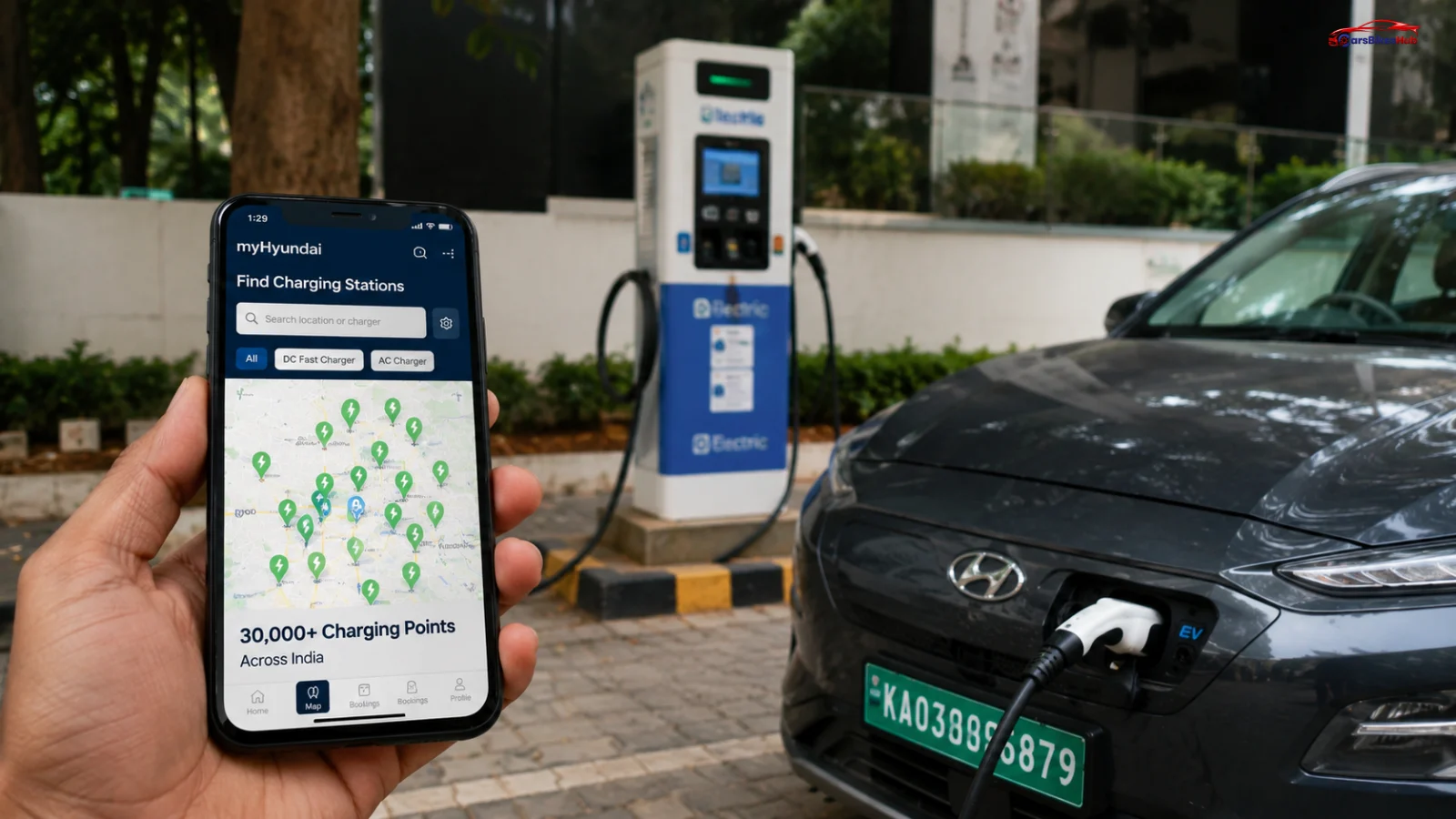
Hyundai’s latest update to the myHyundai app tries to chip away at exactly this problem. The company has expanded the app’s charging network integration to more than 30,000 charging points across India, and, notably, opened it up to EV owners of any brand, not just Hyundai’s. Whether that meaningfully changes day-to-day ownership, or is simply a nice-to-have layered on top of an already messy ecosystem, is worth examining honestly.
Quick Highlights
- Access to 30,000+ charging points across India, up from ~20,000 in late 2025
- Open to EV owners of all brands, not just Hyundai
- Lets you find, navigate to, book, and pay for a charger in one app
- Aggregates multiple Charge Point Operators (CPOs) into a single interface
- Doesn’t fully replace other charging apps; some networks and features still need their own app
- Chargers available within an average 25 km radius nationwide, per Hyundai
What Has Hyundai Announced?
Hyundai Motor India Limited (HMIL) confirmed that the myHyundai app now provides access to over 30,000 EV charging points nationwide, built through partnerships with multiple Charge Point Operators (CPOs) and service providers. This is a significant jump from the roughly 20,000 points the app offered as recently as September 2025.
Inside the app, users get:
- Charger discovery: locating nearby charging points from HMIL’s own network as well as partner CPOs, shown on a single map instead of five different ones
- Navigation: turn-by-turn routing to the selected charger
- Slot booking: reserving a charging slot in advance, rather than showing up and hoping it’s free
- Digital payments: a unified payment flow instead of separate wallets per operator
- Route and highway coverage: Hyundai says the network covers major intercity corridors including Delhi-Gurugram-Jaipur, Mumbai-Pune-Bengaluru, Mumbai-Ratnagiri-Goa, Chennai-Vellore-Bengaluru, and Hyderabad-Kurnool-Bengaluru
Hyundai also states that charging facilities are now available within an average radius of 25 km across the country, a claim aimed squarely at range anxiety, and one that’s meaningful if it holds up in practice, since it’s the gap between chargers, not their total count, that actually determines whether a road trip is stressful.
On its own proprietary side, Hyundai says its public fast-charging stations have served more than 3 lakh charging sessions and delivered over 50 lakh kWh of electricity to date. The company has also outlined plans to grow its own DC fast-charging network from 183 stations to 600 by 2030, a separate, slower-moving effort from the app integration, but one that shows Hyundai is investing in owned infrastructure and not just aggregating other people’s chargers.
Can Any EV Owner Use the myHyundai App?
Hyundai has explicitly stated that the integrated charging platform is open to electric vehicles of all brands, so Tata, MG, Mahindra, Kia, BYD, and any other EV owner can register and use it, not just Hyundai IONIQ 5 or Creta EV owners.
In practice, this means:
- Registration is done through the myHyundai app (available on Android and iOS), and doesn’t require proof of owning a Hyundai
- Charging itself happens through whichever CPO operates that particular charge; Hyundai’s app is acting as an aggregator and payment layer, not the charging hardware provider, for the partner network portion.
- Compatibility depends on your car’s charging port and the charger type (AC/DC, CCS2 being the dominant standard in India; same as with any other charging app, the myHyundai app doesn’t change what your car can physically plug into
The catch, and it’s a real one: being listed in an aggregator app doesn’t guarantee a seamless experience. Some users have reported friction points like being logged out unexpectedly, unclear real-time pricing information, or unit-display settings that don’t reflect what they’d prefer. These are the kinds of issues that come with any app trying to unify multiple third-party backends, and they’re worth knowing about before you rely on it for a long trip.
Why Does This Matter?
The value here isn’t the number 30,000. It’s what having a single interface does to the experience of finding, paying for, and using a charger.
Fewer app switches: Instead of maintaining five apps with five logins and five stored payment methods, you check one app first. Even if you occasionally need to fall back to an operator’s own app for niche chargers, you’ve cut down the friction for the vast majority of situations.
Easier long-distance planning: For anyone doing an interstate drive, say Delhi to Jaipur or Mumbai to Goa, having pre-mapped, integrated corridors in one app makes trip planning less of a guessing game. You’re not toggling between three apps trying to figure out which one shows a working charger near your lunch stop.
Lower barrier for first-time EV buyers: A lot of hesitation around buying an EV in India isn’t about the car; it’s about the uncertainty of “will I be able to charge it when I need to?” An app that shows tens of thousands of points, with booking and payment built in, makes that uncertainty feel more manageable, even if the underlying charger reliability hasn’t changed at all.
Better confidence on unfamiliar routes: If you’re driving somewhere you haven’t been before, a unified map with real-time availability (as reliable as the underlying data feed is) beats guessing which network has coverage there.
None of this changes how many working chargers exist in India. It changes how easily you can find and use the ones that do.
Does This Replace Other Charging Apps?
Not entirely, and it’s worth being upfront about that. myHyundai works as an aggregator layered on top of existing CPO networks; Tata Power’s EZ Charge, Statiq, ChargeZone, BPCL, Shell Recharge, Jio-bp Pulse, and others are still the ones physically operating the majority of those chargers.
In practice, here’s a realistic breakdown of what changes and what doesn’t:
- If a CPO’s chargers are integrated into myHyundai, you can likely discover, book, and pay through the Hyundai app instead of downloading that operator’s app separately- genuinely useful.
- If you hit a charger from a network that isn’t yet integrated, or if the integration doesn’t cover certain features (say, a loyalty program or a specific tariff plan the operator offers directly), you may still need that operator’s own app.
- For home charging or society-level charging setups, myHyundai isn’t really the tool; that’s usually managed through the installer or a separate residential charging app.
So the honest answer is: myHyundai reduces how often you need other apps, but it’s unlikely to fully replace them yet, especially for chargers outside its partner network or in newer, still-expanding pockets of the country.
Which Charging Networks Are Available on the myHyundai App?
Hyundai hasn’t published a full, itemised list of every CPO folded into the 30,000-point network, a fair gap to flag rather than gloss over. What the company has confirmed is that the network is built through partnerships with “multiple Charge Point Operators and service providers,” alongside HMIL’s own DC fast-charging stations.
In practice, expect the app to draw from operators that already dominate India’s public charging map, such as Statiq and ChargeZone, alongside Hyundai’s own branded chargers at dealerships and highway locations. If a specific operator matters to you, say, because you already hold a paid plan or RFID card with one, check directly in the app before assuming it’s covered, since these integrations tend to be added over time rather than all at once.
How Does It Compare with Other Automakers?
Hyundai isn’t alone in trying to solve this problem, and the comparison is worth laying out plainly.
Tata Motors has arguably built the most extensive owned-and-operated network through Tata Power’s EZ Charge, which independently claims thousands of stations across hundreds of cities, backed by Tata’s own energy infrastructure. Tata’s IRA.ev app, tied to its newer EV sub-brand, is also moving toward a similar “one app, multiple CPO” model through Mega Charger partnerships with ChargeZone, Statiq, and Zeon.
Mahindra, as it ramps up its BE and XUV EV range, has been building charging partnerships but doesn’t yet have as large a self-branded aggregator footprint as Hyundai or Tata.
MG Motor has largely leaned on third-party networks and partnerships rather than building an extensive proprietary charging or app ecosystem of its own.
Kia, sharing platform and group resources with Hyundai, has a comparatively smaller dedicated charging app presence in India.
If the metric is “largest owned physical charging network,” Tata Power currently has the edge, given its scale and years of infrastructure investment. If the metric is “most useful single-app aggregation across brands,” Hyundai’s move to 30,000+ points puts it at or near the front of the pack, at least on paper. Both companies are converging on the same idea: that no single company can build all the infrastructure alone, so partnering with CPOs and unifying access through one app is the more realistic path.
What Are the Limitations?
- Reliability varies by operator: A charger showing as “available” in the app doesn’t guarantee it’s actually working. Third-party charger uptime in India still varies meaningfully; well-run networks report uptimes in the 90%+ range, but smaller or older installations can lag.
- Charging speeds differ widely: Not every point in that 30,000 figure is a fast DC charger. Many are slower AC points, which is fine for topping up during a meal but not for a quick highway stop.
- Pricing isn’t uniform: Tariffs differ by operator and location, generally landing somewhere in the ₹15–25 per kWh range, and the app aggregating access doesn’t necessarily mean uniform, transparent pricing across every listed charger.
- Coverage gaps remain: Despite the 25 km average radius claim, that’s an average; some regions, especially Tier 3 towns and the Northeast, will have far sparser coverage than metro corridors.
- App-level friction: As with any software aggregating multiple backend systems, expect occasional syncing issues, login quirks, or inconsistent real-time data, at least while the integration matures.
None of this makes the update meaningless; it just means it should be treated as a genuinely useful tool, not a guarantee of a frictionless charging experience.
Is This Good News for Someone Planning to Buy an EV?
It depends on how you’ll actually use the car.
Daily city users who mostly charge at home will notice this the least. The bigger convenience here is for the occasional public top-up, not everyday use.
Highway travellers and interstate commuters stand to benefit the most, since corridor coverage and booking directly address the two biggest pain points of long-distance EV travel: finding a working charger and not wasting time waiting for one.
Apartment dwellers without dedicated home charging will find this meaningfully useful, since they’re more dependent on public infrastructure day-to-day, and a single reliable app reduces a genuine daily hassle.
Home charging users get less direct benefit, since their primary charging need is already solved; this mostly matters for their occasional trips out of the city.
First-time EV buyers get an intangible but real benefit: a lower psychological barrier. Seeing a large, unified, multi-brand-accessible network makes EV ownership feel less like a gamble.
Final Verdict
This update genuinely improves the EV ownership experience in India, but it’s an improvement in convenience and confidence, not in the raw amount of physical charging infrastructure available. Hyundai hasn’t built 30,000 new chargers; it has organized existing and partner infrastructure into a single, more usable interface, and importantly, opened it to every EV owner, not just its own customers.
That distinction matters. The core challenges of Indian EV charging inconsistent uptime, uneven charging speeds, patchy coverage outside major corridors haven’t disappeared. What has changed is that finding, booking, and paying for a charger is now less fragmented, regardless of what badge is on your car.
For someone cross-shopping EVs today, this isn’t a reason by itself to pick a Hyundai. But it’s a sign of where the industry is heading: automakers competing not just on range and price, but on how painless they can make charging, even for people who didn’t buy their car.
If you already drive an EV, downloading one app instead of managing five is a welcome convenience. It won’t fix unreliable chargers or expand infrastructure overnight, but it does make public charging simpler. For buyers considering their first EV, that’s one less barrier to switching.


FAQs
Is the myHyundai app only for Hyundai EV owners?
No. The charging network integration is open to EV owners of any brand; Tata, MG, Mahindra, Kia, BYD, and others can register and use it to find, book, and pay for chargers.
How many EV charging points does the myHyundai app cover?
Over 30,000 charging points across India as of mid-2026, up from roughly 20,000 in September 2025, through partnerships with multiple Charge Point Operators plus Hyundai's own DC fast-charging network.
Does the myHyundai app replace apps like Tata Power EZ Charge or Statiq?
Not entirely. It aggregates many CPO networks into one interface, but some operators, loyalty programs, or newer chargers may still require their own app.
Can I book a charging slot in advance through the app?
Yes. The app supports advance slot booking along with real-time charger discovery, navigation, and digital payments.
Is public EV charging through the myHyundai app expensive?
Pricing depends on the operator running that specific charger, generally falling in the ₹15–25 per kWh range typical of India's public charging market; the app itself doesn't set a uniform tariff.