




























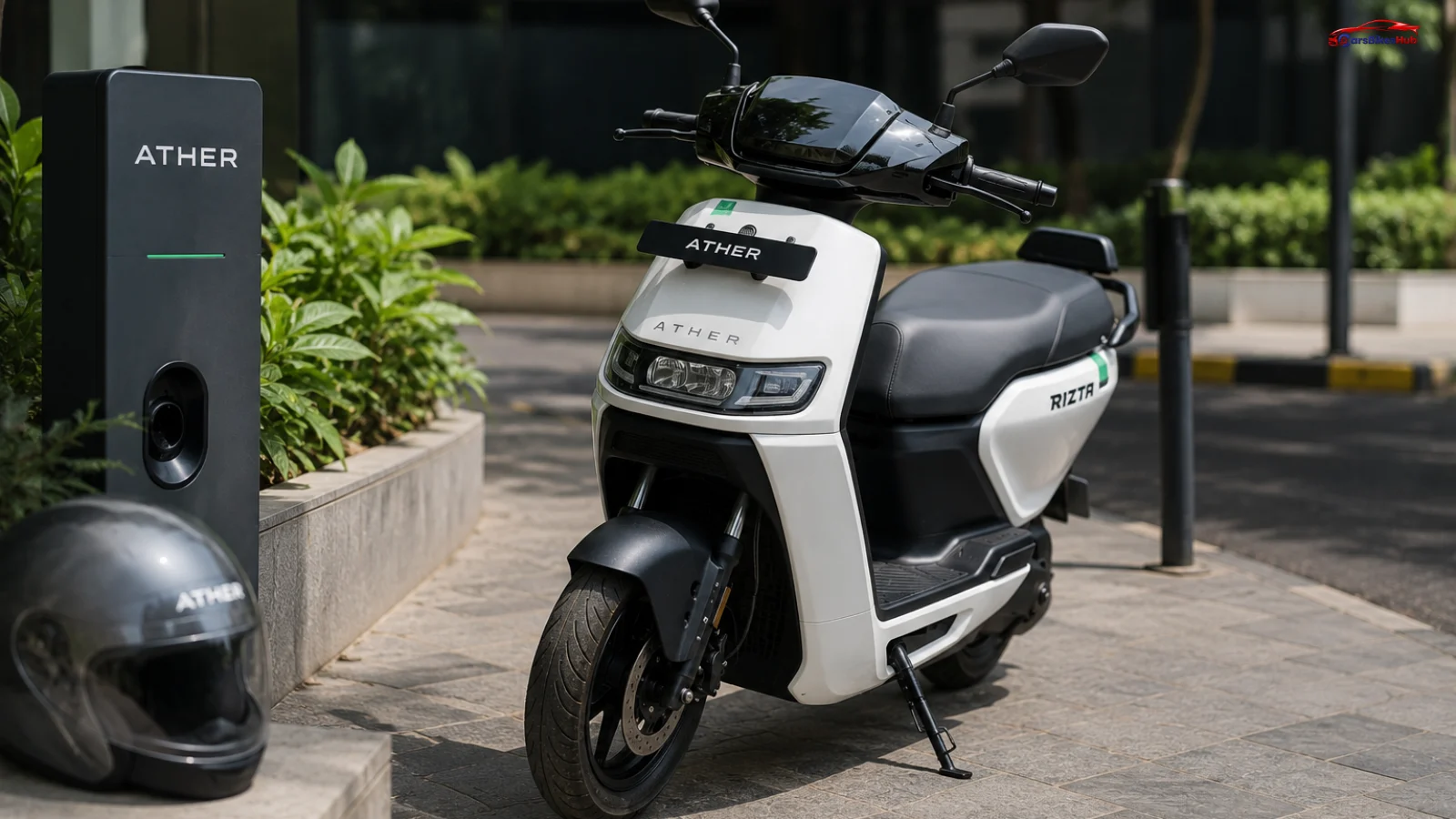
Ather Energy has quietly made one of the biggest changes to its electric scooters in recent years. The company has introduced LFP battery technology on select Rizta variants, reduced battery capacities across its lineup, and yet claims the same driving range. Naturally, buyers have one question: does any of this actually matter?
The Rizta can now come with either LFP (Lithium Iron Phosphate) or NMC (Nickel Manganese Cobalt) battery cells, while the 450 series continues with NMC only. This article answers the “do Ather’s Battery Chemistry Changes matter” question first, then walks through the technical side for anyone who wants it.
What Has Actually Changed?
Here’s the confirmed part, separated from speculation.
On the Rizta:
- The smaller pack, earlier a 2.9 kWh NMC unit, is now available as a 2.7 kWh LFP pack on select units. Claimed IDC range stays at 123 km despite the smaller capacity.
- The larger pack stays NMC, but capacity has been trimmed from 3.7 kWh to 3.5 kWh. Claimed range hasn’t dropped; some reports put it slightly higher at 161 km, up from the earlier 159 km.
- You can’t choose LFP over NMC at the showroom. Which chemistry you get on the smaller-pack Rizta depends on production supply at the time, not customer preference.
On the 450 series (450S and 450X):
- Both stay NMC-only. Ather’s stated reasoning is that the 450’s more powerful motor requires the higher-energy-density NMC currently available.
- The larger 3.7 kWh pack drops to 3.5 kWh, with claimed range unchanged at 161 km (450X). The smaller 2.9 kWh pack and its range figures carry over unchanged.
Across both series:
- Larger-pack variants now get a 900W portable charger, up from 700W, cutting claimed 0-80% charging time from around 4 hours 30 minutes to about 3 hours 12 minutes.
- Prices and battery warranty terms are unchanged.
- Performance, features, and everything else about the scooters stay the same.
What Ather hasn’t detailed publicly is the exact production split between LFP and NMC units, or its longer-term plans for LFP across the rest of the lineup. Anything on that front is industry observation, not company confirmation.
Should Buyers Care About Ather’s Battery Chemistry Changes?
For most riders doing a typical 20–30 km daily commute, you’re unlikely to notice any real-world difference between an LFP-equipped Rizta and an NMC-equipped one in the first couple of years of ownership. Range, performance, charging speed, and price are effectively unchanged either way, and Ather isn’t letting you pick your chemistry, so there’s nothing to actively decide at the point of purchase.
Where it does start to matter is time horizon. If you’re planning to keep your scooter for 5-7 years rather than trading it in after two or three, LFP’s slower capacity fade could mean a noticeably healthier battery by year five compared to an equivalent NMC pack, especially if you live somewhere that gets genuinely hot for months at a stretch. That’s a real, practical difference, just one that shows up gradually rather than on day one.
So the honest answer is: this update is worth knowing about, but it shouldn’t be the deciding factor in whether or when you buy. Treat it as a small, structural improvement happening in the background, not a reason to rush in or hold off.
Why Did Ather Introduce LFP Batteries?
Ather hasn’t published a detailed explanation of its reasoning, but the move fits a pattern the wider EV industry has been following for a couple of years. A few plausible drivers, based on how LFP is generally used across the industry:
- Thermal stability. LFP tolerates heat with less degradation than NMC, which matters when a scooter sits in direct sun through Indian summers.
- Longer cycle life. LFP typically supports more charge cycles before capacity meaningfully drops.
- Cost and material dependence. LFP skips cobalt and nickel, both expensive and geopolitically concentrated, which can make it cheaper to produce at scale.
- Fit for commuter use. LFP’s lower energy density is a smaller compromise on a commuter scooter like the Rizta than on a performance model like the 450, where every watt-hour of density counts more.
These are the commonly cited industry reasons for adopting LFP, not an official statement from Ather, worth keeping in mind if you see this framed elsewhere as confirmed company strategy.
LFP vs NMC: The Simple Version
Both are lithium-ion batteries, but the chemistry of the positive electrode differs, and that changes how each behaves in daily use.
| Factor | LFP | NMC |
| Safety/heat tolerance | Higher | Lower |
| Lifespan (charge cycles) | Generally higher | Generally lower |
| Energy density | Lower, needs more mass for the same energy | Higher, lighter for the same energy |
| Performance under load | Less suited to high-torque demands | Better suited to high-performance motors |
| Cost to produce | Lower (no cobalt/nickel) | Higher |
| Best suited to | Daily commuting, hot climates, long ownership | Performance-focused riding, compact packaging |
In short: LFP trades a bit of energy density for durability and heat resistance. NMC trades some long-term robustness for lighter, more powerful packs. Neither is objectively “better”; they’re built for different priorities.
Why Does the New Battery Have a Smaller Capacity but Similar Range?
This is the part that trips up a lot of buyers, and it’s worth explaining properly, because a smaller kWh number doesn’t automatically mean less range.
- Efficiency improvements. If the motor, controller, or software converts stored energy into distance more efficiently, a scooter can travel the same distance on less energy.
- Tighter BMS margins. Manufacturers usually keep a safety buffer unused at both ends of a pack’s charge to protect long-term health. Narrowing that buffer slightly frees up more usable capacity without adding cells.
- Testing conditions. IDC range figures are measured under standardised lab conditions, so small efficiency gains show up cleanly in the claimed number.
Think of kWh as the size of the fuel tank, not how efficiently the vehicle uses that fuel. A smaller, better-managed pack can match, or even edge past a larger, less optimised one.
Which Battery Is Better for Indian Conditions?
- City riding and daily commuting: LFP’s heat tolerance and cycle life suit stop-start traffic and short daily trips well, which describes most Rizta usage.
- Weekend touring or longer rides: NMC’s higher energy density matters more if you regularly push toward the edge of a scooter’s range, which fits 450 riders more than Rizta riders.
- High temperatures: LFP has a real edge for buyers in hotter states, where scooters bake in the sun for hours.
- Long-term ownership: If you’re the type to keep a scooter well past the five-year mark, LFP’s slower fade is the kind of difference you’ll actually feel by then.
A simple way to think about it: if you ride 25-30 km a day and swap scooters every couple of years, you’ll probably never notice which chemistry you have. If you’re buying something to keep for the long haul, LFP is quietly working in your favour the whole time, even if it never shows up as a headline spec.
Should Existing Owners Worry?
No. If you already own a Rizta or 450 with the older, larger-capacity NMC pack, nothing about your ownership changes because of this update. Ather has stated that battery warranty terms are unaffected, so existing coverage stays exactly as it was. This is a change to new production, not a retroactive fix or a signal that older packs are inferior; it’s simply how Ather is building scooters going forward.
There’s also no indication that servicing, spare parts, or support will differ for older NMC units. If you’re happy with your scooter today, this update is background noise for you, not a reason for concern.
Is the Rizta Now a Better Buy?
For the Rizta’s core buyers- families, daily commuters, and anyone prioritising low running costs over outright pace- this update is a quiet, genuine improvement, provided the unit you get ships with the LFP pack.
- Family buyers benefit most from LFP’s durability, since family scooters tend to see years of consistent, low-drama use.
- Office commuters doing predictable daily distances are exactly the use case LFP is built for.
- Running costs shouldn’t shift, since prices and range are both holding steady.
The catch remains the same one from earlier: you can’t choose LFP over NMC at purchase. Whether you end up with one or the other depends on what’s coming off the line that week, not on ticking a box.
What Does This Mean If You’re Buying an Ather Today?
If you’re close to a purchase decision right now, here’s the practical breakdown:
- Should you wait? Not really. There’s no price difference, no range difference, and no way to guarantee you’ll get LFP even if you delay your purchase. Waiting mainly costs you time without buying you certainty.
- Is LFP worth waiting for specifically? Only if you’re extremely particular about chemistry and willing to ask your dealer directly about current stock; otherwise, it’s not worth holding off your purchase over.
- Will resale value change? There’s no evidence yet either way. Resale in the EV scooter market has so far been driven far more by battery health checks, service history, and overall condition than by chemistry type, and that’s unlikely to change quickly.
- Will servicing change? No indication of that. Ather hasn’t flagged any difference in service intervals or procedures between the two chemistries.
- Which scooter benefits the most from this update? The Rizta, by a clear margin;n, it’s the one actually getting a new chemistry option. The 450’s update is really just a quiet efficiency and charging-speed improvement.
How Is Ather’s Approach Different?
Most rivals pick one chemistry and use it across their entire lineup. TVS and Bajaj Chetak build every current model around NMC. Ampere has gone the other way, building its Nexus and Magnus Grand around LFP as a core selling point, backed by a longer battery warranty. Ola Electric currently ships NMC in its production scooters, though it has separately shown a new LFP cell aimed at future, more affordable models.
Ather is doing something a little different: matching the chemistry to the scooter’s purpose rather than standardising one chemistry across the board. LFP goes on the commuter-focused Rizta, where durability and heat tolerance matter more than outright energy density.
NMC stays on the performance-oriented 450, where every watt-hour of density counts. It’s a more deliberate, model-specific approach than simply picking one chemistry and applying it everywhere, and it’s worth knowing about mainly because it explains why the two models are diverging rather than moving in lockstep.
Should You Buy an Ather After This Battery Update?
Buy now if:
- You want a reliable commuter scooter and don’t want to delay your purchase.
- You’re choosing between the Rizta and other family-oriented scooters.
- You’re comfortable that either chemistry could show up in your unit, since price, range, and warranty are unaffected either way.
Wait only if:
- You specifically want an LFP-equipped Rizta and are willing to check current stock with your dealer first.
- You’d like more clarity on how widely Ather rolls out LFP across the rest of its lineup before committing.
For nearly everyone else, this update is a reason to feel a little better about buying, not a reason to pause.
Final Verdict
This update isn’t a reason to rush a purchase, and it isn’t a reason to hold one off either. It’s a sensible, incremental engineering change; smaller battery packs without a drop in claimed range point to real efficiency gains, and LFP arriving on the Rizta is a logical step for a scooter built around daily practicality rather than performance.
For most buyers, battery chemistry shouldn’t be the deciding factor. Choosing the right scooter for your riding needs, charging convenience, and service support will have a much bigger impact on ownership than whether your Rizta comes with an LFP or NMC battery.





FAQs
Can I choose between LFP and NMC when buying an Ather Rizta?
No. Ather currently allocates chemistry based on production supply, not customer choice, so which battery you get on the smaller-pack Rizta isn't selectable at booking.
Does the smaller battery pack mean less range?
No. Ather claims IDC range figures are unchanged, and on the larger Rizta pack, claimed range has slightly improved despite the smaller capacity, largely due to efficiency gains.
Will my existing Ather scooter's warranty change because of this update?
No. Battery warranty terms remain the same for existing and new owners alike; this update applies to new production only.
Why doesn't the Ather 450 get an LFP option?
Ather says the 450's more powerful motor needs the higher energy density NMC currently provides, making LFP less suited to that model's performance character for now.
Is LFP actually better than NMC?
Not universally; LFP offers better heat tolerance and cycle life, suiting daily commuting and long ownership, while NMC offers higher energy density, suiting performance-focused riding. The better choice depends on how you use the scooter and how long you plan to keep it